
Early stimulation restores function after severe muscle loss
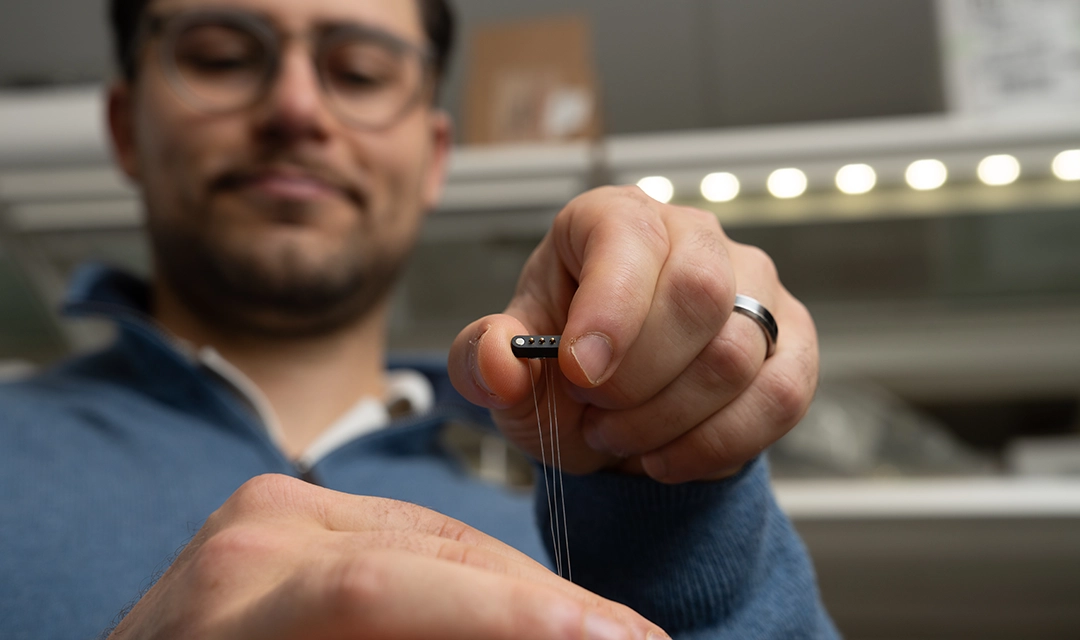
Researchers have developed an implanted platform that delivers targeted electrical stimulation to severely injured muscle tissue, showing that early, daily stimulation during the acute post-injury window helped damaged muscle regain near-normal strength.
Traumatic muscle injuries, whether from battlefield wounds, gunshots, surgical resections, or major open fractures, can cause volumetric muscle loss (VML), the loss of so much tissue that the muscle cannot regenerate on its own. Recovery typically brings chronic inflammation, scarring, and permanent weakness. Current treatments remain palliative, with none reliably restoring the lost muscle.
A multi-institution research team led by Carnegie Mellon University and the University of Pittsburgh has developed an implanted platform that delivers targeted electrical stimulation to severely injured muscle tissue. In work published in Acta Biomaterialia, the team showed that early, daily stimulation during the acute post-injury window helped damaged skeletal muscle regain near-normal strength, identifying a therapeutic window that had been out of reach. The research highlights several years of collaborative work on this project under the Regenerative Electronic Platform through Advanced Intelligent Regulation (REPAIR) initiative that was supported by the U.S. Defense Advanced Research Projects Agency’s (DARPA) Bioelectronics for Tissue Regeneration (BETR) program.
These results demonstrate that early bioelectronic intervention can steer injured tissue toward repair rather than scarring.
Tzahi Cohen-Karni, Professor, Biomedical Engineering/Materials Science & Engineering
“These results demonstrate that early bioelectronic intervention can steer injured tissue toward repair rather than scarring,” said Tzahi Cohen-Karni, professor of materials science and engineering and biomedical engineering at Carnegie Mellon, who co-led the project with Bryan Brown, professor of bioengineering at the University of Pittsburgh.
While electrical stimulation has long been recognized as a driver of muscle maturation and nerve activation, applying it early in VML has been hampered by the need to apply general anesthesia for every session. This logistical constraint limited how frequently stimulation can be delivered during the crucial initial days of healing. To overcome this, the research team turned to the electrode interface itself, developing a nanostructured platinum electrode designed to sit within the injured muscle and deliver stimulation from the first days of healing.
The researchers modified multistranded stainless-steel wires through the electrodeposition of nanoporous platinum, resulting in a 3D porous coating that expanded the electrochemically active surface area without increasing the electrode’s overall size. That extra surface area allows each pulse to deliver more charge safely than bare stainless steel could, which is what makes stimulation from the first days after injury feasible. Most importantly, the electrodes were sustained in the animal. Implanted directly in the injured muscle, they remained electrochemically functional across the full eight-week study, with only a modest rise in impedance, indicating that neither the healing tissue nor repeated stimulation degraded the interface.
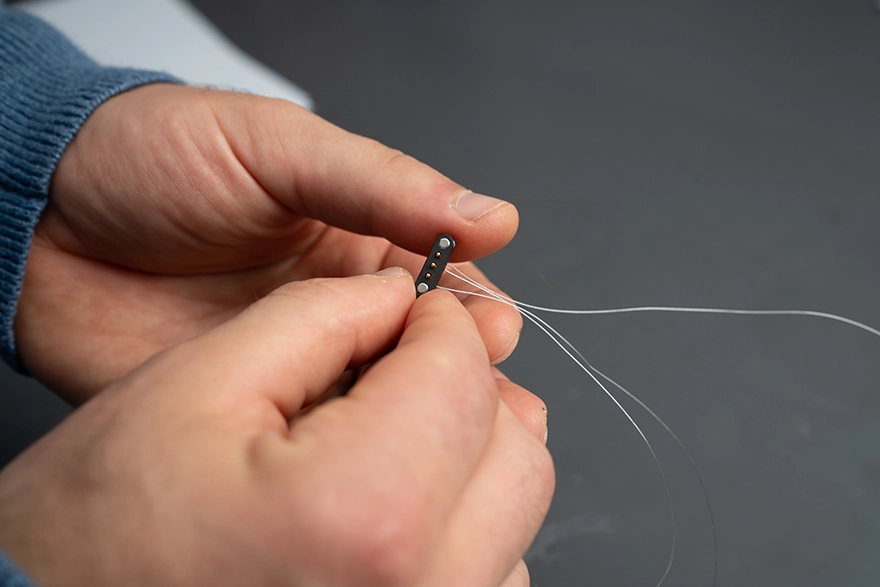
Researchers modified multistranded stainless-steel wires of the device allowing for expansion of the electrochemically active surface area without increasing the electrode’s overall size.
Once implanted, one-hour daily stimulation sessions were coordinated in awake, freely moving animals over the course of two weeks following injury. The intervention showed an impact during an eight-week evaluation period, with animals receiving the stimulation experiencing a 90% of baseline torque recovery compared to the control group, which plateaued at 71% of pre-injury baseline strength. Furthermore, analysis of the experimental group showed that the gains stemmed from true structural remodeling within the muscle, rather than compensatory growth in neighboring, uninjured muscles.
“We hope these findings inspire future efforts to incorporate early electrical stimulation into integrated devices that support complex wound healing and traumatic muscle recovery,” notes Sam Gershanok, a postdoctoral researcher at Carnegie Mellon, who led the recent publication.
By demonstrating that the acute post-injury period is a therapeutically actionable window, the study establishes a foundation for combining early bioelectronic stimulation with engineered tissue scaffolds, conductive hydrogels, and regenerative cell therapies.
This research was funded by the Defense Advanced Research Projects Agency (DARPA) through the REPAIR program under award AWD00001593. Additional Carnegie Mellon co-authors include Anne Behre, Sofya Vinokurova, Aaditya Nandakumar, Liyang Wang, Seonghan Jo, Daniel Ranke, Devora Cohen-Karni, Adam Feinberg, and Douglas Weber.