
Rethinking the environmental impact of automotive inspections
New findings from Carnegie Mellon challenge assumptions about how safety regulations change driving behavior.
Many states enforce vehicle inspection laws to reduce traffic accidents, congestion, and harmful emissions from older cars. Regulatory analysis may assume keeping older cars on the road translates to a proportional surge in overall driving and fuel consumption. However, new research from Carnegie Mellon University reveals that while fleet size does grow after mandatory safety inspections are removed, travel and fuel consumption do not grow proportionally.
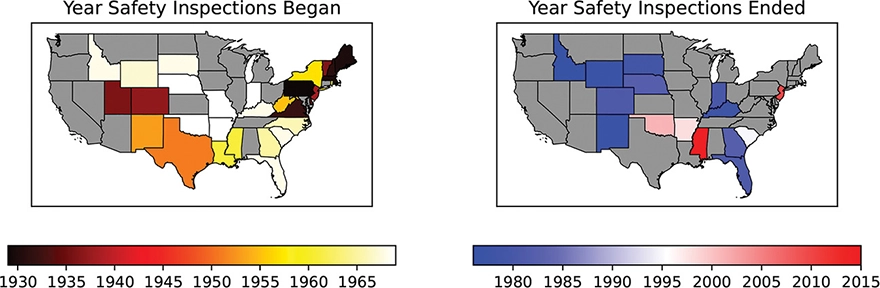
Source: From U.S. Government Accountability Office and U.S, Census Bureau
Maps of the year that each state implemented safety inspections (left) and the year that each state removed safety inspections (right). States colored gray in both the left and right panels never implemented safety inspection programs; states colored gray in the right panel do not have a year that safety inspections ended, either because they never started or because they started but never ended. These maps exclude Alaska and Hawaii; Alaska has never had safety inspections; Hawaii began safety inspections in 1961, and they are still in place. The District of Columbia had safety inspections from 1939 to 2009.
Researchers Connor Forsythe, Akshaya Jha, Jeremy Michalek, and Kate Whitefoot studied how mandatory vehicle inspection policies shape total driving habits and environmental impacts. They compiled 47 years of U.S. Federal Highway Administration data across all 50 states tracking statewide vehicle registrations, vehicle miles traveled, gasoline usage, and road mileage. Leveraging the staggered termination of mandatory safety inspection programs across various states from 1970 to 2017, the researchers used a difference-in-differences model to show that while removing these policies does increase overall fleet size by roughly 5%, the empirical evidence does not suggest similar growth in total miles driven or gasoline consumed.
“As safety inspections were removed, it seems that people kept old cars around longer before scrapping them but didn’t drive them as much,” says Michalek.
Fleet growth does not equal more traffic
The removal of mandatory vehicle inspection laws predictably results in an increase in total car ownership. One reason for this effect may be that more people retain an old car that would have otherwise required expensive repairs to remain drivable.
Strikingly, however, the authors found that increased fleet size did not have a proportional effect on driving behavior. The authors implemented an instrumental variables framework to measure how changes in fleet sizes alter travel distance and fuel usage. They compared miles driven and gas consumed in states with mandatory inspections and states without.
While this finding contradicts some policymakers’ assumptions, it is logically consistent: change in the number of vehicles owned would not necessarily impact driver travel routines. It’s possible that people kept older cars longer but mainly used them as backups to their primary vehicles.
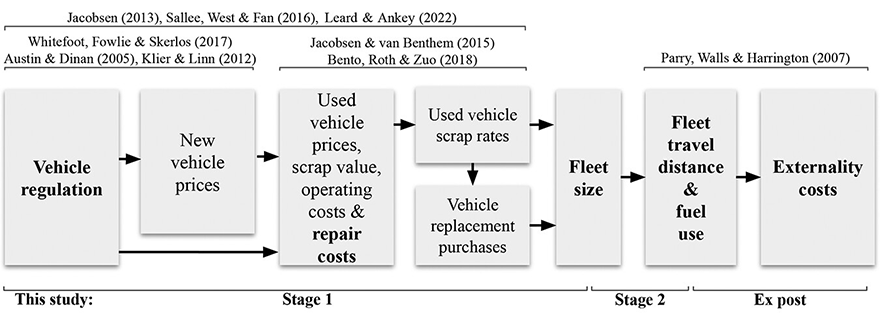
Prior empirical research on how automotive policy affects the externality costs of fleet travel distance and fuel use. Bold text and arrows highlight the factors examined in this study.
A $90 billion overestimate
The cost of this analytical error is staggering. If policymakers assumed each extra vehicle on the road creates an average driver’s worth of extra pollution and accident risk, they would overestimate costs to society by at least $90 billion (in 2021 dollars) from 1970 to 2017.
Regulatory impact analyses estimate the costs and benefits of proposed policies—including, in this case, how regulations affect new and used vehicle fleets.
As safety inspections were removed, it seems that people kept old cars around longer before scrapping them but didn’t drive them as much.
Jeremy Michalek, Professor, Engineering and Public Policy, Mechanical Engineering
“When the federal government proposed weakening federal vehicle efficiency and emissions standards in 2018, their analysis assumed that weaker standards would make new vehicles cheaper, causing used vehicle prices to drop, causing more used vehicles to be scrapped, causing a reduction in overall driving and many lives saved,” says Michalek. “That analysis was heavily criticized, and the final rule changed those assumptions. But it motivated our effort to understand what assumptions the empirical evidence really supports so that future policy analyses can be more grounded in the data. Our findings suggest that it’s important not to assume that fewer vehicles necessarily implies proportionally less travel and energy consumption.”
This study offers critical guidance for future regulation and underscores the importance of grounding transportation policy in empirical reality. Lawmakers using “Cash for Clunkers” incentives or fuel economy rules should update their models to reflect actual driving behavior.