
Illuminating a path to career success
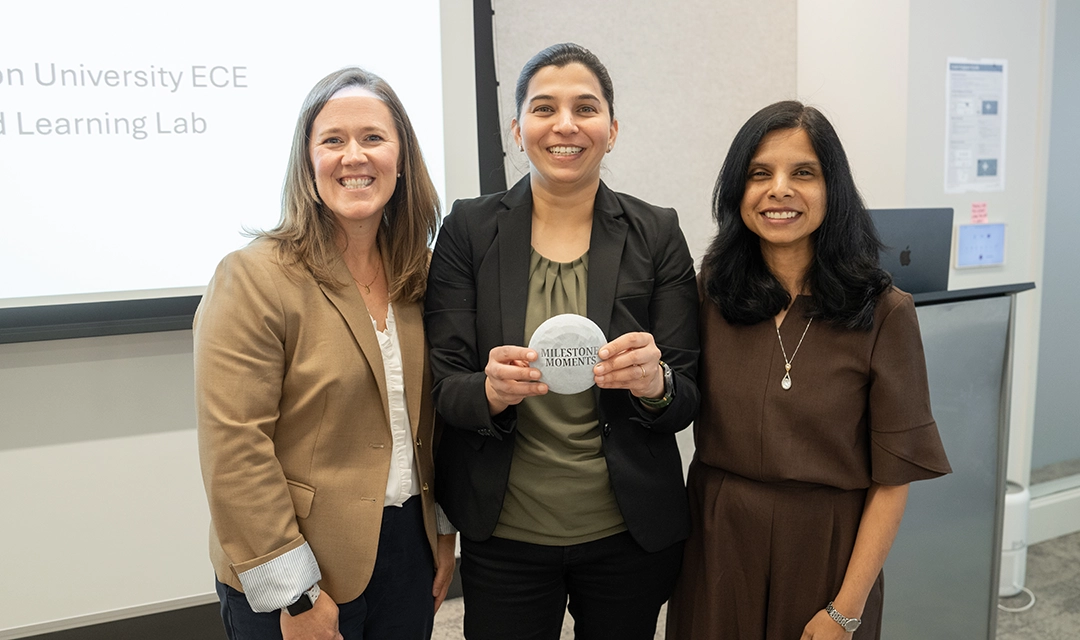
In her Milestone Moments talk, Gauri Joshi says her colleagues helped to brighten the inevitable lessons that only failure could teach.
Gauri Joshi began her Carnegie Mellon career in 2017 on the day of a rare solar eclipse.
She had pursued her education diligently, interned for major corporations, earned her doctorate degree from MIT EECS, and spent a year working as a research staff member at the IBM T. J. Watson Research Center, before joining the College of Engineering.
It seemed that the sun was ready to continue shining on the new electrical and computer engineering professor. But as Joshi described in her recent Milestone Moments talk, there was a brief period when the sunlight seemed to be obscured from her bright career ambitions.
“When I started here, I believed the sky was the limit,” said Joshi who admitted that what she encountered was a rough start that came with repeated rejection in the form of declined proposals and papers.
She credits colleagues, who shared their own similar experiences, with encouraging her when she feared she was ready to give up.
When I started here, I believed the sky was the limit.
Gauri Joshi, Professor, Electrical and Computer Engineering
What she learned was that failure can be important for learning and colleagues are more than just collaborators–they are the teammates who will inspire you when you face the inevitable challenges.
Such lessons are what many of her students came to hear at the Milestone Moment celebration hosted by the Center for Faculty Success (CFS).
CFS Faculty Director Reeja Jayan says the program gives faculty members who achieve the status of full professor the opportunity to talk about their career journey, but she believes the program serves a second important purpose.
“These stories can help encourage our students to be successful scholars as well as happy scholars,” said Jayan.
Joshi’s early days as a professor were not the only hurdle she has had to overcome. She says after having been a very studious and well-organized student in India, she began to see that even though girls were supposed to get an education, they were also expected to serve in supporting, not leading, roles.
When she saw fewer girls in her high school math and science classes, she questioned her place there until one day she was the only student in her math class who was able to solve a tough problem, which helped her to trust her choice and believe in herself.
And that self-confidence has served her well. Today she is an award-winning researcher who envisions democratizing AI by transcending the need for big compute and big data by optimizing computing systems using a broad range of tools, including probability, coding theory, and machine learning.
Her work aims to make AI more practical, accurate, and efficient in real-world environments where data, computing power, and communication are limited or unevenly distributed. Her Optimization, Probability and Learning (OPAL) Lab’s research can help engineers design cloud and machine-learning infrastructure that performs well despite uncertainty, variability, and unpredictable demand.
She reminded her audience to be grateful for the support they get from family and friends and to always seek the company of those who are smarter, which she says has always been easy to do at CMU.