Engineers and theater students tackle stage design in partnership with TAIT
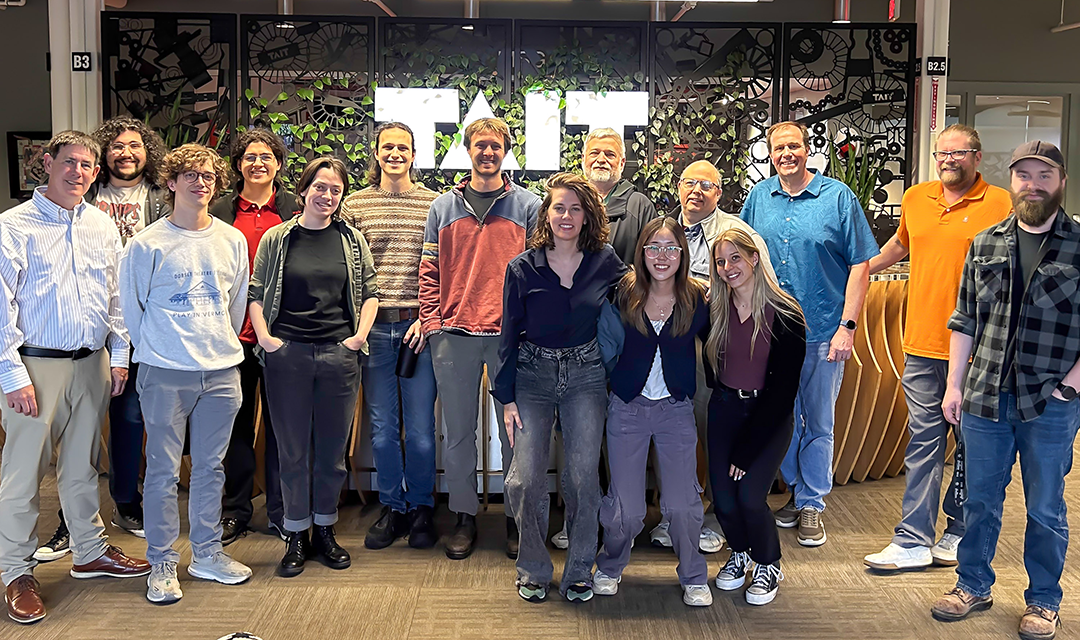
A new Carnegie Mellon course is bringing engineers and theater students together to solve live entertainment challenges by redesigning the systems behind modern touring productions with industry partner and global entertainment company TAIT.
Concert stages may look effortless when the curtain rises, but backstage they are giant mechanical systems filled with moving parts, tight timelines, and constant problem-solving.
At Carnegie Mellon University, students are learning how to tackle those challenges firsthand through Entertainment Engineering, a new course that combines mechanical engineering and theater production to solve fundamental problems for the live entertainment industry.
Developed jointly by professors Phil LeDuc and Mark Bedillion from the Department of Mechanical Engineering and Kevin Hines and David Boevers from the School of Drama, Entertainment Engineering brings students together from two fields that rarely overlap in the classroom but constantly intersect behind the scenes of live productions.
In its first semester, students collaborated on a challenge sponsored by TAIT, the global company behind staging and automation systems used in concerts for artists like Taylor Swift, theater productions on Broadway and the West End, and live events around the world including the Olympics. The company itself has strong roots at CMU as its CEO Adam Davis and dozens of its employees are CMU alumni.
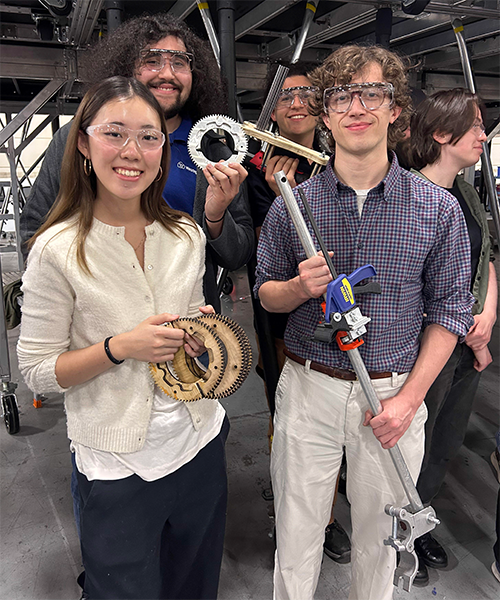
Students show off the tools they built to adjust the height of staging legs.
One of the program’s first challenges was to develop an automatic tool to adjust the height of staging legs. Traditionally, this is a labor intensive and time-consuming job for production crews, especially when stages need to be assembled and reconfigured quickly during load ins and load outs. Students were introduced to the challenge during the first week of class alongside professionals from TAIT.
Over the next several weeks, teams made up equally of engineering and drama students developed multiple concepts and prototypes before presenting their ideas to both TAIT employees and faculty mentors at TAIT’s global headquarters in Lititz, Pennsylvania.
“The structure of the course mirrors the workflow of professional entertainment engineering projects,” said Hines, associate teaching professor of production technology and management. “They must consider engineering constraints and a budget while crafting designs.”
For many students, the experience revealed just how much engineering exists behind the scenes of live entertainment.
‘It’s not like a textbook problem where there’s a thought process you’re supposed to follow,” said Bryce Casey, mechanical engineering student. “There are a lot more variations from the normal linear thought process to find solutions. You have a stage with 20 different variations and 80 different parts that all have their own problems. Then you need to figure out testing and prototyping to mitigate those problems.”
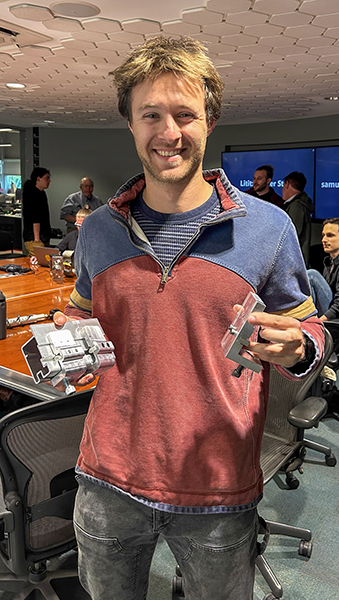
TAIT manufactured pieces on site for Bryce Casey’s mechanical engineering course project.
The unique blend of technical precision and creative thinking is exactly what the course was designed to encourage. According to Matt Hales, vice president of team leadership and culture at TAIT (CMU ’05), the partnership reflects the kind of interdisciplinary collaboration that already defines the entertainment industry.
“This course being a hybrid between mechanical engineering and drama is really what TAIT is,” Hales said. “Theater students do well because they have a high willing suspension of disbelief—nothing is impossible, it’s just expensive and takes a long time. Then you have engineers who say, ‘Cool, but there’s this thing called physics, and this is how gravity actually works.’”
“When you put those two things together,” he added, “you get really smart solutions and incredibly creative problem solving.”
By the end of the semester, students had developed a customized tool to adjust the staging legs more efficiently, reducing the physical strain and time required for crews assembling large-scale productions. However, the biggest takeaway extended beyond the prototype. Students also gained experience working across disciplines, communicating with teammates who approached problems differently and navigating the ambiguity of open-ended design challenges.
“Carnegie Mellon is one of the best in the world at breaking down barriers between fields, and Entertainment Engineering is another example of that,” said LeDuc, professor of mechanical engineering. “When you bring together the creativity of theater students and the analytical thinking of engineers, you create solutions neither group could have developed on its own.”