
Accelerating materials innovation through AI and data science
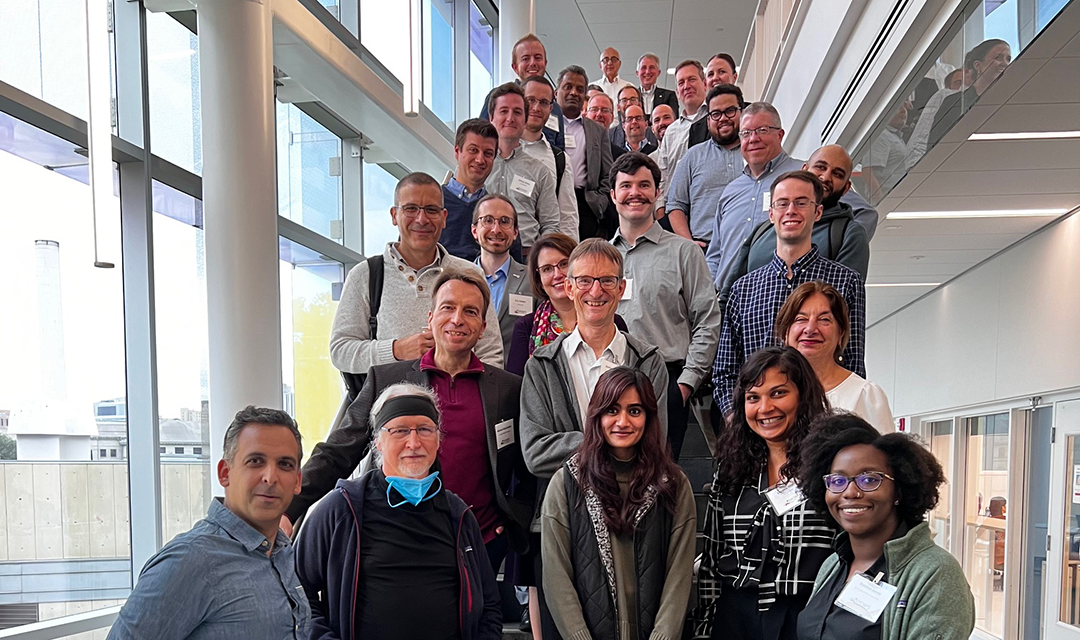
The Center for Data-Driven Design of Optimized Multifunctional Material Systems is exploring solutions to the challenges facing materials discovery by bringing together experts in materials and artificial intelligence.
The discovery of multi-functional materials has potential to answer challenges faced across many industries, including energy, healthcare, aerospace and manufacturing. Developing and testing novel combinations has been aided by developments in artificial intelligence (AI) and machine learning (ML), as the modern tools can be deployed to analyze large amounts of data and simulations as opposed to relying on trial-and-error testing.
The Center for Data-Driven Design of Optimized Multifunctional Material Systems (D3OM2S) at Carnegie Mellon University was established in 2019 to explore solutions to the challenges facing materials discovery and has leveraged the expertise of CMU faculty and students alongside researchers from the Air Force Research Laboratory (AFRL). The center brings together experts in materials and artificial intelligence from materials science and engineering, civil and environmental engineering, chemical engineering, mechanical engineering, electrical and computer engineering, and machine learning departments to accelerate the discovery, design, and testing of high‑performance materials.
“Bringing together materials scientists and AI experts to share language, tools, and intuition is critical to unlock new kinds of functional materials and fabrication processes that traditional approaches would likely miss,” says Michael Bockstaller, professor of materials science and engineering and director of the center.
Bringing together materials scientists and AI experts to share language, tools, and intuition is critical to unlock new kinds of functional materials.
Michael Bockstaller, Professor, Materials Science and Engineering
The work of the center revolves around four coordinated research thrusts, each focused on addressing challenges in materials research and fabrication using AI solutions. Within each thrust, experimental and computational scientists at CMU work alongside researchers at AFRL to address materials science challenges of interest to the Air Force.
Characterizing and predicting rare events in materials systems
In this area of research, team members have studied how grain patterns form in additively manufactured metals, particularly titanium alloys used in aerospace applications, and how they crack and exhibit fatigue over time. By using image-analysis methods accelerated by computer vision (CV) and ML, connections can be made between how parts were made, their structure, and their durability.
Multimodal materials data fusion
While imaging technology has greatly advanced materials characterization in the last two decades, current methods often collect data from every point in a manner that is slow and inefficient. In this research thrust, advanced AI and signal-processing techniques are used to detect patterns so that scanning electron microscopy (SEM), transmission electron microscopy (TEM), and high energy diffraction microscopy (HEDM) tools can be used to focus on the most critical areas of a sample, which dramatically reduces the time required to produce high‑resolution 3D images of materials.
Adaptive experimental design
Experimental design for materials discovery coordinated by humans is prone to errors, biases, and limitations, and can be costly, leading to limited data representations. This research thrust focuses on building and integrating AI systems that will learn from previous data and simulations to guide future testing and thus efficiently search and develop materials with desired properties.
Adaptive materials design in complex environments
The creation of adaptive materials that can reorganize or self-heal after damage have great promise for advances in defense and energy technologies. Such materials often feature complex microstructures that depend on a large number of variables. This research thrust has focused on establishing toolsets and protocols for the use of AI models to explore vast parameter spaces that would be impossible to search both experimentally or by using detailed computer simulation. The self-assembled brush particle-based materials studied in this area are tuned so they can achieve several desirable properties at the same time, such as strength, flexibility, or self-healing ability.
In 2023, the center extended its research portfolio by funding two “seed” projects that focused on (1) the application of large language models (LLM) to design reaction campaigns that can be implemented in automated fabrication processes; and (2) the application of data-driven methods to advance composite materials made with MXenes and liquid metals (such as EGaIn), intended to sustain the extreme environments experienced in Air Force and Space Force applications.
In addition to numerous publications, presentations, and open-source data and tools, one major outcome of the center has been the development of a pipeline of research talent with expertise in AI and materials science. To date, 12 students have graduated based on projects funded through the center. Three recent graduates have been awarded prestigious NRC fellowships to pursue AI solutions for materials science challenges in collaboration with researchers at AFRL and the National Institute of Standards and Technology (NIST). Other students have joined companies such as Amazon, Seagate Technologies, and Soar Technologies in which AI solutions are being applied to accelerate innovation.
“A central goal of the center has been to establish and sustain a community of AI and materials researchers that leverage the most current AI solutions to address materials challenges that are of relevance to the Air Force,” says Bockstaller.
The opportunities to continue these collaborations have been demonstrated through the AFRL Regional Network Mid-Atlantic, of which Carnegie Mellon is a member, as well as through awards from the National Science Foundation’s (NSF) Designing Materials to Revolutionize and Engineer our Future (DMREF) program. As a member institution of the Center on Materials Data Science for Reliability and Degradation, researchers from Carnegie Mellon are also continuing to engage in the application of data science-informed research to better understand the reliability and performance of materials.