Rail renaissance
Carnegie Mellon University researchers are bringing passenger rail back to communities by revitalizing existing rail lines—and in doing so, decreasing costs from billions to millions.
Passenger rail has the power to transform communities by connecting residents to essential services while reducing emissions and roadway congestion. Despite these benefits, expanding rail in the United States has proven nearly impossible due to its sky-high price.
As an example, the city of Seattle recently embarked on a four-mile light rail extension, costing just under $2 billion per mile. With this price tag, in addition to regulatory and bureaucratic hurdles, projects in this space often stall before they begin. Carnegie Mellon University researchers are working to flip this model and, in doing so, decrease a multi-billion-dollar project to millions.
With support from the National Science Foundation’s Civic Innovation Challenge (CIVIC), a unique program that emphasizes rapid, on-the-ground impact with direct community engagement, the team is leveraging the nation’s underutilized “legacy rail,” or existing and established tracks that remain underutilized or abandoned, to pave a path toward faster, more affordable, and more sustainable rail transit.
The project was conducted in two phases, where Phase 1 aimed to quantify the scale and feasibility of the project undertaking, from the on-the-ground community engagement to the technology deployment and the partnership collaboration.
Centered around 1.61 miles of legacy rail along Philadelphia’s Delaware River Waterfront, a neighborhood long isolated from its community by Interstate 95 and unreliable public transit, the CIVIC team set out to reconnect these residents to essential services, economic opportunity, and safe transportation. By deploying a modular, low-cost rail system that is responsive to real-time needs, the goal was to overcome the technical, financial, and regulatory hurdles that stall traditional transit development.

“The challenges in the Delaware Riverfront mirror those in cities nationwide, where thousands of miles of underused legacy rail remain untapped to close this gap,” said Katherine Flanigan, assistant professor of civil and environmental engineering, and lead principal investigator of the CIVIC project. “This project will disrupt the standard model of rail transit development by demonstrating that revitalizing legacy rail in collaboration with community stakeholders creates effective and scalable transit solutions.”
This project will disrupt the standard model of rail transit development by demonstrating that revitalizing legacy rail in collaboration with community stakeholders creates effective and scalable transit solutions.
Katherine Flanigan, Assistant Professor, Civil and Environmental Engineering
Through community forums, surveys, and workshops, more than 4,000 Philadelphia residents provided insights into their needs that would directly inform the pilot design. Led by partners Hinge Collective, the Delaware River Waterfront Corporation, and Operation Lifesaver, direct community engagement ensured that the project addressed future rider needs and priorities.
On the technical side, CMU’s Flanigan and Mario Bergés, professor of civil and environmental engineering, tested their cutting-edge, on-board rail damage detection technology for rail inspection. By integrating acceleration- and vision-based AI, their system monitors rail integrity to not only detect broken rail in real time but also evaluate the overall condition of existing tracks. With improved track monitoring, communities are able to confidently introduce rail transit on their legacy lines and cost-effectively streamline maintenance strategies.


“By translating sensing technologies from our lab into operational rail vehicles, we can monitor safety and reliability in a way that is low-cost, scalable, and adaptable to changing community needs,” said Flanigan.
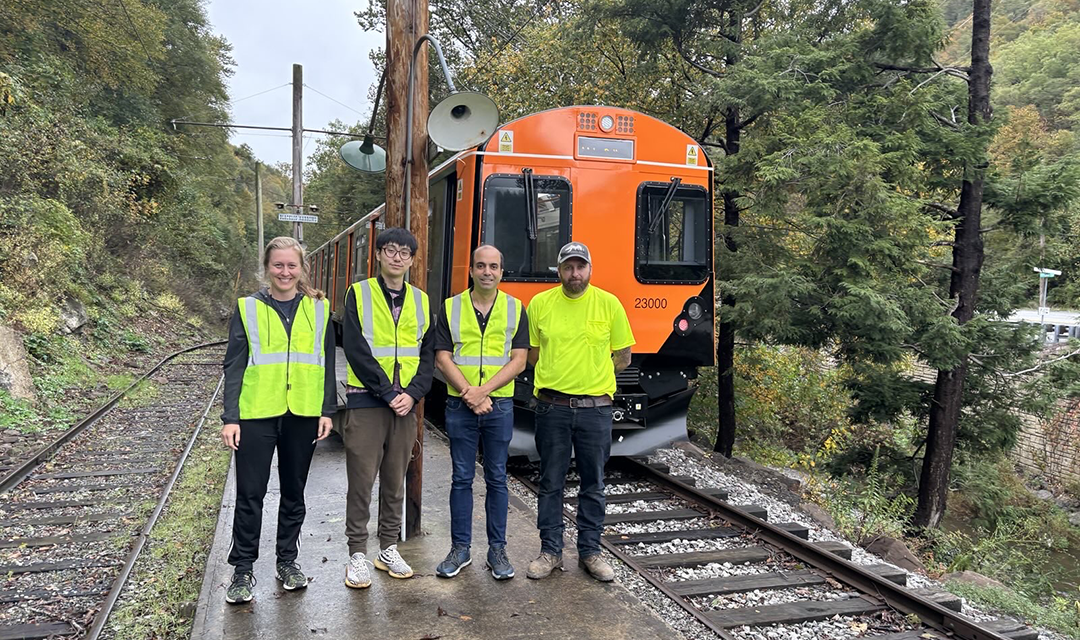
Between the technical innovation; resident engagement; low-cost, lightweight Pop-Up Metro train cars; and existing rail lines, the project showed that their model of revitalizing legacy rail for passenger service could be achieved for under $1 million per mile, compared to constructing new rail lines for nearly $2 billion per mile.
NSF’s CIVIC recently awarded Phase 2, for which work started in October 2025 to scale the pilot into a full operational deployment in Philadelphia. The project will also create an open-access database of America’s legacy rail lines, providing tools and workshops to identify opportunities for replication across the country.

Map of Philadelphia's Delaware Riverfront CIVIC project deployment.
“Phase 1 allowed us to work closely with communities to understand both the promise and the barriers,” said Bergés. “Phase 2 is where the rubber meets the road. It’s about putting our vision into practice and showing communities across the U.S. that they can replicate this approach.”
“30 cities across the country have already expressed interest in adopting our model,” said Flanigan. “This project is truly an unprecedented example of the power of community-driven innovation.”
Demonstrating that legacy rail can be revitalized for millions over billions, as well as the impact on accessibility, emissions, and economic growth, could transform the rail industry, an accomplishment congruent with the Western Pennsylvania region.
We see this project as charting new pathways into the future of how the rail industry will operate, and we’re thrilled to be a part of this renaissance.
Mario Bergés, Professor, Civil and Environmental Engineering
“There’s a deep connection between the legacy of our region and the future of rail in this country,” said Bergés. “We see this project as charting new pathways into the future of how the rail industry will operate, and we’re thrilled to be a part of this renaissance.”
This collaborative project was conducted in partnership with Pop-Up Metro, Hinge Collective, the Delaware River Waterfront Corporation, the Philadelphia Belt Line Railroad, BRT Services, and Operation Lifesaver.