
Training students to bring fundamentals to AI frontiers
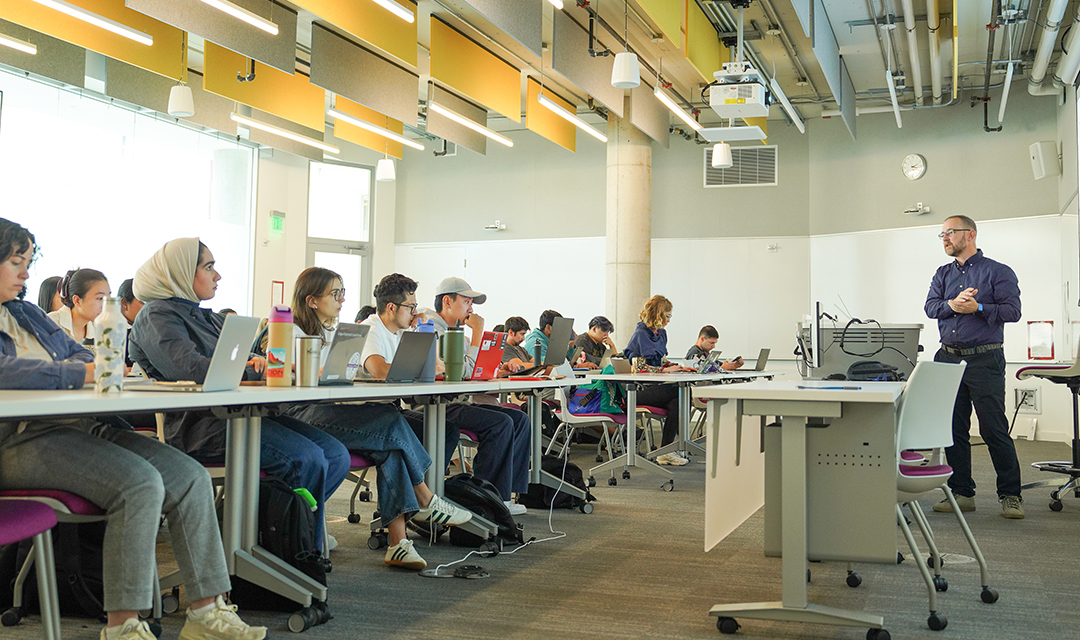
Chemical engineering students learn to fuse domain knowledge with machine learning and data science, a combination of skills that puts them at the forefront of changes in industry.
Chemical engineering graduates assisted by artificial intelligence (AI) will have the power to speed up scientific discovery, improve the replication of research, and unlock new paths of inquiry. Before they can responsibly combine high-throughput and remote experimentation with machine-learning-driven experimental design, they need skills in three areas.
First, students need domain knowledge. “You have to know about the problem you are solving, or you can’t evaluate the solutions you find,” says John Kitchin. Second, they need a foundation in machine learning to understand the math and ideas behind the models, as well as their capabilities and limitations. Third, students need programming skills. “Even when code is written by a large language model,” says Kitchin, a professor of chemical engineering, “you need the skills to steer the LLM and to evaluate if the code is correct and doing what is needed.”
For students who want the training to integrate AI and chemical engineering more deeply, the Department of Chemical Engineering offers the Master of Science in Artificial Intelligence Engineering-Chemical Engineering (MS in AIE-ChE). These students gain practical experience applying their skills through research. In a current collaborative project, MS in AIE-ChE students are developing a benchmarking testbed for a widely-used chemical process engineering time-series dataset. They are testing machine learning and deep learning models for anomaly detection in industry.
Industry needs chemical engineers with data science training, and our students are equipped to meet this need.
Carl Laird, Department Head and Professor, Chemical Engineering
“We hear from our industry partners that they do not get effective data science solutions simply by putting classically trained chemical engineers in the same room as computer scientists,” says Carl Laird, department head and professor of chemical engineering. “Industry needs chemical engineers with data science training, and our students are equipped to meet this need.”
Kitchin teaches master’s students to combine chemical engineering, machine learning, and programming into practical ability. He begins at "print('Hello world')", a simple computer program used to illustrate the basic syntax of a programming language. From there, his sequence of graduate-level courses guides students through scientific programming, into data science and machine learning, and finally into reusable scientific software development for automation.

Source: John Kitchin
Claude-Light
Undergraduate chemical engineering students are also introduced to machine learning, data science, and remote experimentation. First-year students learn linear regression while using a remotely-accessible instrument built by Kitchin. The Claude-Light Green Machine has one input (the green level of an LED) and one output (the wavelength of light). Students generate their own real data from Claude-Light, instead of using standard data and problems from textbooks. In one assignment, they make a measurement at a different time every day for one week, then calculate the standard deviation and the variance in their data.
Kitchin designed Claude-Light with an open light sensor. Because of the ambient light, the output varies widely at different times of day, even when the input is the same. Having that noise in the data prompts students to account for nuisance variables.
Joanne Beckwith Maddock, an assistant teaching professor who teaches Introduction to Chemical Engineering, hopes that the Claude-Light experiment helps students see how chemical engineers are part of the vanguard of automated experimentation. "Chemical engineers develop models that describe phenomena around us. Those phenomena are impacted by many variables, and chemical engineers are really good at designing experiments to get at those relationships," she says.
As students learn different computational methods, they practice applying them to real-world problems. One project in the Numerical Methods and Machine Learning for Chemical Engineering undergraduate core course this fall asked students to evaluate three machine learning models for steam methane reforming, a common industrial process for producing hydrogen. Students in the course say the project helped to demystify artificial intelligence and machine learning by clearly showing how to use the tools effectively in science and engineering.
Once they begin to fuse chemical engineering fundamentals with machine learning and data science, students are empowered to think beyond course assignments. Techniques like enhanced predictive modeling, for example, have the potential to transform reactor design and drug discovery. Chemical engineering graduates bring a unique combination of skills to lead those changes across industries.