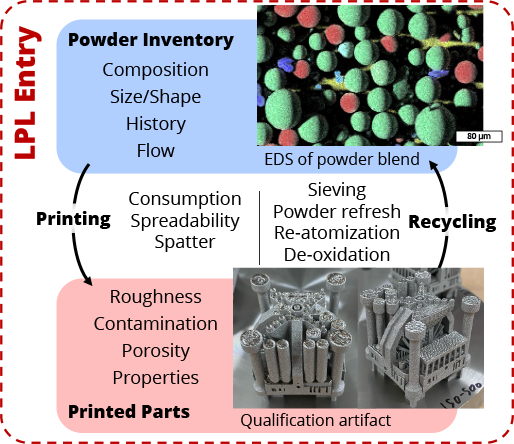
This project establishes the Large Powder Library (LPL) to serve as a comprehensive digital twin for metal powder additive manufacturing (MPAM) inventories, directly addressing industrial challenges surrounding material waste, storage hazards, and part quality degradation caused by undocumented powder variations. Implemented via the Digital Data Backbone at Mill 19, the project integrates physical powder labeling systems with standardized digital metadata tracking particle geometry, flowability, and alloy composition. In its immediate term, the project utilizes machine learning tools—including random forest regressions and surrogate models—to track and predict complex material behaviors like oxygen contamination and degradation in recycled Ti-6Al-4V powder over multiple printing, storage, and re-atomization cycles. Ultimately, this scalable data infrastructure aims to replace slow, computationally expensive multi-physics simulations with rapid data analytics, supplying human operators with real-world processing recommendations, refining scientific models of granular feedstock, and establishing a center-scale foundation for accelerated material innovation.
Application/demonstration
The planned demonstration will train machine learning surrogate models on recycled Ti-6Al-4V powder datasets to accurately predict how storage, printing, and ultrasonic re-atomization cycles impact powder flowability and oxygen contamination.