
Class project leads to award-winning conference paper
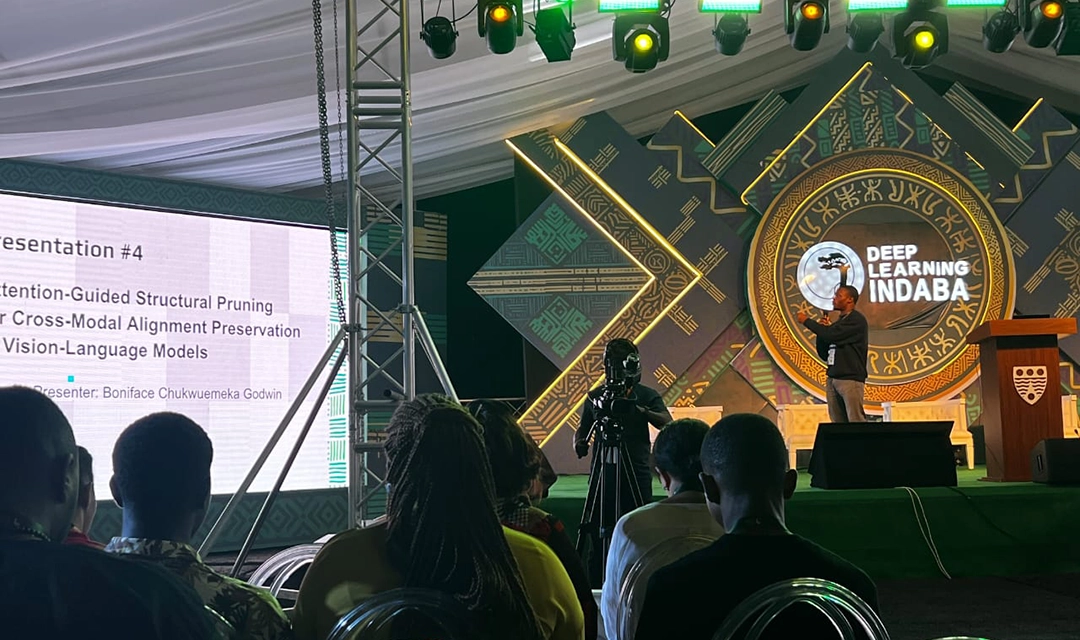
Working on a class project quickly evolved into an award-winning conference research paper for two CMU-Africa students, Boniface Chukwuemeka Godwin (MS EAI ’27) and Jean Gabriel Mpuhwezimana (MS EAI ’27). Their research, which focuses on deploying AI models in low-resource settings, shows promise for applications in areas such as robotics, drones, and healthcare.
Working on a class project quickly evolved into an award-winning conference research paper for two Carnegie Mellon University Africa (CMU-Africa) students. Their research, which focuses on deploying AI models in low-resource settings, shows promise for applications in areas such as robotics, drones, and healthcare.
The students, Boniface Chukwuemeka Godwin (MS EAI ’27) and Jean Gabriel Mpuhwezimana (MS EAI ’27), said that it was a true “wow” moment in their research journey when it was announced that they won the Best Paper Award at the Deep Learning Indaba Conference. The conference was held August 2, 2026-August 7, 2026 in Lagos, Nigeria, and is one of the largest AI conferences in Africa, attracting more than 1,000 participants.
The students started working together during Ozan Tonguz’s Principles of Engineering and Artificial Intelligence course in spring 2026. Tonguz is a professor of electrical and computer engineering at Carnegie Mellon University.
“I am very proud of this amazing achievement of CMU-Africa students,” said Tonguz. “While I supervised their research and helped with the final paper, in terms of the key research ideas and their implications, credit should go to these students for the excellent research they did.”
The students wanted to find a way to optimize AI systems that use vision language models, or AI systems that can look at, understand, and talk about pictures.
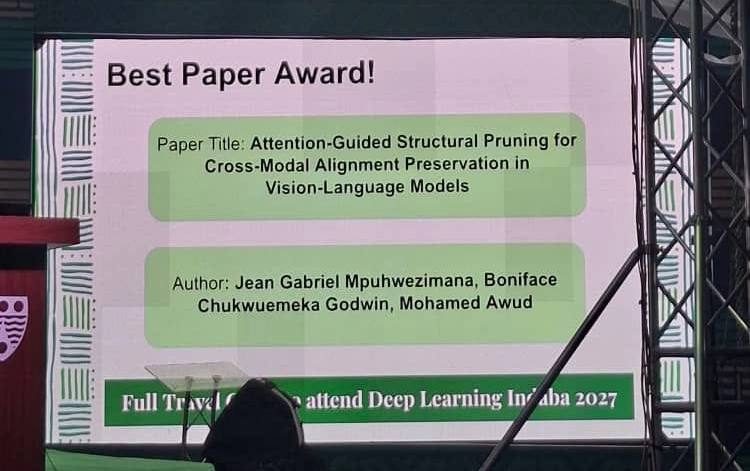
Source: Jean Gabriel Mphuhwezimana and Boniface Chukwuenmeka Godwin
CMU-Africa students Boniface Chukwuemeka Godwin and Jean Gabriel Mpuhwezimana win the best paper award at the Deep Learning Indaba Conference.
“Most of the current vision language models are huge and require a large amount of computation,” Godwin said. “Making these models run in places that most need them but don’t have access to high-performance computing resources is vital.”
The team wanted to find a way to make vision language models available in low-resource settings in order to reach communities across the continent.
“We don’t have enough infrastructure or resources in Africa for large models. Our question became how to reduce the size of the AI model so that it does not need powerful infrastructure, but at the same time functions normally,” said Jean Gabriel.
In order to tackle this research question, the team decided to challenge the common AI model optimization technique, called “magnitude pruning.”
As the name suggests, in magnitude pruning researchers reduce an AI model’s size by removing components based on their magnitude. Godwin compared the optimization technique to a traveler’s reasoning when sitting in an airport deciding what to remove from their overweight luggage. If using the principles of magnitude pruning, they would choose the item that was taking up the most space and weight in their luggage. For example, a pair of heavy hiking boots. However, this reasoning alone can have flaws.
When the traveler gets to their destination—in this case, the hiking trails of Costa Rica—they will be out of luck because they have removed their most important item.
The researchers therefore wanted to test if they would be able to develop a new AI model optimization technique that would prune based on importance and not magnitude.
The team designed an alignment score to determine importance of the AI function regardless of size, and how this contributes to the function of the vision language model. A higher alignment score shows the function in the model is important, while a lower score shows the function is not as important.
After additional experiments comparing both types of pruning, the pruning method based on importance proved to be a better solution than magnitude, or size-based pruning.
After consulting with Tonguz and revising the paper, they submitted their work to the conference and received an invitation to participate in the poster session and present their research in a session.
“We didn’t do this alone,” Godwin said. “We had a lot of help from the Pittsburgh Super Computing Center and professors supporting us.”
CMU-Africa creates an environment that encourages us to explore ambitious ideas, challenge ourselves, and grow as researchers.
Jean Gabrial Mphuwezimana (MS EAI ’27)
Their findings, which challenged the conventional way of optimizing AI systems, was particularly interesting to researchers at Deep Learning Indaba.
“This research is a great example of how creativity is a core component of engineering at Carnegie Mellon University. Thinking outside of traditional methods is a challenging but necessary way to move the field forward,” said Tonguz.
Currently the students are continuing their research while looking for collaborations at CMU-Africa and in Pittsburgh. Both students plan to pursue their doctorates in the future.
“CMU-Africa creates an environment that encourages us to explore ambitious ideas, challenge ourselves, and grow as researchers,” Jean Gabriel said. “We are grateful for the opportunities we have here, and we are going to keep going.”