
Cultivating an engineering mindset at CMU’s community garden
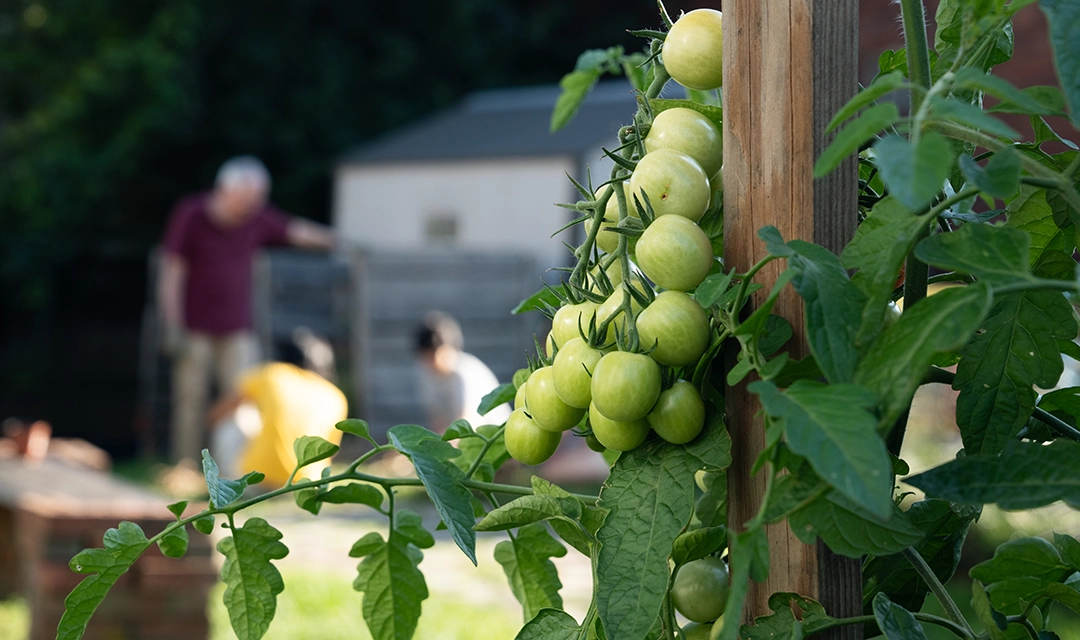
The Winthrop Community Garden provides a popular outlet for College of Engineering students to consider engineering problems—or to simply unwind from their studies.
On a warm Sunday afternoon, you will find Carnegie Mellon University students and neighborhood volunteers planting marigolds, picking leafy greens, and propping up tomato plants on a plot of land near the university’s Pittsburgh campus. For more than a decade, Carnegie Mellon University’s Winthrop Community Garden has served as a space for students to put engineering concepts into practice, as well as to simply get away from screens for a few hours.
The garden is managed by the CMU Sustainable Earth organization and operates from February into November. Students work alongside community organizers to practice organic methods for raising vegetables, fruits, and flowers.
Many of the gardeners are students in the College of Engineering. This includes two leaders in the garden, Brian Spradley and Phi Abraham.
Spradley graduated in May with majors in environmental engineering and engineering and public policy. His academic interests have centered on environmental chemistry, particularly within wastewater treatment and environmental remediation. This fall, he is pursuing a master’s in CEE with a goal of going into environmental consulting.
Spradley joined Sustainable Earth as a sophomore and served as the group’s garden representative from 2024 to 2026. “Nobody goes into environmental engineering without caring about the environment,” he said. “Being involved with Sustainable Earth and the garden is an opportunity to channel stewardship of the environment, the will to do something good for the planet.”
Taking care of plants is an engineering problem. There is a problem-solving aspect to gardening.
Brian Spradley (CEE ’26), Former CMU Sustainable Earth garden representative, Civil and Environmental Engineering
“An engineering problem”
While the garden is open to all students, Spradley noted how it seems to be a particular draw for engineering students. He noted how the little free library and bee house on the garden’s grounds came from sophomore class projects in the Department of Civil and Environmental Engineering (CEE). He said projects like this existed “because civil and environmental engineering in particular is inherently community-centered. There’s always some sort of human reason for doing a project. That fits in well with a community garden being a resource that requires input from people who care.”
That human element was also emphasized by Phi Abraham, a sophomore in chemical engineering. Phi worked this summer in the Center for Atmospheric Particle Studies as part of the Summer Undergraduate Research Fellowship (SURF)-Sustainability program, an initiative sponsored by the Office of Undergraduate Research and Scholar Development. Since June, they have been the Sustainable Earth garden representative.
“Community gardens are a very special space because they aren’t governed through bureaucracy,” Abraham said. “There’s no particular structure to them. They don’t have to run a certain way. You don’t always have to attend. You don’t have to take up a responsibility. So in that way, they can be accessible to a wider audience. It’s not this extractive, consumptive process, and there’s no prerequisite for a class or for knowledge.”
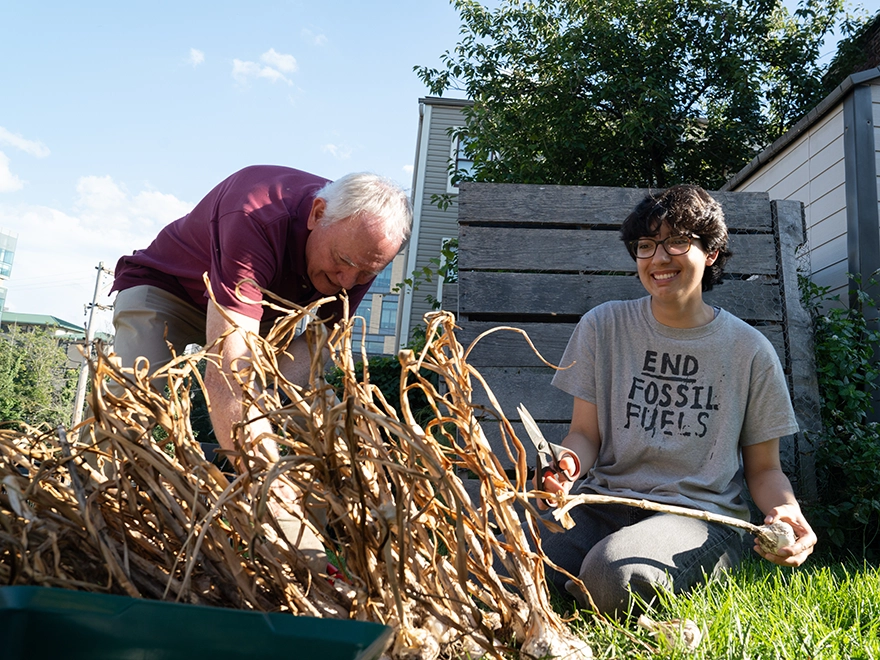
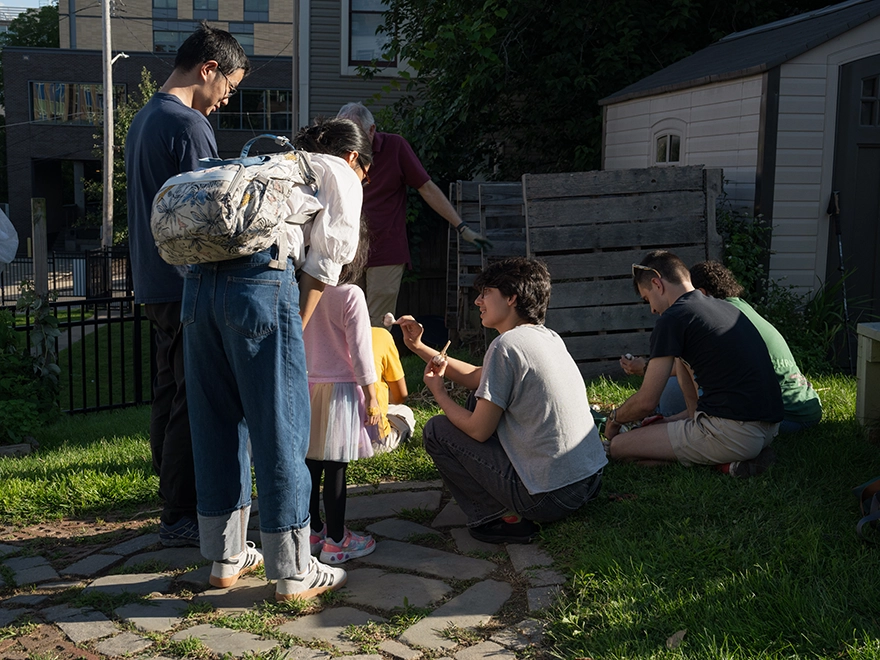
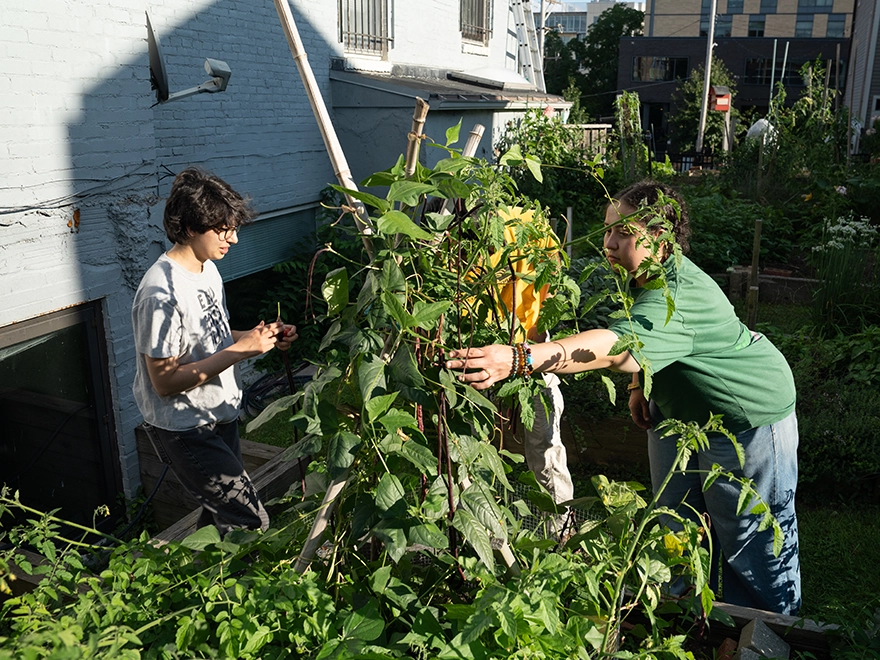
Both Spradley and Abraham connected their engineering studies to their work in the garden. “Taking care of plants is an engineering problem,” Spradley said, “in that there are defined solutions and frameworks and best practices for how far apart to plant certain types of plants, how often they need to be watered, whether or not rabbits like to eat them. So there is a problem-solving aspect to gardening. You can’t just plant things based on vibes and know for sure that it’s going to work.”
“For me, gardening is a very grounding practice,” Abraham said. “I may be thinking about all of the molecules and the atmosphere and the autoxidation”—that is, the plants’ natural intake of oxygen at normal temperatures. “I spend a lot of time in a technical space and learning technical knowledge, and gardening is part of the why.”
A chance to reconnect
At the same time, both reflected on how the garden allows students a break from academics, too. “Students go to the garden to hang out on the weekends and do something fun with other engineers and people in the community,” Spradley said. He added that even when there wasn’t necessarily a “super technical” connection, something close to an “emotional” connection did exist.
On this point, Abraham quoted writer and activist Arundhati Roy: “Another world is not only possible, she is on her way. On a quiet day, I can hear her breathing.” For Abraham, “The garden is that quiet day, often. I hear another world breathing. It’s this spiritual practice in the sense of, I’m not being judged on my studies. I’m not worried about my grocery list. I’m not thinking about the utility bills. I’m here, and I’m with other people, and we’re here to nurture growth.”
Even in that simple connection, there can be teachable moments. “So many people, on their first time harvesting at the garden, say things like, ‘It’s such a privilege to have produce as a student,’” Abraham said. “I appreciate that the garden was bringing them that, but at the same time, produce should not be a privilege for college students. That’s definitely an important aspect of it: teaching people the skills to grow a tomato plant in their apartment if they want to.”
That teaching extends to community members, too. Abraham recalled a Sunday in the spring when a woman and her child serendipitously walked in. Abraham taught the child about cutting branches off of tomato plants to promote new growth and how those cut branches can provide new nutrients by going into the compost bin. Being visible and accessible to the community is integral to the garden’s identity, Abraham said.
In that vein, Abraham is hoping to expand who the garden welcomes and serves. They said one pressing goal is to introduce a plant bed accessible to people in wheelchairs. They also want to begin donating part of the harvests to organizations providing meals to those who can’t easily access healthy food.
These ideas align with the garden’s rehabilitative role in many participants’ lives, allowing for a few hours away from screens and scholarly responsibilities. “Gardening is a nonviolent practice of care,” Abraham said. “From dust to dust: that’s what the garden is. Except maybe it’s from compost to compost.”