
CMU researchers bring lab-grade movement analysis into everyday life
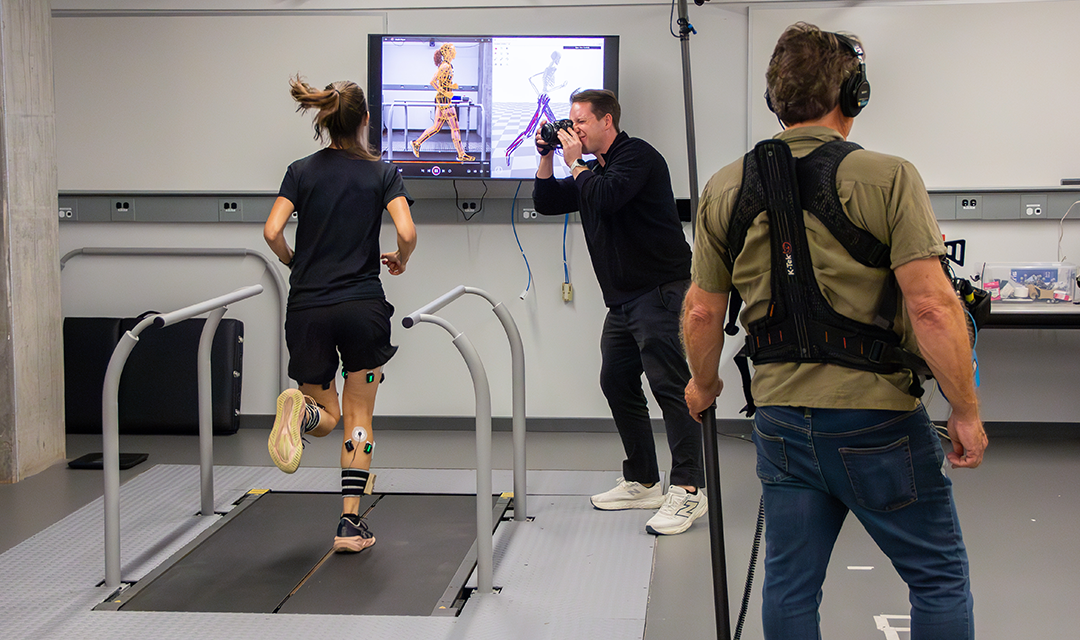
Carnegie Mellon University researchers have developed wearable sensing methods that achieve laboratory-level accuracy in measuring human joint motion, paving the way for movement analysis to rehab injury, monitor neurological disease, and optimize sports performance in everyday environments.
Every step you take carries valuable information about your health. The way your knees bend, your hips rotate, and your feet strike the ground can reveal whether you’re performing at your athletic peak, recovering from an injury, or even developing a neurological condition. For decades, scientists have known that these subtle movement patterns offer powerful clues about human health, but accurately measuring them has traditionally required specialized laboratories equipped with expensive cameras, reflective markers, and expert operators.
Now, researchers at Carnegie Mellon University, in collaboration with the University of Pittsburgh, have shown that wearable sensors can deliver laboratory-grade accuracy, opening the door to measuring human movement where life happens. For researchers and clinicians, that means understanding not just how people move in a laboratory, but how they move through everyday life.
In a study published in Nature Communications, a research team led by Eni Halilaj, associate professor of mechanical engineering, evaluated wearable sensor measurements against biplane radiography, a technology widely regarded as the gold standard for measuring skeletal motion. The researchers found that modern wearable sensors can match the accuracy of traditional laboratory motion-capture systems during short recordings. They also developed a new biomechanics-informed sensor fusion method, IMoveLab, that further improves accuracy and eliminates the compounding errors that have long challenged wearable systems during extended recordings.

Source: College of Engineering
These wearable sensors are bringing lab-accurate motion tracking beyond the lab.
Today’s consumer wearables can estimate metrics such as cadence, symmetry, and stride characteristics, but they cannot directly measure how individual joints move. Those measurements are essential for researchers and clinicians evaluating movement quality, injury, disease progression, and recovery. As wearable technology advances, systems like IMoveLab could continuously measure joint motion and compensatory movement patterns, providing objective biomechanical markers to guide diagnosis, rehabilitation, and treatment.
Rather than relying solely on artificial intelligence or generic sensor-fusion algorithms, the researchers embedded biomechanical knowledge directly into the motion-estimation process. By incorporating the body’s natural movement patterns into the underlying algorithms, the system generated more accurate and stable estimates of joint motion.
The next frontier in wearables is teaching them biomechanics, so that the outcomes we derive from them are accurate, interpretable, and actionable.
Eni Halilaj, Associate Professor, Mechanical Engineering
“We were inspired by decades of research into how the human body moves,” said Vu Phan, doctoral student in Mechanical Engineering and lead author of the study. “What surprised us was how much the integration of that knowledge into emerging wearable-sensing algorithms could improve their accuracy.”
“The sensors in modern wearables are remarkably capable,” said Halilaj. “Researchers have spent decades making them smaller, cheaper, and more powerful. The next frontier is teaching them biomechanics, so that the outcomes we derive from them are accurate, interpretable, and actionable.”