
Automated lab to accelerate materials discovery
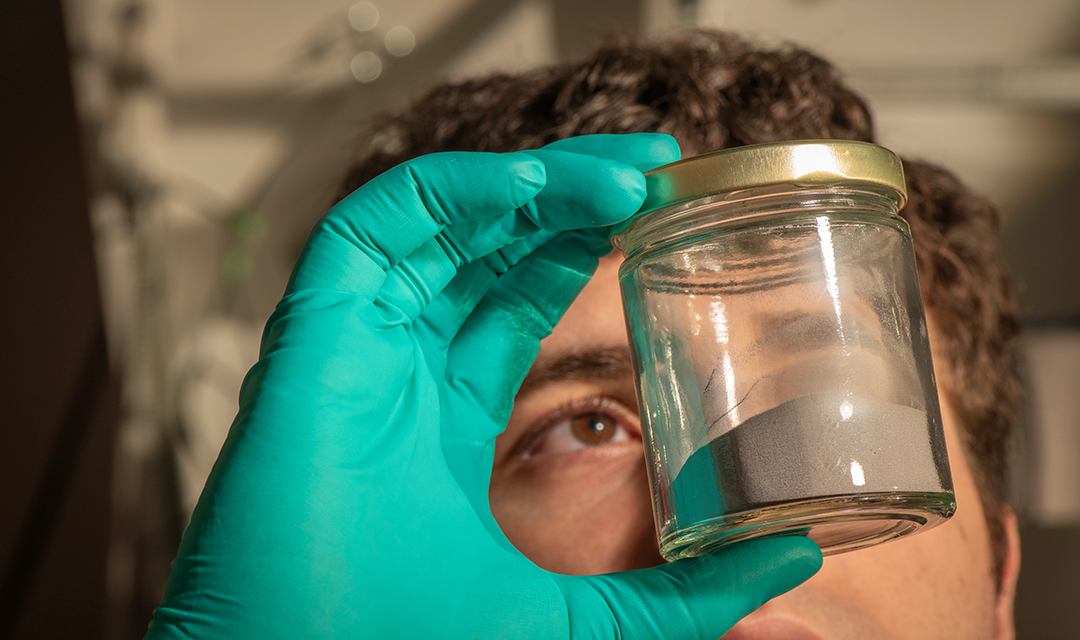
The Materials Innovation Cloud Lab, part of CMU’s AI Science Foundry, will provide a flexible, automated environment to generate new materials for aerospace, energy, and infrastructure.
Next generation materials discovery lies at the intersection of agentic AI, computational design, and physical fabrication. To facilitate this connection, the Materials Innovation Cloud Lab (MICL) at Carnegie Mellon University is moving toward operating as a “self-driving” research environment where AI, robotics, and metallurgy converge to transform how new alloys, particularly additively manufactured ones, are developed.
Located at Mill 19 at Hazelwood Green, the state-of-the-art lab is a testbed for academic and industry research collaboration. The MICL, a component of CMU’s AI Science Foundry, provides a flexible, automated environment to develop the next generation of materials for aerospace, energy, and infrastructure. The Foundry was recently selected as a node in the U.S. National Science Foundation’s (NSF) Programmable Cloud Laboratory (PCL) Testbed, a national initiative to build a network of AI-enabled laboratories.
Using the Manufacturing Futures Institute (MFI) Digital Data Backbone, an infrastructure that allows AI models to orchestrate automated workflows, manage material movement, and contextualize research data, the MICL will be able to plan and execute experiments with minimal human intervention. The machine learning models plan work, manage material movement, and optimize design, supporting workflows that range from mixing raw materials to final production for additive manufacturing experiments.
“It’s the combination of all of these steps, the computational discovery, the assessment and the scaling up to make powder and parts, that you need to put together to get a new material for use in practical applications,” said Bryan Webler, a professor of materials science and engineering who will be the co-director of the metal node and leading automation of the experiments.
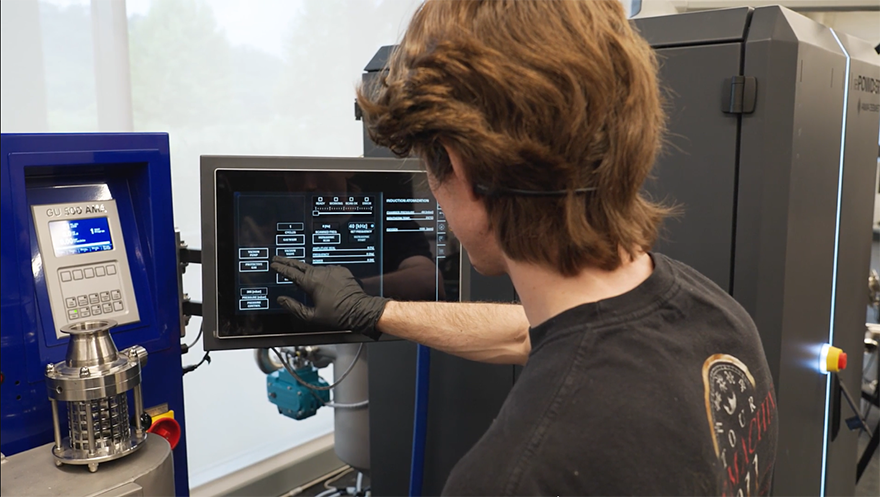
A postdoctoral researcher works with the new equipment in the MICL.
Key to the lab operations is recently acquired equipment that enables this work, such as the Amazemet rePOWDER platform, which allows for the rapid prototyping of custom alloys in the form of as-cast metals samples, or metal powder produced by ultrasonic atomization. The creation of these custom samples, particularly of powders, addresses a critical challenge in additive manufacturing by offering small, experimental quantities. The equipment also allows for the powder to be re-atomized so that researchers can recycle it for future use.
“Robotic automation of this equipment enables us to go from an invention idea to a testable alloy in a fraction of the time it used to take,” notes Mohadeseh Taheri-Mousavi, assistant professor of materials science and engineering who will co-direct the metal node, leading the AI framework and aluminum alloy design. “ orchestrates, automates, and accelerates computational simulations, robotic execution of experiments, and flow of data via intelligent reasoning. It’s fundamentally changing the pace at which the whole design loop will take place. As data becomes more and more available, foundation models will be made which makes the decision process smarter.”
Robotic automation of this equipment enables us to go from an invention idea to a testable alloy in a fraction of the time it used to take.
Mohadeseh Taheri-Mousavi, Assistant Professor, Materials Science and Engineering
Once the samples have been created, the lab houses a suite of instruments that can be used to test the performance and perform characterization. For powder production this can include powder specifications such as size and morphology of the powder, composition, printability, and powder yield. The initial aim of the lab will be to automate production of aluminum alloy powder for aerospace applications. High temperature, high strength, and low cost aluminum alloys can significantly enhance performance, cost, and environmental sustainability of aerospace applications.
The laboratory is capable of processing a wide range of metals and alloys, with melting temperatures ranging from 200°C to 3500°C. The versatility in materials production opens the door to a wide range of partners and users, ranging from the steel industry to aerospace. These capabilities collectively allow the MICL to serve as a sandbox for hardware and software development, accelerating the discovery of new alloys for applications that have the potential to improve the sustainability and durability of components in a variety of applications.