
Safety21’s workforce development plan in action

Safety21, a National University Transportation Center, is helping Pennsylvania grow and retain a skilled workforce that will adapt to forthcoming advanced and autonomous vehicle technologies.
Carnegie Mellon’s Safety21 is helping Pennsylvania grow and retain a skilled workforce that will adapt to forthcoming advanced and autonomous vehicle technologies. As a U.S. Department of Transportation (USDOT) National University Transportation Centers (UTCs). Safety21 is positioned by design to help build our nation’s transportation workforce. USDOT invests in universities and colleges to advance transportation education, research, and technology transfer, and workforce development is a federally mandated part of their mission. Workforce development is a long-established pillar of the work in Safety21, as it was in Carnegie Mellon’s previous national UTC, Mobility21.
The center is supporting workforce development at the high school, community college, and career development stages of learning. This includes targeting high school students with career-oriented programs; teaming with regional industry, public entities, and labor unions to inform a statewide curriculum for community colleges to train apprentices and mechanics; and providing instruction to first responders and other trainees on how to manage traffic incidents involving automated vehicles along with disruptions in smart infrastructure and vehicle-to-vehicle communications.
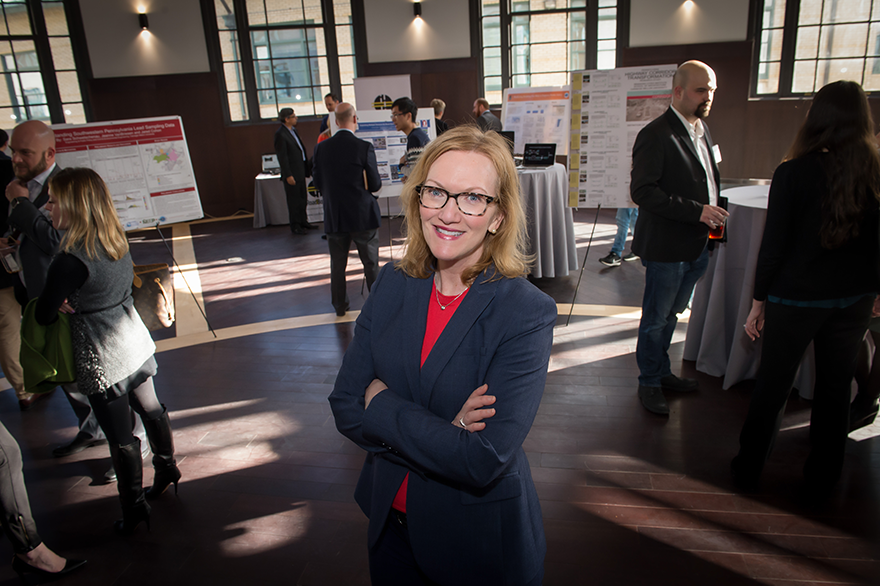
Source: College of Engineering
Karen Lightman at a Safety21 event.
“Our approach to workforce development relies on the concept of ‘teach the teachers,’” says Karen Lightman, executive director of Safety 21. In June, Lightman attended the Council of University Transportation Centers at Auburn University to participate on the panel, “Workforce Development in Action: Center Strategies and Best Practices for Implementation.”
“At the meeting, there were breakout sessions to discuss common issues that affect all UTCs,” said Lightman. “Workforce development is always front and center.”
In addition to collaborating with partner universities, Safety21 works with community and technical colleges to ensure that cutting-edge technology transfers to the vocational level. A collaboration between Safety21 and the Community College of Allegheny County resulted in the nation’s first apprenticeship program to train mechanics who will maintain and repair high-tech automated and electric vehicles. The program was announced in fall of 2024, and the first cohort of technicians graduated in March 2026. Safety21 has also worked with the Community College of Philadelphia.
“Technology and knowledge are transferred from universities to community colleges. What we are seeing is that community colleges are becoming more flexible; in addition to offering associate degrees, they are adding certification programs.”
We are helping to shape an environment where transportation will be safer, and people will have good jobs.
Karen Lightman, Executive Director, Safety21
Mirroring Safety21’s employment-focused activities with schools are the collaborations with the Pennsylvania Department of Transportation (PennDOT). PennDOT and the Pennsylvania Turnpike Commission (PTC) are state agencies; however, they often take advantage of public-private partnerships. Aligned with PennDOT and PTC, Safety21 is examining how emergency responders, such as EMS personnel, firefighters, and police officers, interact with automated vehicles. “This training allows emergency workers to practice different scenarios and learn safety protocols in a controlled environment,” says Lightman.
Roughly 30 miles southeast of Carnegie Mellon is the Pennsylvania Safety, Transportation, and Research Track (PennSTART), which is managed by the Regional Industrial Development Corporation of Southwestern Pennsylvania (RIDC) and funded by PennDOT and the PTC. At the PennSTART Training Center, Safety21 and its partners are applying their knowledge to design mock training scenarios for students, professionals, and first responders. At the state-of-the-art testing facility, they are learning how modern vehicle technology behaves during accidents and how emergency vehicles can communicate with autonomous vehicles and connected infrastructure.
Safety21 projects being deployed at PennSTART focus on issues such as work zone safety, vulnerable road users, safety transportation policy and planning, and edge-case autonomous vehicle safety. In step with Safety21’s goal of advancing education, this developing curriculum will eventually serve as a model for other states as they create their own programming.
“What is exciting about Safety21 is that we are future-focused on autonomous vehicles and connected infrastructure,” says Lightman. “We are helping to shape an environment where transportation will be safer, and people will have good jobs.”