
Joint human-machine learning improves non-invasive BCI outcomes
New research published in Nature Communications signals significant acceleration of control in non-invasive brain-computer interfaces when utilizing both human and machine learning.
Implantable devices in the brain have been used for about 30 years to assist disabled individuals in completing motor tasks. However, the devices are simply not accessible to the vast majority of people in need of help. Despite decades of work in this field, fewer than than 100 individuals worldwide have benefited from the technology. The costs are prohibitive and the brain surgeries are inherently risky.
That’s why Carnegie Mellon researchers, including Bin He, professor of biomedical engineering, electrical and computer engineering, and the Neuroscience Institute, have long been working on noninvasive brain-computer interfaces (BCIs) to develop technology that is less expensive, safer and more accessible to a wider population. Over the last 10 to 15 years, they have used noninvasive BCIs to fly a drone, maintain continuous control of a robotic arm, and most recently, complete fine motor tasks at the finger level. Yet the accuracy and level of control using noninvasive technology remains challenging.
The more work we do in this area, the more likely we will one day reach a non-invasive BCI that is as accurate as an implanted device in the brain.
Bin He, Professor, Biomedical Engineering
For the first time, a team of researchers led by He have developed a hybrid technology that combines human learning and machine learning in noninvasive BCIs. The results of the study, published in Nature Communications, show a significant scientific and technological advancement in BCIs through a novel framework that directly addresses long-standing training inefficiencies and establishes a scalable pathway toward robust and generalizable neural interfaces
One of the challenges addressed with the novel framework is that humans and computers learn in different ways. Humans learn by trial and error as our brains try different things, get feedback, and rewire themselves based on what works. The AI or machine learning code updates itself using strict, predictable mathematical formulas to find the most efficient path. Because the human brain and the computer program are adapting in such different ways, they can get out of sync or pull in different directions, creating a roadblock for the BCI.
In this study, researchers introduced the first sensory-guided joint learning framework that explicitly unifies these two modes of learning. By embedding structured tactile guidance to shape user strategies and deploying adaptive algorithms that selectively weight informative neural patterns, their novel approach aligns human neuroplasticity with decoder optimization.
In a study of 31 able-bodied participants untrained in BCIs, they demonstrate that the sensory-guided joint learning framework produces rapid and sustained gains in motor imagery control across tasks of increasing complexity. Participants achieved average discrete accuracies of 86% for one-dimensional cursor control and 77.5% for two-dimensional cursor control, along with continuous accuracies of 77.5% (1D) and 66.9% (2D).
He, senior author of the study, said these performance levels are rarely observed in BCI users with limited training.
“By incorporating neuroscience and machine learning we are approaching closer and closer the accuracy of invasive brain computer interfaces,” said He. “By aligning reinforcement-driven neural plasticity with gradient-based decoder optimization, our approach transcends the limitations of conventional BCI training protocols that rely on passive calibration or one-way feedback.”
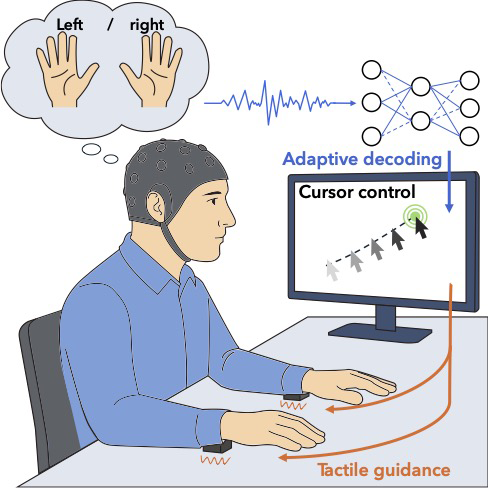
Participants in the study performed motor imagery tasks while seated in front of a monitor, wearing an EEG cap, with vibrotactile actuators placed under both wrists. The human-machine joint learning framework involved an adaptive decoding algorithm processing the participants’ brain signals, while tactile stimulation provided sensory guidance to align their cognitive strategies with the decoder’s target features.
The outcome is not only a marked improvement in accuracy, but also the establishment of a fundamentally new mode of human–machine co-adaptation in which both partners converge toward shared, physiologically grounded control strategies
Beyond laboratory validation, He said this novel integrated approach has clear translational potential. The ability to achieve rapid and reliable BCI control in untrained users addresses a central barrier to clinical deployment, particularly in neurorehabilitation, assistive communication, and prosthetic control.
“By reducing training demands while enhancing neural engagement, the sensory-guided joint learning framework brings noninvasive BCIs closer to scalable, everyday use,” He said. “In doing so, it marks a paradigm shift from calibration-intensive systems toward adaptive, user-centered neural interfaces with real-world viability.
“The more work we do in this area, the more likely we will one day reach a non-invasive BCI that is as accurate as an implanted device in the brain,” said He. “That is my hope, my dream.”
This work was supported in part by the National Institute of Neurological Disorders and Stroke, by the BRAIN Initiative of the National Institutes of Health, and by a National Institute of Biomedical Imaging and Bioengineering training grant. Other collaborators on the Nature Communications paper include the first author Hanwen Wang, a biomedical engineering postdoctoral associate; Yisha Zhang, a former biomedical engineering lab technician; Maxim Karrenbach, an electrical and computer engineering Ph.D. student; and Yidan Ding, a biomedical engineering Ph.D. student.