
Using arts and crafts to introduce engineering and materials
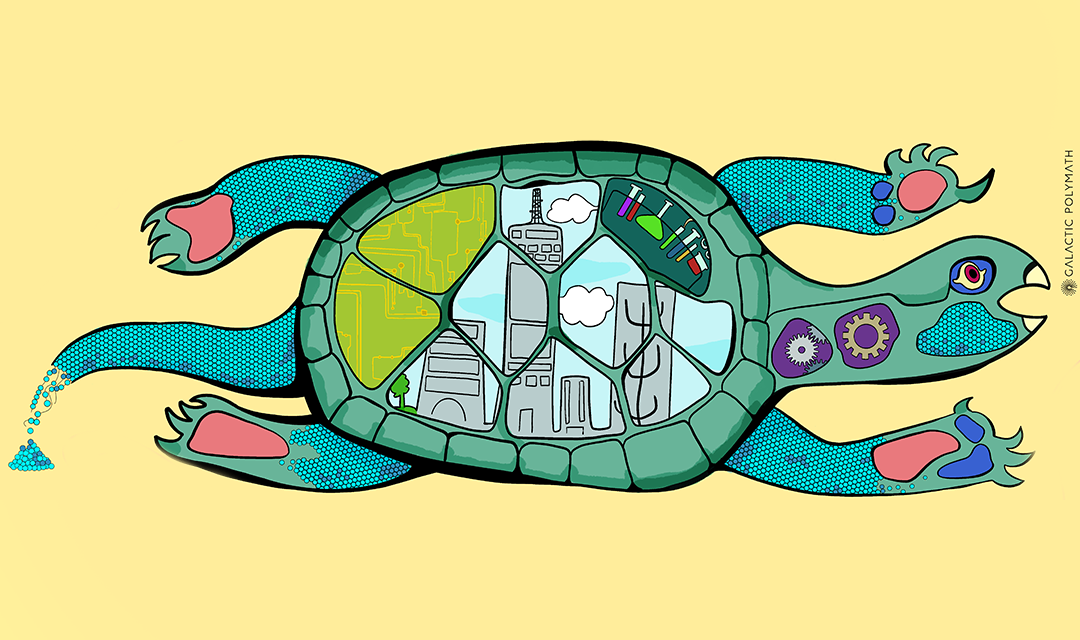
A partnership between Trevor Jones and Galactic Polymath has brought advanced engineering research topics into middle school classrooms through free, hands-on lessons.
What if the same ideas behind folding origami or arranging beads could help students understand engineering concepts?
That’s the question driving a new collaboration between Trevor Jones and the education platform Galactic Polymath. Backed by Jones’ National Science Foundation CAREER award, the partnership is translating his research into free online lessons for middle schoolers.
“Researchers are always asked to make their work more accessible,” said Jones, assistant professor of mechanical engineering at Carnegie Mellon University. “I wanted to do that in a way that felt authentic, so that students can see how things they’re already doing, like crafting, connect to the bigger engineered world around them.”
Students can see how things they’re already doing, like crafting, connect to the bigger engineered world around them.
Trevor Jones, Assistant Professor, Mechanical Engineering
To do that, Jones worked closely with a team at Galactic Polymath to develop The Science of Craft, a three-part series designed to meet curriculum goals while remaining free for teachers. Each lesson includes a video introduction to bring the concept to life, a cross-disciplinary connection to math, geometry, or art, and a hands-on activity using easy-to-find materials.
“We are incredibly grateful for Dr. Jones’ partnership and the critical funding from the National Science Foundation. I feel this is our best unit to date,” said Matt Wilkins, founder and CEO of Galactic Polymath, “Our lead developer, Dr. Madelyn Leembruggen produced truly excellent videos that make the lessons engaging and powerfully show how STEM is all around us, demonstrating that science and engineering are directly tied to the arts and crafts students already love.”
For example, one lesson, Taking Tiles to a New Dimension, asks a seemingly simple question: How do tiles fill a space?
Students then explore how squares, triangles, and hexagons fit together. They learn how angles combine to form patterns, or how when they don’t quite add up, those patterns expand into 3-D structures.
“If four squares meet at a point, you get a flat surface,” Jones explained. “But if only three meet, suddenly you’re forming the corner of a cube. That’s the kind of connection we want students to make.”
Each lesson is rooted in Jones’ broader research focus on crafted matter, which draws connections between traditional crafts and advanced materials science. Jones sees practices like beadwork and origami not just as art, but as powerful entry points into engineering.
“People have developed these techniques over generations. They might not describe their art with equations, but they understand the principals at work in a very real, hands-on way,” he said. “I want students to realize that when they’re building, crafting, or experimenting, they’re also engaging with math and science.”
Launched this spring, the free lessons will reach classrooms across the country to help students engage with concepts that they aren’t typically introduced to until further into their education.
“Engineering doesn’t have to wait until college, or even high school,” Jones said. “These ideas are already part of how we see and interact with the world, so the sooner students recognize that, the more empowered they’ll be to explore it.”