
MechE grad teaching prosthetic feet how to walk
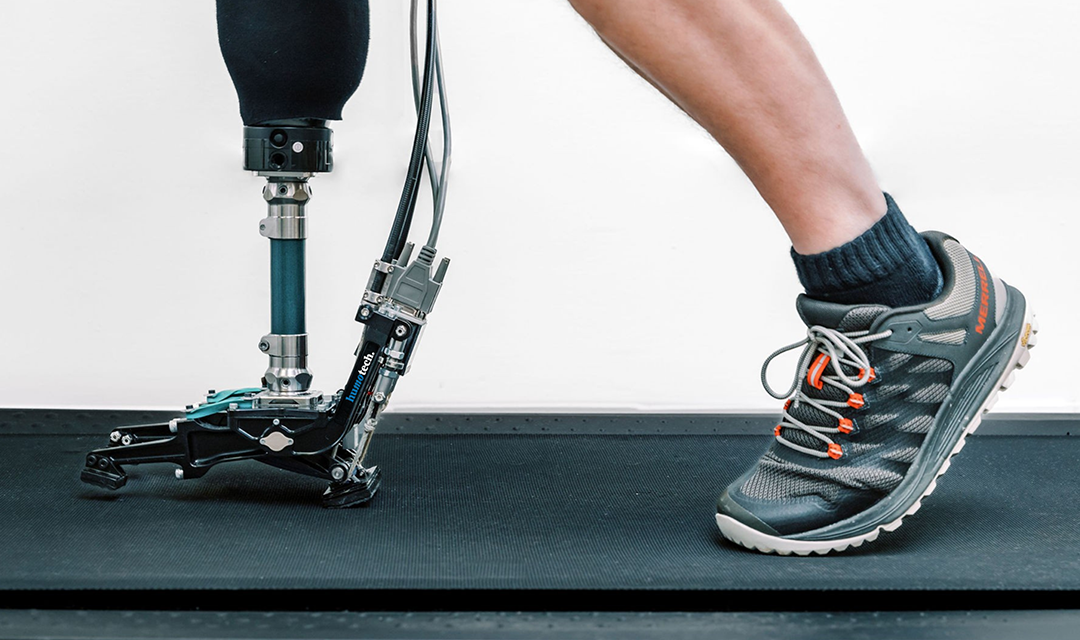
For millions with limb loss, prosthetic care is still guesswork. Josh Caputo (B.S. MechE/ECE ’10, Ph.D. MechE ’15), the founder of Humotech, is changing that by using robotic emulation to match every patient with the right fit.
Each year, more than half a million Americans experience limb loss or are born with limb difference, yet only a small fraction receives truly personalized prosthetic care. For many, choosing the right prosthetic foot relies less on data and more on trial and error or clinician’s intuition. Josh Caputo (B.S. MechE /ECE ’10, Ph.D. MechE ’15) encountered this challenge firsthand while pursuing his Ph.D. at Carnegie Mellon University and made it his mission to change the process. The result is Humotech, a company leveraging cutting-edge robotic emulation systems to empower patients and researchers to personalize prosthetic and exoskeleton design like never before.
While Caputo (B.S. MechE /ECE ’10, Ph.D. MechE ’15) didn’t set out to start his own company, he was drawn to engineering because of his interest in cars, bikes, and “anything with a motor.” As a new student, a tour of CMU’s labs solidified that the mechanical engineering department would be his home, particularly with a focus on robotics. It was from internships at NASA and a defense contractor that Caputo began to feel the itch of entrepreneurship. “I realized I wasn’t meant to be a small cog in a big machine,” he said. “And I wanted to build something that mattered, something human-centered.”
Caputo’s Ph.D. work laid the foundation for exactly that—Humotech’s signature innovation: a cable-driven emulation system that personalizes prosthetic and exoskeleton design.
“One of the first things I geeked out about was how a powered prosthetic foot could offer advantages over the low-tech options available,” he explained. Instead of building a new prototype for every experiment, Caputo developed a tethered system that allowed for rapid testing and personalized tailoring through software that adjusts for torque, force, and stiffness for patients in a matter of minutes.
I was no longer building a foot but creating a platform that can be personalized to individual users.
Josh Caputo, B.S. MechE/ECE ’10, Ph.D. MechE ’15
“This approach changed everything,” he said. “I was no longer building a foot but creating a platform that can be personalized to individual users. Some people respond to the same design in completely different ways. That insight shaped the direction of Humotech.”
In 2016, Humotech launched its first clinical trials in partnership with the Puget Sound VA in Seattle, Washington. Eighty-six patients tested different prosthetic foot options in a controlled, emulation-driven environment and, nine years later, it has resulted in data and insights now driving clinical adoption. “Patients could try multiple designs and identify what worked best for them. It validated the idea that personalized design can transform lives,” he said.
Looking ahead, Caputo envisions Humotech expanding with mobile clinics capable of deploying emulation technology worldwide to help the hundreds of thousands of patients receiving prosthetic legs every year receive the right foot the first time.
“Our goal is to reduce the cost and improve the quality of prosthetic care,” he explained. “We want people to walk better, feel confident, and live healthier lives.”
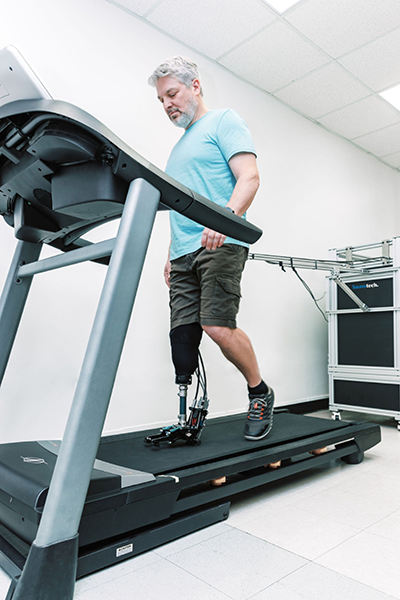
Source: Humotech
Humotech’s clinical prosthetic foot trialing service enables people with limb loss to rapidly compare their options, informing clinical decision-making with powerful, patient-specific data.
Q&A with Josh Caputo Building Humotech
Q: What was the steepest learning curve in starting Humotech?
A: The technical challenges were the easy part. We learned how to do the engineering in our sleep. What I wasn’t prepared for were the business and HR challenges—forming a company, managing people, navigating hospitals and clinical systems. I didn’t have co-founders or business school friends, so I was learning everything in real time. I wish I’d started building that business foundation earlier.
Q: Did anything surprise you about tech-transfer in the medical space?
A: How differently engineers and clinicians are trained. We share the same mission and values, but we speak completely different languages. At first, going into hospitals was intimidating. Working with patients who have experienced limb loss is deeply personal and often traumatic. I had to build confidence and learn how to listen. Mentors at the VA helped me understand how the real world works outside of an engineering lab.
Q: Were there early moments when the company could have gone another direction?
Absolutely. Early on, I thought building a high-powered robotic foot would be a winning idea. But our research showed something deeper: even if you restore power, patients can’t always coordinate with the device because the neural connection is gone and the socket interface dissipates energy. That realization shifted us toward personalization and emulation as the real opportunity.
Q: What engineering lessons still guide you as a CEO?
Fundamentals matter. Free-body diagrams. F = ma. It sounds basic, but those principles explain so much about the world. I use engineering thinking to solve everything—even business problems. As a leader, you make decisions quickly and often intuitively, but they’re grounded in those core principles.
Q: What has been the most rewarding part of the journey?
Seeing the impact. When patients are given options and can choose what works best for them, they walk better and they’re happier. Knowing that the system we built can help someone receive the right prosthetic the first time and seeing how that delights them—that’s what makes all the hard parts worth it.