
Developing robots that can walk through mud
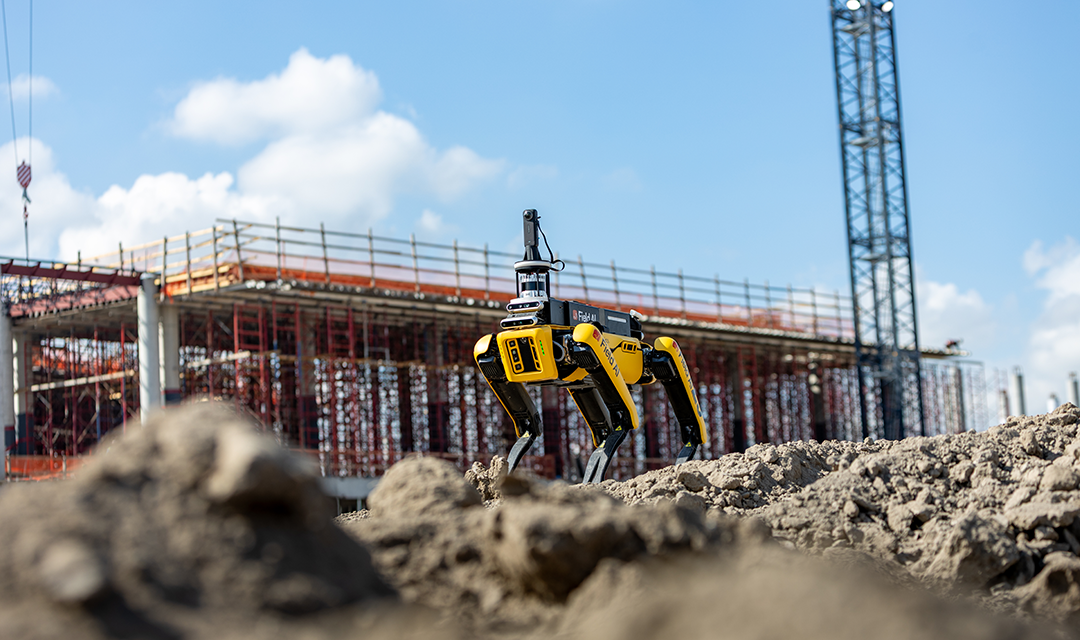
Aaron Johnson’s Robomechanics Lab and FieldAI are developing a new technology to help robots move efficiently through muddy and deformable terrain.
Carnegie Mellon University’s Robomechanics Lab and FieldAI have been awarded a Small Business Technology Transfer grant from the U.S. Army to develop new technology that will enable quadruped robots to move safely, efficiently, and reliably through muddy and deformable terrain.
The project combines FieldAI’s expertise in deploying general-purpose robotics with Aaron Johnson’s leadership in legged locomotion and terramechanics. Together, the team will develop new software and hardware that allow four-legged robots to sense, adapt, and maintain traction in mud without requiring a preexisting model of the terrain.
While quadruped robots have made rapid progress in navigating tricky terrain, muddy environments remain difficult due to their unpredictability. Acting like a solid under low stress but flowing like a fluid when stress increases, mud is extremely difficult to model.
“The core problem is that there isn’t one ‘right’ way to walk in mud,” said Johnson, professor of mechanical engineering at Carnegie Mellon. “The strategy that works in one patch can fail a few steps later. We’re building a control system that lets robots recognize the differences and respond immediately. This is a fundamental shift from how locomotion is typically engineered.”
Instead of attempting to precisely model every possible type of mud, the researchers will develop learning-based controllers that adapt to terrain conditions in real time. These controllers will analyze sensory feedback from the robot’s interaction with the ground and quickly determine the best movement strategy for current conditions.
The project will also explore bio-inspired hardware designs including deployable ankle pads and secondary support surfaces that increase the contact area for robots walking on soft ground. These features are inspired by elephants and camels whose feet naturally spread under their weight to prevent sinking.
The research team will test the technology at Carnegie Mellon’s Robotics Innovation Center outdoor testing grounds where FieldAI is the first corporate tenant.
“Mud is a classic example of what makes field deployment hard. It’s also common across the industries where robots are needed most, such as construction, mining, energy, and government,” said Eric Krotkov, R&D programs lead at FieldAI Federal. “This collaboration with CMU pushes the boundaries of where robots can go and how effectively they can operate once they get there.”
Legged robots are already being used for a widening range of valuable tasks such as inspection and mapping, so improving mobility in soft terrain expands their role. By enabling robots to navigate muddy conditions more reliably, the project supports applications ranging from disaster response and environmental monitoring to construction, mining, and agriculture.
The research also reaches beyond mud. The same adaptive learning framework could be applied to other challenging terrains.
“Ultimately, we want robots that can go wherever they’re needed,” said Johnson. “That means handling any environmental conditions that may come up along the way. Today, we’re starting with mud.”