
Breakthrough in digital thermal control
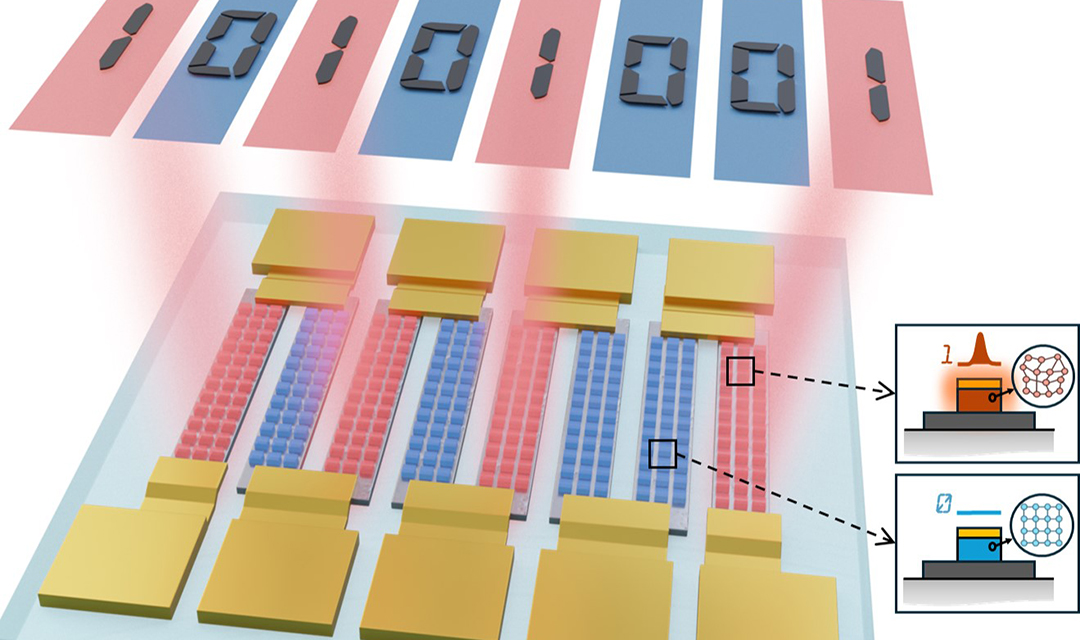
A Carnegie Mellon research team developed an energy-efficient “digitized heat” technology using phase-change materials to precisely and rapidly control thermal radiation, enabling applications like adaptive camouflage and advanced sensing.
A Carnegie Mellon University research team has developed a pioneering technology that manipulates thermal radiation with the precision of pixels. The work, published in Science Advances, outlines a method for “digitizing heat,” allowing for the intelligent, high-speed, and continuous control of thermal emission. This breakthrough holds significant promise for applications ranging from advanced thermal camouflage to chemical sensing.
Every object emits thermal radiation, which is invisible to the human eye but can be detected by thermal cameras. Controlling this emission is extremely difficult. Hence, traditional methods rely on heating or cooling an entire object, which is slow and requires copious amounts of energy.
“Previously, we didn’t have this kind of digital-type design. Every piece was merged into a single one,” explained Xiu Liu, Ph.D. student in mechanical engineering and the lead researcher on the paper. “We could only simply switch the whole device into binary states—on or off.”
The team’s innovation combines metasurface concepts with a specific phase-change material called germanium telluride (GeTe). This material is commonly used in electronic long-term memory devices. GeTe is unique because it can change its physical state to alter how it emits heat, but it does not require constant power to maintain that state, making it non-volatile.
“Just like in computer memory, after we electrically switch it, we don’t need extra energy to maintain such a state,” Liu noted. This makes the device highly energy efficient as power is only needed during the transitioning state.
By arranging this material into tiny ribbons on a metasurface, the team created a device that goes beyond simple on/off commands. They can independently control different segments, creating a pattern, essentially a tunable thermal barcode.
Sheng Shen, professor of mechanical engineering, describes this advancement as the “intelligent control of thermal emission.”
The most immediate application of this digitized control is adaptive thermal camouflage. “With this new capability, we can locally, precisely control the thermal signature of one object,” Shen said. Instead of just hiding an object, this technology could actively alter its appearance to an infrared camera.
Crucially, the new device allows for gradual tuning. Instead of jumping from zero to 100% emission, the team can precisely dial in thermal output, providing a level of granularity and specificity that was previously impossible. With switching speeds clocked in microseconds, the technology is fast enough to adapt to rapidly changing environments in real-time.
Currently, the team demonstrates this capability in a one-dimensional array, similar to a barcode. In the future, the team’s next milestone is scaling the technology up to create a true two-dimensional display, similar to a thermal QR code. Other future uses include developing flexible substrates so the technology could be integrated into wearables and using the precise infrared control as a light source for chemical and bio-sensing.
This work is supported by the Defense Threat Reduction Agency and the National Science Foundation. Sheng Shen and Gianluca Piazza are the corresponding authors. Xiu Liu, Hyeonggyun Kim, and Zexiao Wang contributed equally to this work.