See one, do one, teach AI one
In Chris McComb’s Mechanics II: 3D Design course, AI pushes students to think critically and teach nuanced engineering topics while strengthening their expertise and confidence along the way.
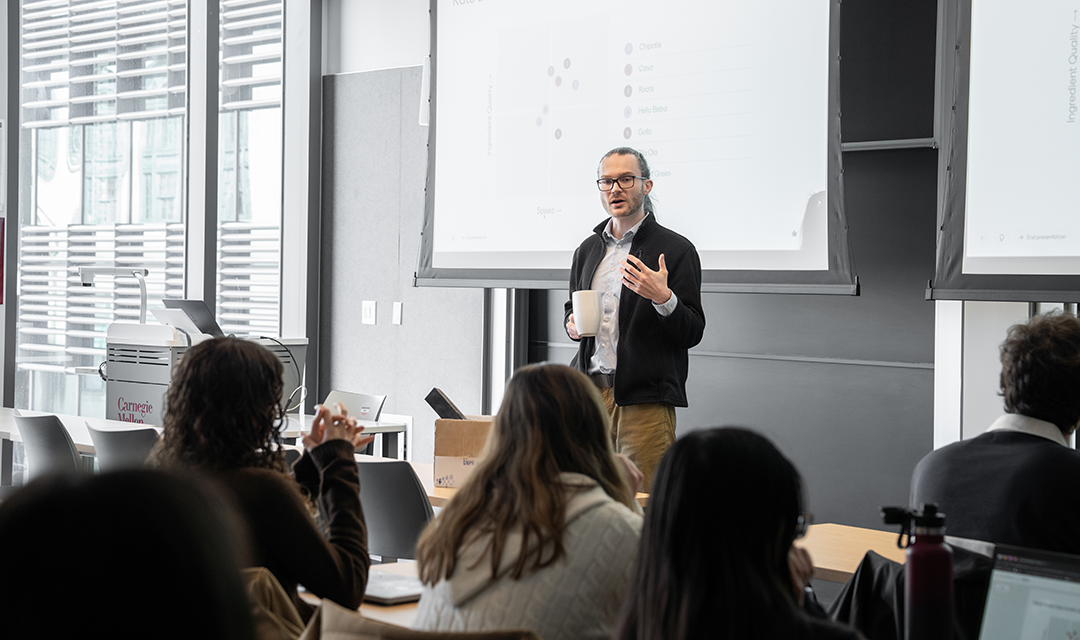
In Chris McComb’s Mechanics II: 3D Design course, artificial intelligence isn’t the expert or a shortcut to producing perfectly polished designs. Instead, AI plays a far more interesting role. It is forcing students to think more critically and, in the process, become the experts themselves.
“In education, a lot of people are finding ways to turn AI into a tutor,” said McComb, associate professor of mechanical engineering and director of the Human + AI Design Initiative. “But it’s not capable enough to handle the nuance of specialized engineering topics yet. So, instead of asking AI to teach my students, I asked my students to teach AI.”
Building on the “see one, do one, teach one” learning paradigm—which has demonstrated that teaching material to others enhances information processing, performance, and motivation—McComb and MIIPS student Giovannia Natasha prompted Microsoft CoPilot to function as a tutee in McComb’s14-week mechanical engineering course. Throughout the semester, students interacted with the genAI tool on eight homework assignments, using pre-engineered prompts that instructed the AI to make specific mistakes and to act like a novice student. Each prompt was given to the students in Indonesian so that they were unaware of what mistakes to lookout for.
Students in the Spring 2025 course who used AI as a tutee significantly outperformed students from the previous semester in three of the four major concept areas: predicting deformation, predicting failure, and understanding the influence of material properties. Performance on the fourth concept, predicting the location of failure, remained consistent with the prior semester.
Student confidence in their ability to use engineering skills improved, and so did their confidence in their ability to use genAI.
Chris McComb, Associate Professor, Mechanical Engineering
“Students who engaged more authentically with their AI tutee reaped the benefits,” said McComb. “Their confidence in their ability to use engineering skills improved, and so did their confidence in their ability to use genAI.”
Potentially more compelling than the improved test scores is the accessibility factor. In this scenario, AI helps to level the playing field for students who may not have taken advanced physics in high school, or who cannot attend office hours because they are balancing a part-time job. Because AI is an easy-to-use, always available tool, any student can use it to refine their understanding.
In McComb’s classroom, AI is not the expert or the shortcut, it becomes the practice field. “If students are going to use AI anyways,” he said, “we should design experiences that make them better engineers because of it.”
This research was supported by CMU’s Generative AI Teaching as Research (GAITAR) initiative.