
Robotics Innovation Center is open and ready for research and partners
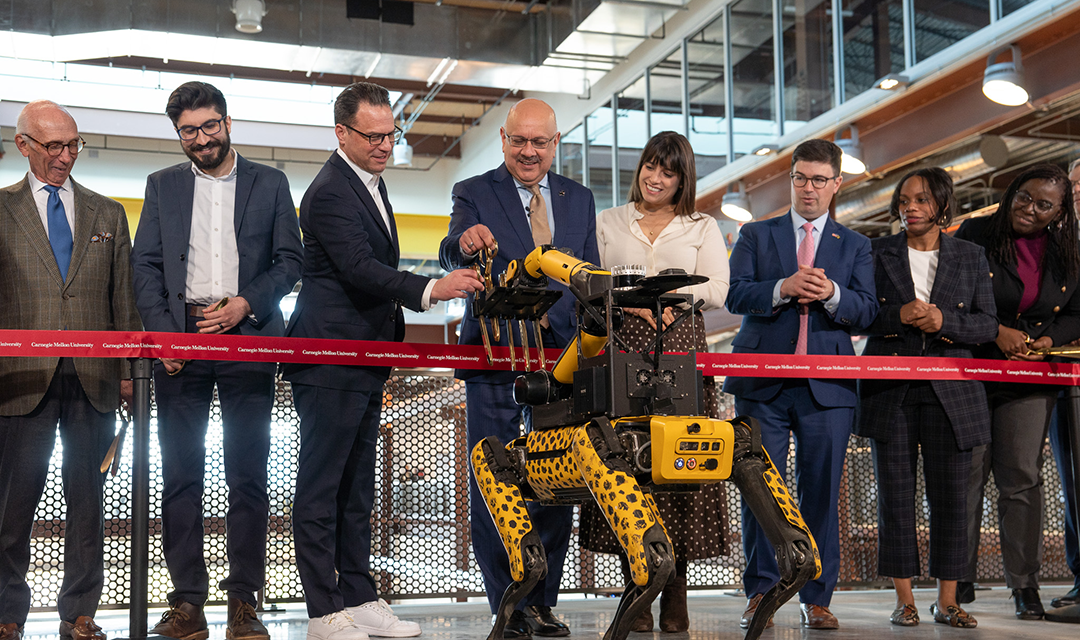
Marked with a visit from Pennsylvania Governor Josh Shapiro, Carnegie Mellon University officially opened the Robotics Innovation Center on February 27.
Marked with a visit from Pennsylvania Governor Josh Shapiro, Carnegie Mellon University officially opened the Robotics Innovation Center on February 27. CMU is a global leader in artificial intelligence (AI) and robotics, and the new 150,000-square-foot center sited in Hazelwood Green will serve as a proving ground for the university’s robotics, automation, and AI breakthroughs.
Government, community, foundation, and industry leaders were invited to tour the facility and attend a riveting mix of robotic demonstrations. Housing more than 50 labs and working groups, the Robotics Innovation Center will support the creation and testing of robots for use on land and in water, air, space, and even in humans.
To accelerate research and development and fuel economic growth, industry is welcome to partner with the center, and FieldAI became the first corporate tenant. FieldAI, a unicorn company, is transforming industrial operations through physically embodied robotic AI and autonomy. Ascribing to the notion that breakthroughs don’t happen in isolation, the company sees benefit in setting up a location in the Robotics Innovation Center, where researchers, entrepreneurs, and students will collaborate and create.
Shapiro honed in on the importance of supporting innovation and announced that the Commonwealth of Pennsylvania will invest $1.5 million into the center to support physical AI.

Source: College of Engineering
CMU President Jahanian looks on as Governor Shapiro operates a robot.
A theme throughout the event was that AI and robotics are transforming the region and that local investments are addressing national needs. The Robotics Innovation Center is adjacent to Mill 19, the home of Carnegie Mellon’s Manufacturing Futures Institute (MFI). MFI researchers have a vision for how robot capability needs to evolve to empower a new level of automation and productivity throughout the U.S. manufacturing sector. A $150 million grant from the Richard King Mellon Foundation in 2021 to CMU included generous funding for both MFI and the Robotics Innovation Center.
After the ribbon-cutting, engineering researchers showcased robotics that will use the facility for discovery and field testing in different environments, including aquatic and virtual. A smart drone that flies autonomously and avoids obstacles was demonstrated in the drone arena. A four-legged, land-crawling robot developed in the Robomechanics Lab exemplified robots that can be used in dangerous environments across challenging terrain. While robots that mimic the mechanical properties of natural organisms, like an octopus tentacle’s capacity to grasp, highlighted the College of Engineering’s pioneering work in Softbotics. This research uses novel soft materials and systems for human-machine interaction and healthcare monitoring, among other purposes.
Finally, CMU is considered to be a birthplace of autonomous vehicle technology, and multiple generations of the university’s self-driving cars were displayed, allowing viewers to see contributions that engineers are making in AI, automation, and safety.