
Simulator boosts strength, design in spray 3D concrete printing
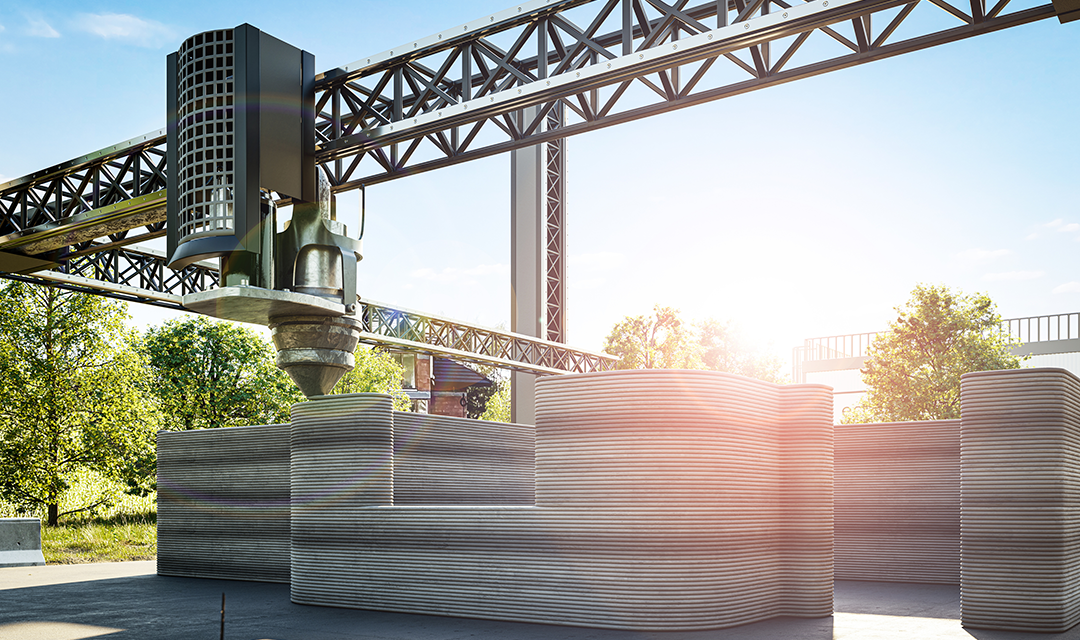
Carnegie Mellon engineers have developed a simulation tool that predicts how sprayed concrete behaves and solidifies, even around rebar. The breakthrough could transform how buildings are constructed, cutting material waste and enabling stronger, more complex structures for tomorrow’s cities.
Concrete 3D printing reduces both time and cost by eliminating traditional formwork, the temporary mold for casting. Yet most of today’s systems rely on extrusion-based methods, which deposit material very close to a nozzle layer by layer. This makes it impossible to print around reinforcement bars (rebars) without risk of collision, limiting both design flexibility and structural integrity of builds.
Kenji Shimada and researchers in his Carnegie Mellon University’s Computational Engineering and Robotics Laboratory (CERLAB), are breaking through that limitation with a new simulation tool for spray-based concrete 3D printing.
“Spray-based concrete 3D printing is a new process with complicated physical phenomena,” said Shimada, a professor of mechanical engineering. “In this method, a modified shotcrete mixture is sprayed from a nozzle to build up on a surface, even around rebar.”
The ability to print freely around reinforcement is especially important in places like Japan and California, where earthquakes are an imminent threat and structural strength is critical.

CERLAB traveled to Tokyo, Japan, where Shimizu Corporation already operates spray 3D printing robots to validate their model.
“To make this technology viable, we must be able to predict exactly how the concrete will spray and dry into the final shape,” Shimada explained. “That’s why we developed a simulator for concrete spray 3D printing.”
The new simulator can model the viscoelastic behaviors of shotcrete mixtures, including drip, particle rebound, spread, and solidification time. This way, contractors can assess multiple printing paths based on a CAD design with the simulator to evaluate whether spray 3D printing is a feasible fabrication technique for their structure.

Spray-based concrete 3D printing allows builders to work around reinforcement bars. This is especially important in places like Japan and California, where earthquakes are an imminent threat and structural strength is critical.
The team traveled to Tokyo, Japan, where Shimizu Corporation already operates spray 3D printing robots to validate their model. In the first test, the team focused on the simulator’s ability to predict shape based on the speed of the nozzle’s movement. With 90.75% accuracy, the simulator could predict the height of the sprayed concrete. The second test showed that the simulator could predict printing over rebar with 92.3% and 97.9% accuracy for width and thickness, respectively.
According to Soji Yamakawa, a research scientist in Shimada’s lab and the lead author of the team’s research paper published in IEEE Robotics and Automation Letters, a simulation of this kind would typically take hours, if not days, to run.

Spray-based concrete 3D printing also allows builders more flexibility in the design of their builds.
“By making wild assumptions, we were able to successfully simplify a super complex physics simulation into a combination of efficient algorithms and data structures and still achieved highly realistic output,” Yamakawa said.
Future work will aim to increase accuracy by identifying environmental parameters like humidity, optimize performance, and add plastering simulation to create smoother finished products.
“There are still so many applications and technologies that we can develop with robotics,” said Kyshalee Vazquez-Santiago, a co-author of the paper and a mechanical engineering Ph.D. candidate leading the Mobile Manipulators research group within CERLAB. “Even in concrete 3D printing, we are working with an entirely new type of application and approach that has so many advantages but leaves so much room for further development.”