AI Coach is changing the way teams perform for better results
Backed by psychology-informed AI, AI Coach is making high-performance teamwork more accessible than ever.
Teamwork may fuel effective ideas, even at times better than a single person has the ability to generate on their own, but even the best groups need guidance. Teams become most effective when there is a facilitator who keeps conversations on track, draws out quieter voices, and helps steer decisions. To guide collaboration, researchers at Carnegie Mellon University introduce AI Coach, a novel artificial intelligence agent that can perform as well as, if not marginally better, than a human manager.
Backed by psychology-informed artificial intelligence, AI Coach doesn’t need to be trained on prior problem-solving examples to be successful. Instead, it monitors teams’ collective intelligence.
“Training AI for every problem-solving scenario is impractical,” said Chris McComb, associate professor of mechanical engineering. “If an AI can understand how members of a team contribute to the conversation, assess how aligned they are on the same goals, and prevent individuals from becoming disengaged, then the team will design better solutions regardless of what problem they’re solving.”
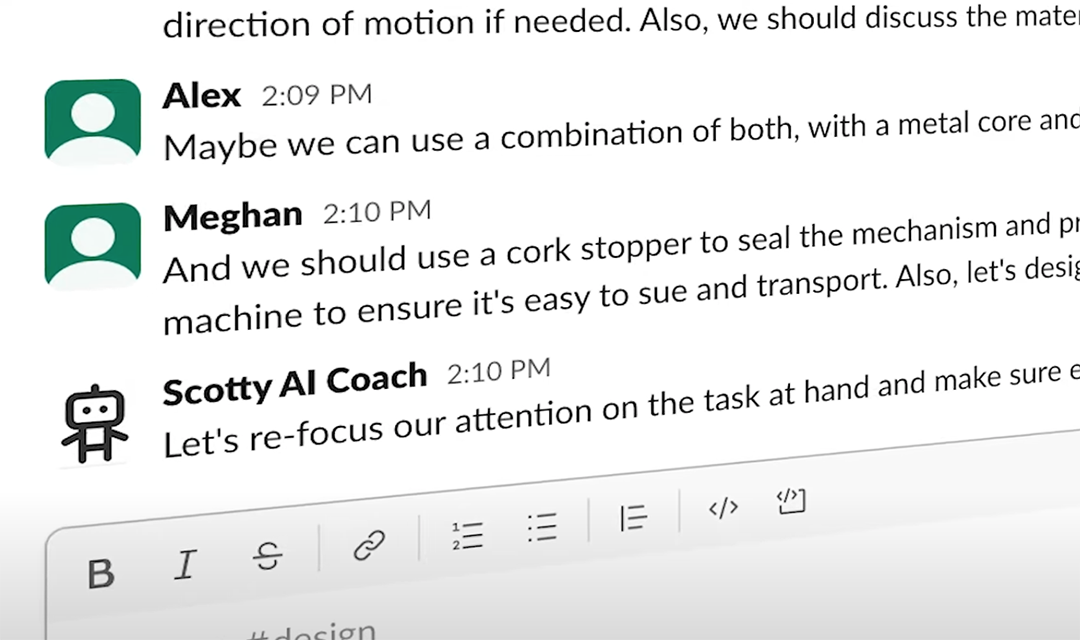
To build the AI Coach, McComb in partnership with Jon Cagan, professor of mechanical engineering, and Scotty McGee, a Ph.D. candidate in the department of mechanical engineering, focused on three specific communication dynamics: equal participation, collective attention, and consistent communication. By understanding these dynamics, the AI coach can intervene when the team is heading off track. For example, if one member of the team is not contributing, the Coach may nudge them by saying, “It’s important that we hear from all team members, so let’s take a moment to gather input from everyone.”
Published in the Journal of Mechanical Design, the researchers tested AI Coach in two studies where teams were tasked with designing a manual peanut shelling machine. Participants in the first group worked remotely via text chats while those in the second group worked in person. AI Coach listened in real time to team conversations via a microphone in the room. The researchers then compared each team’s final design solutions to solutions proposed by one team that had no coach and one team that was guided by a human.
The teams using AI Coach developed better peanut sheller designs than the team that received no guidance at all. In both virtual and in-person studies, the AI Coach was as, if not more, effective than the human coach.
“In this study, we also saw that over time, the team is self-learning, adapting, and improving how they interact with each other so that the AI coach needs to intervene fewer and fewer times during even one problem solving process,” said Cagan. “This shows that not only are their solutions getting better, the team is actually performing better over time through this process.”
We saw at NASA that AI Coach made teams more mindful of how they were collaborating, which led to richer conversations and stronger design ideas.
Scotty McGee, Ph.D. candidate, Mechanical Engineering
With early partnerships including ANSYS and pilot explorations at NASA, the research team is actively working with organizations to bring AI Coach into workplaces where collaboration drives results.
“We saw at NASA that AI Coach made teams more mindful of how they were collaborating, which led to richer conversations and stronger design idea,” said McGee. “The teams embraced the experience and were excited about how AI agents could be integrated into other design work.”
By keeping conversations focused, encouraging equal participation, and helping teams tap into their full collective intelligence, AI Coach is making high-performance teamwork more accessible than ever.