
Flawed economic logic undermines EPA policy
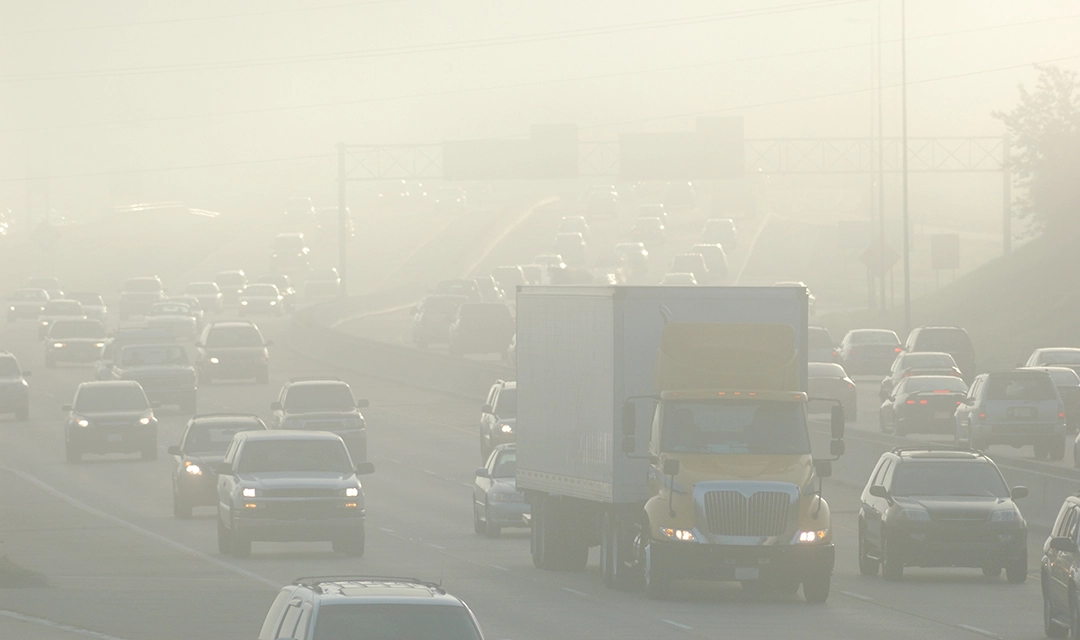
A new paper shows the true economic impact of emissions rollbacks looks very different from official estimates.
The Environmental Protection Agency (EPA) recently eliminated all vehicle greenhouse gas (GHG) standards for light, medium, and heavy-duty vehicles. A study published in Science by Kate Whitefoot and her colleagues demonstrates that the EPA’s claim that eliminating the regulations would save the public hundreds of billions of dollars is based on faulty logic. When the calculations are corrected, the study shows that eliminating the standards costs the public hundreds of billions.
The federal government relies on the EPA’s cost-benefit estimates of its policies to justify how it regulates greenhouse gas emissions. The agency assesses overall economic impact by weighing social costs against benefits, comparing alternatives, and analyzing uncertainties using key assumptions. One particularly important assumption is how much to value fuel savings above normal market trends. “If consumers aren’t purchasing vehicles with fuel-saving technologies because they are focused on other aspects of the vehicle, then encouraging more vehicles to have those technologies will mean more money in the pockets of those consumers,” said Whitefoot, professor of engineering and public policy. However, if efficiency upgrades require trade-offs that buyers dislike, those drawbacks diminish the policy’s overall value.
The paper focuses on two critical flaws in the assumptions of fuel-saving valuation that undercut the EPA’s assertions.
First, the EPA’s analysis completely disregards most fuel savings. The authors note that consumers undervalue fuel savings at the time of a vehicle’s purchase. Car buyers will pay roughly $0.23 for every $1 saved because of fuel-saving technologies. The EPA mistakenly interprets this as an indicator that all fuel savings above this amount are cancelled out by other performance drawbacks of the technologies and, therefore, do not confer real economic benefits. By doing so, the EPA ignores $0.77 per $1 saved, but the study’s authors show that empirical estimates of these drawbacks are much smaller. The true cost penalty associated with fuel-saving technologies caps out at $0.17 to $0.31 per $1 saved, and those penalties will steadily decline as vehicle technology advances.
Second, the EPA makes an accounting error when it double-counts manufacturing costs and lost performance costs. The agency’s model includes the full manufacturing cost required to enhance efficiency without compromising any other aspects of vehicle performance, but it also ascribes a cost for presumed lost performance. The paper points out that the cost-benefit analysis can penalize one or the other, but not both.
If consumers aren’t purchasing vehicles with fuel-saving technologies because they are focused on other aspects of the vehicle, then encouraging more vehicles to have those technologies will mean more money in the pockets of those consumers.
Kate Whitefoot, Professor, Engineering and Public Policy and Mechanical Engineering
Whitefoot and her colleagues show how correcting these mathematical errors reverses the agency’s conclusion. The EPA’s analysis argues that eliminating vehicle greenhouse gas standards would increase U.S. welfare by $600 billion to $790 billion. However, the paper demonstrates that when fuel efficiency, manufacturing, and performance costs are corrected, eliminating the greenhouse gas standards will actually decrease U.S. welfare by $684 billion.
Under executive order, the EPA must rely on a cost benefit analysis for significant regulatory action, centralizing the model’s economic rationale for emissions standards. Regulation based on a framework undermined by methodological contradictions and accounting errors has real-world costs for the economy, the environment, and consumer wallets.
The authors emphasize that establishing a consistent, logically sound evaluative framework is made more vital by the fact that modeling flaws have appeared under the leadership of both major parties. They suggest that a stable approach to emissions standards, consistently applied, will yield long-term benefits for the economy.
In addition to Carnegie Mellon University, collaborators included researchers from the University of Southern California; Yale; the University of California, San Diego; Massachusetts Institute of Technology; the University of Tennessee; the University of Maryland; the University of California, Davis; the University of California, Berkeley; and the University of Pennsylvania.