Sustainability from sky to sea

Engineering students employ the use of naturally occurring resources in their summer research endeavors.
Like many engineering undergraduates who are interested in engineering sustainability solutions, these two students spent their summer working on research that just might find ways to make the world better and the earth greener.
Vedant Misra
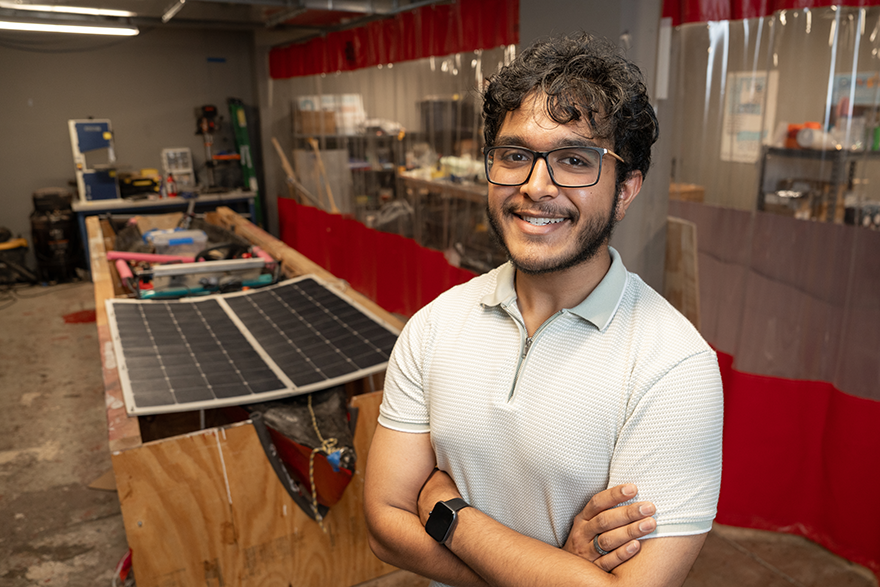
During his first year as an electrical and computer engineering (ECE) student, Vedant Misra got involved with the Carnegie Mellon Solar Racing team, whose members research, design, and engineer all aspects of a solar-electric boat that they use in collegiate competitions.
His participation with the team sparked his interest in solar panels that typically use silicon to convert energy generated by the sun to a usable form of electricity. Misra knew that other materials and alloys could convert that energy more efficiently. He wanted to learn more about how those alternate materials performed in different locations, elevations, and atmospheric conditions to determine how varying temperature, moisture, and light would affect performance.
Although Misra admitted that as a first-year student it was intimidating to reach out to his professors to ask about opportunities to do such research, he was rewarded with a response from Larry Pileggi. The ECE department head not only replied to his email, he introduced Misra to his lab, and agreed to support Misra’s application for the the Summer Undergraduate Research Sustainability Fellowship* to conduct research with his doctoral students.
After spending his summer simulating how the use of other materials perform in varying conditions, Misra plans to apply what he learns to redesign the solar panels used for the racing team.
Last year was only the second time the team returned to competitions since they had been cancelled during the pandemic.
The team raced in the 2026 Promoting Electric Propulsion (PEP) Collegiate Boat Race that was sponsored by the U.S. Navy and held in Portsmouth, Virginia in April. In June, Carnegie Mellon Solar Racing competed at SOLAR SPLASH 2026 in Springfield, Ohio.
*The SURF Sustainability Fellowship is funded by the CMU Sustainability Initiative and facilitated in partnership with the Office of Undergraduate Research and Scholar Development.
Charlotte Betz
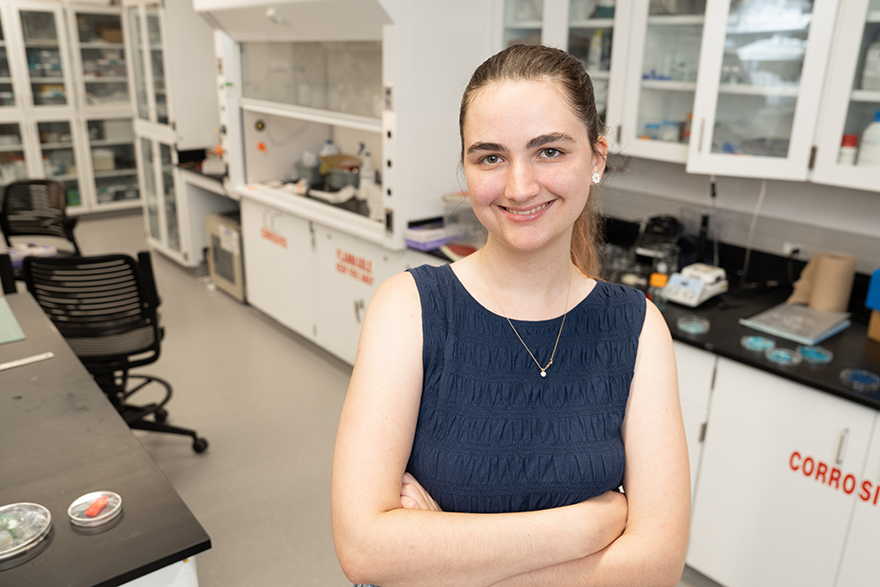
When Charlotte Betz, who is pursuing dual degrees in mechanical engineering and robotics, took Vickie Webster-Wood’s Dynamics class, she discovered a robotics field that sparked her interest and drove her desire to know more.
Webster-Wood, associate professor of mechanical engineering, leads the Biohybrid and Organic Robotics Group (B.O.R.G.), which builds robots that can mimic the structure, adaptability, and complex behavior of animals. In particular, her group uses tissue engineering techniques to print actuators made of plant and muscle-derived materials to create completely biodegradable robots for aquatic applications.
After spending the spring semester getting settled in the lab, Betz received a Summer Undergraduate Research Fellowship grant to work in the lab where she mixed and tested sodium alginate composite materials used to make actuators for biodegradable robots.
Betz is studying how changes in the recipe for these soft actuator materials affect their mechanics. She is currently working with varying the ratio of alginate, which comes from seaweed; gelatin, a collagen protein found in skin, bones, and connective tissue; calcium, an alkaline earth metal and the most abundant mineral in the human body; and glycerol, a chemical formula that enhances the flexibility of the material.
Betz then tests each new combination of organic materials to determine how much it can be stretched before it breaks to better understand how well it might perform in robotic applications.
Robots that can be used for environmentally friendly deployment in sensitive ecosystems need to be capable of animal-like movement, made of soft materials that won’t damage plant or animal life, and biodegradable for those robots that can’t be recovered from underwater environments.
Such pursuits fit neatly into the rising senior’s ultimate desire to earn a Ph.D. and launch a career building robots.