
Improving PFAS water treatment through AI-supported engineering design
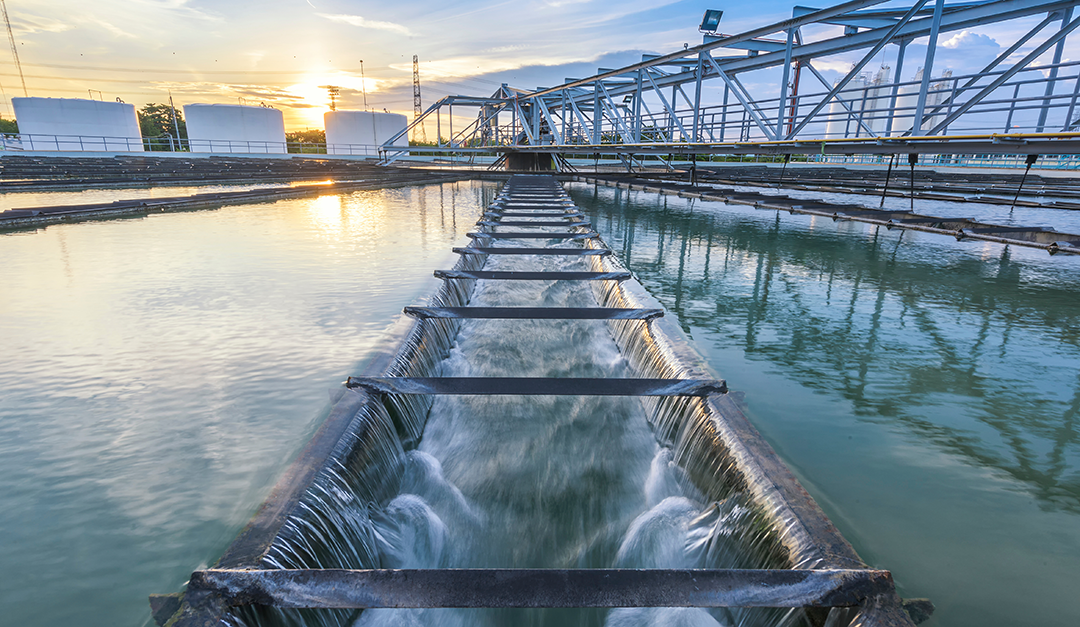
CMU researchers are collaborating with industry partners to help water utilities move more quickly from design concept to engineered systems and deployable infrastructure.
The Water Resources Development Act (WRDA) of 2024 outlines federal priorities for conserving and developing U.S. water resources and infrastructure. One growing priority is ensuring that water treatment systems can remove per- and polyfluoroalkyl substances (PFAS), often referred to as “forever chemicals,” from public drinking water.
“PFAS are synthetic chemicals that can persist in water and accumulate over time, which can be harmful to humans when ingested in large amounts,” says Pingbo Tang, associate professor of civil and environmental engineering. “The Environmental Protection Agency is regulating water treatment nationwide to ensure that water utilities achieve a certain level of PFAS compliance to protect the health of the community.”
Designing systems to remove PFAS from drinking water is a complex engineering challenge because conventional treatment is often ineffective, and regulations are tightening. Engineers typically adapt established technologies—such as granular activated carbon, ion exchange, and membranes—but must re‑optimize them for PFAS behavior and new regulatory limits, often based on site‑specific pilot testing and evolving design guidance.
To address this challenge, CMU researchers are collaborating with industry partners Circular Water Solutions, LLC and Ethos Collaborative to help water utilities move more quickly from design concept to engineered systems and deployable infrastructure.
Jinghua Xiao, president and principal engineer at Circular Water Solution, LLC, served as the project’s environmental engineer. She brought extensive experience in environmental issues and water chemistry to address the regulatory specifications for PFAS systems.
“Dr. Xiao is the domain scientist on this project,” says Tang. “She provided our team data to analyze the relationship between chemical doses and the treatment speed of the water—calculations that are EPA-regulated and therefore critical to testing your design.”
Meanwhile, Damon Weiss, a civil engineer at Ethos Collaborative, contributed his expertise in water infrastructure design and engineering to the project.
“We are leveraging Damon’s expertise to build a digital twin of CMU’s campus to understand how sewage systems generate wastewater and how wastewater should be treated,” says Tang. “This analysis of an existing sewage system helped us build a knowledge base for differentiating between good and poor engineering design.”
Tang explains that support from industry partners helps researchers tackle what engineers call an ill‑defined problem—one where existing treatment technologies must be re‑engineered and integrated under new regulatory constraints and site‑specific conditions. Rather than designing PFAS systems entirely from scratch, engineers face a tedious, iterative process of adapting and optimizing available options into deployable treatment trains, a task that increasingly requires digital computational tools to coordinate design–engineering collaboration.
The project investigated how artificial intelligence can streamline the design process for PFAS treatment systems. By analyzing how high-performing engineering teams communicate during the design process, the researchers hope to identify strategies that help water utilities move more quickly from concept to deployable infrastructure. Communication gaps between teams of environmental engineers (process designers) and mechanical engineers can lead to repeated design iterations, slowing the delivery of deployable solutions.
“What we are trying to do is observe both high-performing teams and teams that struggle with communication,” says Tang. “By studying how these groups exchange information, we hope to identify communication patterns that help teams reduce the number of design revisions needed to reach a final solution of mechanical systems design that properly implements the process design subject to all engineering constraints.”
These approaches could be used broadly in civil engineering and product design research.
Pingbo Tang, Associate Professor, Civil and Environmental Engineering
To study how design decisions affect system usability, the research team is testing designs in a digital twin environment. In these simulations, human operators interact with an AI-powered assistant as they learn to operate a virtual water treatment system. Operators can ask the AI co-pilot questions about procedures, such as whether a particular action is safe or appropriate. Each interaction provides the engineering design team with feedback on parts of the design that can cause difficulties for operators in monitoring and controlling the mechanical systems that should fully satisfy the expected PFAS treatment performance subject to engineering constraints.
“We can compare two designs based on the questions users ask,” Tang explains. “If operators need fewer clarifying questions to understand how the system works, that’s usually a sign of a better design. Ideally, the system should be intuitive enough that operators can run it safely and efficiently without relying heavily on chatbot support.”
After these simulations, the researchers plan to use another AI system to analyze the conversations between the chatbot and the operators. Identifying recurring questions or points of confusion can help designers modify aspects of the design to reduce uncertainty.
Tang believes that capturing the behaviors and communication patterns of high-performing PFAS treatment process designers and engineering teams can help other designers and engineers.
“As we study how PFAS treatment process designers and engineering teams collaborate, we’re asking ourselves how their behaviors can be captured and reused in future water treatment system design and engineering projects,” he says. “We’re hopeful that what we learn through this project will not be limited to water system design. These approaches could be used broadly in civil engineering and product design research.”