
An upstream battle: Fishing policy in Alaska
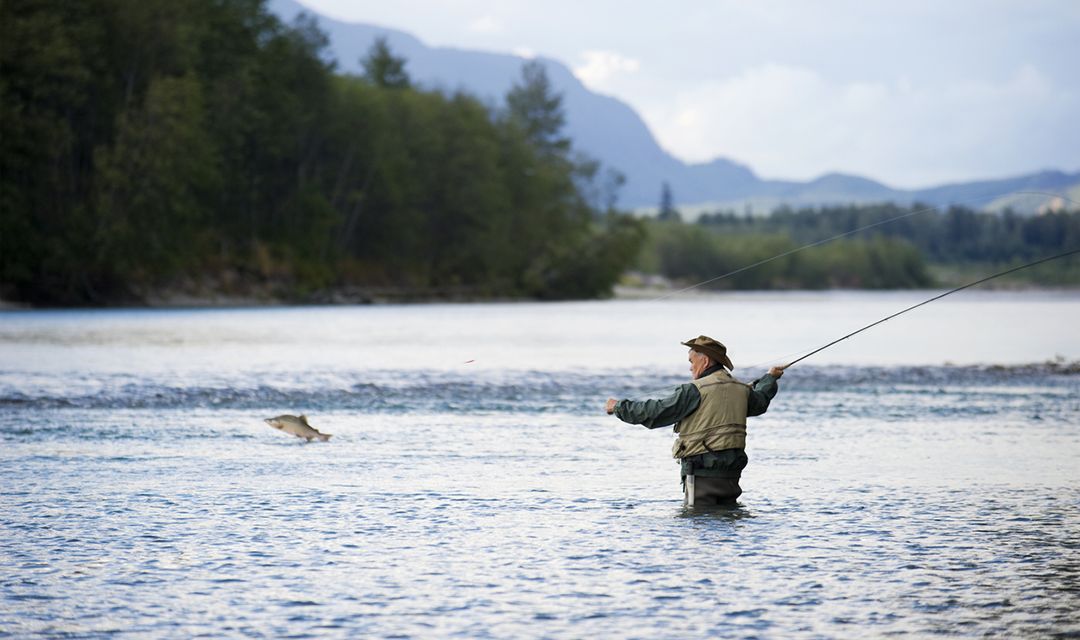
Researchers look at whether salmon fishing management policies in the Yukon River actually balance ecological goals with the needs of the communities that depend on them.
For thousands of years, salmon have sustained communities along Alaska’s Yukon River, not only as a food source, but also as a cornerstone of culture and tradition. Today, however, those salmon populations are declining, and researchers are examining if current policies that are meant to protect them are working as intended, for both the ecosystems and the people who depend on them.
A new study from Carnegie Mellon’s Department of Engineering and Public Policy evaluated how well the Alaska Department of Fish and Game (ADF&G) follows policies designed to promote both ecological and social sustainability in its management of salmon fisheries. By combining historical data analysis and interviews with traditional subsistence users, the team assessed if management decisions align with legal mandates and whether those decisions actually produce sustainable outcomes.
Fisheries are often described as social-ecological systems, meaning environmental conditions and human well-being are closely linked, and in the Yukon River region, that connection is especially strong. Salmon have supported Alaska Native communities for at least 11,500 years, yet populations have experienced decades of decline attributed to pressures like warming oceans, changing river conditions, and harvest impacts across multiple regions and jurisdictions.
“Traditional users of the Yukon River have engaged in reciprocal relationships with salmon since time immemorial,” said Sabrina Curtis, Ph.D. student studying engineering and public policy and lead author of the paper. “But today, they need help to balance systems of management with globalization, industry, and culture.”
Traditional users of the Yukon River have engaged in reciprocal relationships with salmon since time immemorial. But today, they need help to balance systems of management with globalization, industry, and culture.
Sabrina Curtis, Ph.D. student, Engineering and Public Policy
As the agency responsible for regulating Alaska’s fisheries, ADF&G determines how and when fishing can occur for subsistence, commercial, and recreational use. These decisions rely heavily on biological indicators, such as escapement goals, which estimate how many fish must reach spawning grounds to sustain future populations. To evaluate how consistently their decisions align with those benchmarks, researchers introduce a new metric that compares previous decisions about access with species and user groups, examining their effectiveness in sustaining salmon populations.
Findings show that access decisions—whether to allow, restrict, or close fisheries—were moderately consistent with general policy requirements. Yet, salmon populations continued to decline, suggesting that following existing rules alone may not be enough to achieve ecological sustainability. The team also tested whether decisions reflected a subsistence preference, a legal requirement intended to prioritize access for traditional users during times of scarcity.

Sabrina Curtis fishing in Alaska’s Kenai River.
Rather than fully closing fisheries, restricting access may better support conservation and community needs. While closures are intended to protect fish stocks, they can disproportionately affect subsistence users who rely on salmon for food and cultural practices. Curtis’ research found that restrictions offer a more balanced approach that aligns more closely with subsistence preference laws.
The results highlight a bigger challenge: sustainability is often measured through ecological or economic indicators, but social and cultural dimensions are harder to quantify and rarely required in management frameworks. Without those considerations, policies can overlook the well-being of community members even when they meet technical requirements.

Salmon drying rack at the Nenana Culture Camp, captured during Curtis’ fieldwork in Alaska’s Yukon River region.
“Decisions made by state management agencies are intended to ensure sustainability, but traditional users have experienced these decisions as a cascade of negative impacts on their physical, mental, and spiritual wellbeing,” explained Curtis. “Traditional users of the Yukon would like to see increased regulation on industrial ocean fisheries because, while these industries may not be the root cause of the decline, they are the only thing within human control.”
“Improving fishery governance will require rethinking both the indicators used to define sustainability and the systems that shape decision-making,” said Baruch Fischhoff, professor of engineering and public policy and the Carnegie Mellon Institute for Strategy & Technology.

Curtis at the Nenana Culture Camp while conducting fieldwork in Alaska’s Yukon River region.
Fishhoff is Curtis’ advisor at Carnegie Mellon and co-author of the study, along with Valerie Karplus, professor of engineering and public policy and associate director of the Wilton E. Scott Institute for Energy Innovation.
“Sabrina’s research has created an inventive approach to integrating academic and Indigenous knowledge systems, identifying solutions that serve both salmon and people,” he said.
Ultimately, the study and work by Curtis underscores that sustaining salmon resources require more than biological benchmarks alone. Long-term preservation may depend on policies that treat ecological health and community well-being as inseparable, aligning management decisions with the environmental and cultural systems that come with them.