
AI + human intelligence = productivity and scalability
Civil engineering researcher solves complex manufacturing challenges by using factory workers’ intuitive knowledge to train AI.
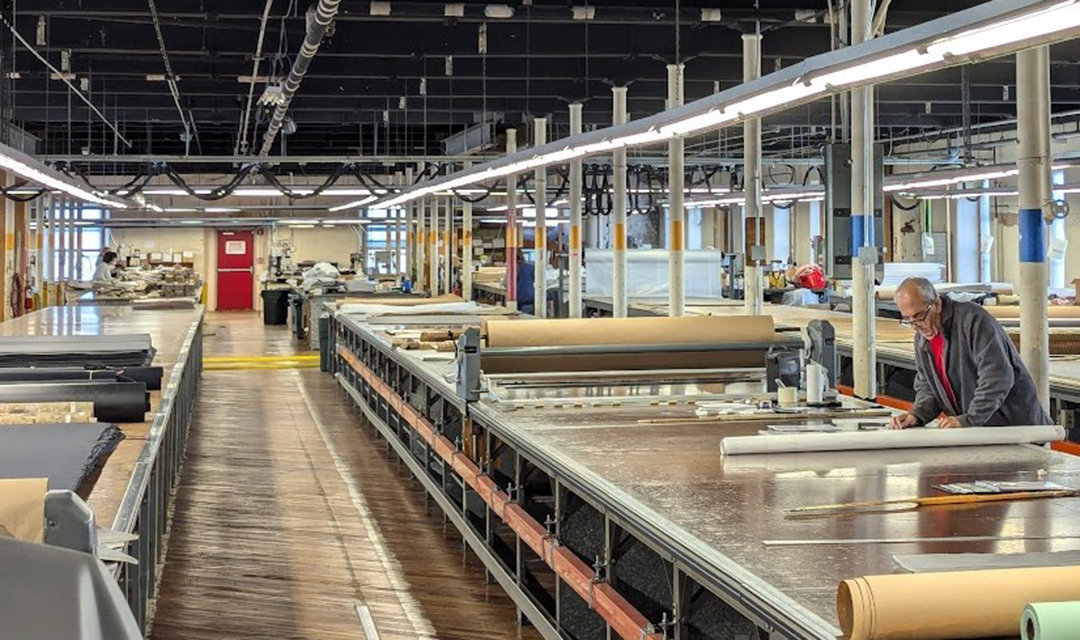
In Falls River, Massachusetts, a textile manufacturing company established nearly 200 years ago is championing “Made in the USA” by embracing the advanced manufacturing technology the U.S. needs to regain competitive advantage.
Charlie Merrow, CEO and 8th generation family member of the Merrow Manufacturing company, is collaborating with Pingbo Tang to optimize his company’s production lines.
“Factories aren’t relics. They’re extensions of the lab,” said Merrow. “When we connect research, universities, commercial problems, and production—we accelerate progress.”
In October 2024, a team of Carnegie Mellon University engineers and scientists led by Tang visited Merrow’s 300,000-square-foot facility to model their production processes with limited data. Their goal was to support business decision-making for using automation to scale up their manufacturing lines. The team visited the factory again in December 2025 to continue integrating human intelligence with artificial intelligence (AI). This was based on the previous work that has already helped the company identify opportunities to achieve a potential three-fold increase in their output of T-shirts they produce for the U.S. military.
Tang, an associate professor of civil and environmental engineering, focuses on human interactions with autonomous machines in airports, nuclear power plants, transportation, and construction systems, as well as manufacturing-related research.
In 2021, Tang received seed funding from Carnegie Mellon’s Manufacturing Futures Institute to study how enhancing human-machine collaboration could reduce waste in the manufacture of customized modular housing components, a process that requires frequent changeovers of equipment and production lines.
His team used digital twin technology to train computers to automatically diagnose human-in-the-loop (HITL) production histories reconstructed from field notes, videos of workers, and control system logs of production lines.
Researchers integrated intuitive human expertise, such as how materials behave and machines perform, with advanced machine learning techniques that used the data derived from actual human interactions. Tang’s team was then able to generate plans for safely and efficiently reconfiguring production lines that could accommodate the production of new products without building new lines.
In 2024, Tang received funding from the Manufacturing PA Innovation program to employ a similar human-machine teaming approach to identify and resolve time and resource waste associated with small orders of customized building products for Module, a sustainable modular home manufacturer, and DMI Companies, which provides ventilation ductwork for commercial and residential buildings.
By collecting waste-generation scenarios from four ductwork and connector production lines operated by workers, the researchers used simulations and data analytics to identify ways to reduce the waste of the costly materials used in making the ductwork.
Compelled to dig deeper, Tang is scrutinizing how human behavior informs AI. “Why is one worker better at a task than another?” he asks. “When we can more proactively observe and capture their historical behavior, we can organize that data and use AI to identify the optimal behavior.”
Tang is also working with DMI Companies to conduct human behavior analysis to determine better methods for training workers on a newly commissioned piece of equipment. Tang and his team analyzed the verbal exchanges between the trainers and users, video capture of their interactions, and biometric data of the participants to find better ways to convey how to set up and use the new equipment.
In this case, researchers are trying to determine which training methods and communication styles are most effective to standardize and optimize how workers can gain new skills.
When we connect research, universities, commercial problems, and production—we accelerate progress.
Charlie Merrow, CEO, Merrow Manufacturing company
Tang is pleased with the potential that digital twin technology has to solve manufacturing problems for both hard and soft production, in single-worker and team scenarios, and by using multiple modes of data collection. He is especially interested in expanding the use of audio, human biometric and behavioral data, in addition to the more commonly used video capture. However, for audio and human behavioral data, as well as subsequent communication, to be most valuable, there must be a unifying language. Researchers must identify and consistently use keywords to ensure that the underlying information related to a machine’s operation and performance is clearly defined.
As an educator, Tang likens the challenge and opportunity to the technique an individual professor might use to show his students how to solve a problem. If you were able to observe, classify, and assess the techniques used by a multitude of professors, you could more readily identify the optimal technique from the behaviors of many people by spotting problems, troubleshooting, and developing better methods. The same results can be achieved for optimizing production lines and similar engineered systems.
AI has the power to make such discoveries from human and machine behavioral data, but only if researchers can eliminate ambiguity in the multimodal data. He hopes to conduct more research on how to standardize observation data to ensure the most reliable and accurate results.
The return visit to Merrow provided Tang and collaborators from Carnegie Mellon and the Advanced Robotics for Manufacturing (ARM) Institute with the opportunity to advance their efforts to analyze and improve production by installing additional sensors, including those capable of gathering visual, vibration, and electricity consumption data that can potentially automate the machine and human state analysis for predictive management of downtimes and worker performance.
The goals of their work are to develop methods that optimize production of an existing system, replicate those methods for use throughout a facility, and predict performance that can justify investment in new levels of automation.
Those goals resonate with Merrow, who believes, “Made in the USA isn’t a premium. It’s a competitive advantage.”