
Freestanding 3D MXene structures push the limits of microscale devices
Rahul Panat has developed a single-step printing technique that transforms atomically thin MXene nanosheets into intricate, freestanding structures. The breakthrough paves the way for powerful, miniaturized energy storage devices and next-generation electronics.
In a breakthrough that could power next-generation electronics, sensors, and energy storage devices, CMU engineers have developed a fabrication technique that arranges MXene nanosheets, each a million times thinner than a sheet of paper, into complex 3D structures in just a single printing step.
“A 3D arrangement of this 2D nanomaterial can help us reach the performance requirements for miniaturized electronic devices like microsupercapacitors and batteries.” said Rahul Panat, lead author of the research published in Small.
MXenes’ outstanding mechanical strength and superior electrochemical stability have captivated researchers for more than a decade. However, their impressive properties alone are not enough to create high-performance devices. The material’s architecture plays a crucial role by governing how efficiently ions and electrons move through an electrode. Without a carefully designed structure, even the most advanced MXenes can run into bottlenecks and barriers.


In previous work, Panat, a professor of mechanical engineering, demonstrated the ability to arrange 2D MXene into 3D structures with the support of a ceramic backbone. Now, Panat’s group has advanced the technique by creating freestanding 3D structures.
By transforming MXene nanosheets into a fully additive-free ink, the team was able to print intricate designs using Aerosol Jet Printing (AJP). To form the ink, the researchers harness the natural evaporation of micron-sized aerosol droplets containing 2D MXene nanosheets. The ink is then precisely directed using aerodynamic control. By leveraging secondary interactions between the nanosheets, the researchers can guide the assembly of complex 3D structures.
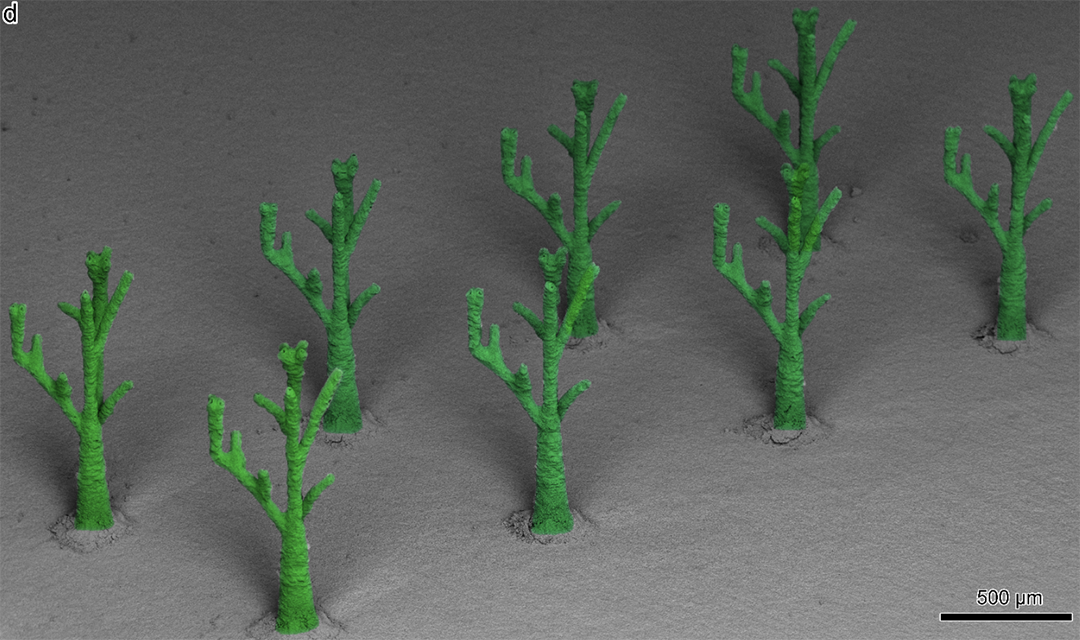
Using this process, the team printed delicately curved petals arranged on a stem to form a microflower, as well as tree-like structures that together create a microforest. They also showcased fine control in 2D by printing complex patterns such as the Carnegie Mellon University logo and a portrait of founder, Andrew Carnegie.
‘These structures are significant because they allow us to translate the exceptional properties of MXenes into practical, high-performance devices at the microscale,” said Panat.
Fabricating these previously unattainable structures is exciting because they can benefit everything from miniature wearable devices to microrobots and batteries.
Rahul Panat, Professor, Mechanical Engineering
To demonstrate the practical impact of this technique, Panat’s lab fabricated an ultrahigh-performance 3D microsupercapacitor. It delivered a record areal capacitance (the electric capacitance per unit of surface area) of 375 mF cm-2 and an area energy density of. 11.04 𝜇Wh cm-2, which far exceeds that of microsupercapacitors made by other high-resolution methods.
“This is the first time additive-free 2D nanomaterials have been assembled into freestanding 3D structures without support structures or post-processing,” Panat said. “Fabricating these previously unattainable structures is exciting because they can benefit everything from miniature wearable devices to microrobots, and batteries.”