Researching a hot topic
Undergraduate research programs give mechanical engineering student the opportunity to help investigate thermal behavior effects in wire arc additive manufacturing.
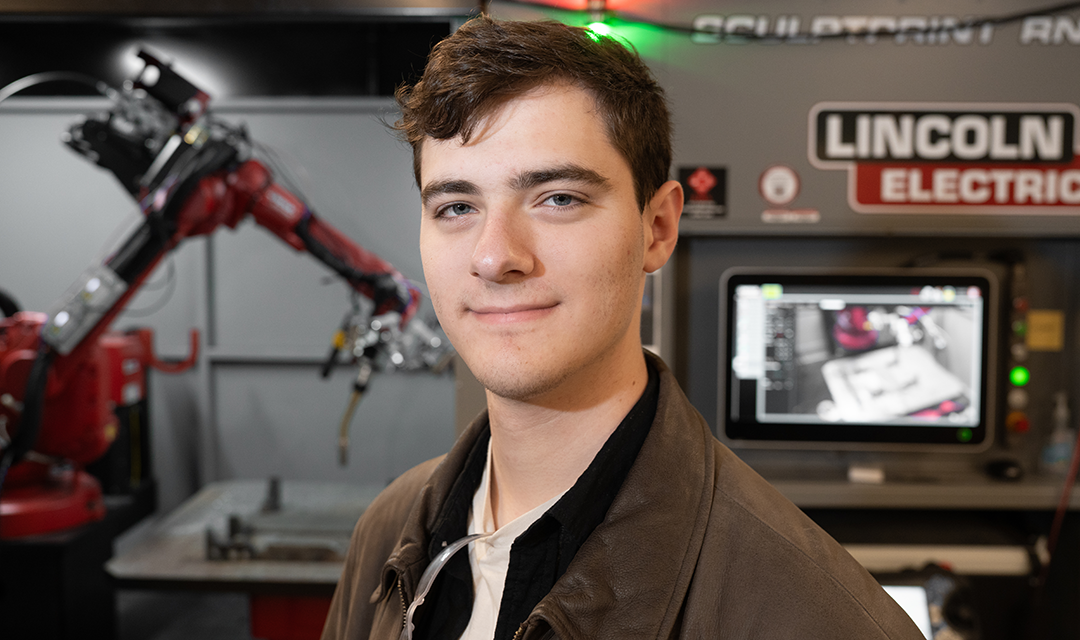
River Sepinuck has found a way to combine his long-time interest in 3D printing with his future career ambitions in industrial robotics. The mechanical engineering junior indulges both as a member of Sneha Prabha Narra’s research team.
Narra is an assistant professor of mechanical engineering. A key area of her work is wire arc additive manufacturing (WAAM), which is a 3D printing process that uses a robotic arm to move a welding torch that melts metal wire feedstock with an electric arc heating source. WAAM is capable of producing metal parts that are significantly larger than those produced using powder-based additive manufacturing methods.
Sepinuck used the Highway to Undergraduate Research in the Academic Year (HURAY) program to find his way onto Narra’s team, where he worked under the direction of Gala Solis, a doctoral student in mechanical engineering. Solis studies WAAM process monitoring using thermal imaging with commercial-grade cameras and a ratiometric method to measure accurate real-time temperatures while eliminating the dependence on emissivity. Monitoring these temperatures is critical for process control, ensuring the quality, consistency, and integrity of the metal parts being built.

After completing his initial training on the equipment and developing an “all-in-one” user interface for recording real-time data, Sepinuck took on the challenge of improving the thermal data acquisition process used by Solis to measure melt pool temperatures. He designed a photodiode-based trigger device with an Arduino controller that synchronized camera recording with the welding arc. This system filtered out oversaturated frames caused by bright arc light, making sure that only valid images were captured.
“The device he made has been really helpful in my work,” said Solis.
The device he made has been really helpful in my work.
Gala Solis, Ph.D. student, Mechanical Engineering
She was confident that the approach could be easily adapted for other welding systems and shared the device concept with NASA during her internship there this past summer. Solis added that “the availability of microelectronic components near the WAAM work area at Mill 19 allows undergraduates like Sepinuck to freely experiment and prototype new ideas.”
Sepinuck had the opportunity to continue working on the WAAM through the Summer Undergraduate Research Apprenticeship (SURA) where he spent the summer simulating the temperature buildup of 3D metal parts that is key to understanding internal stress, distortion, poor surface finish, and microstructural defects. He used the ANSYS Additive library to run simulations that can help inform how to control heat through optimized parameters to produce high-quality prints.
Mikhail Khrenov, the mechanical engineering doctoral student who oversaw Sepinuck’s work last summer, appreciates how valuable research opportunities are for undergraduates.
“The big thing for them is the exposure they get to more specific technical topics,” said Khrenov, who added that “it expands the more fundamental education they get in their undergraduate classes."
The big thing for them is the exposure they get to more specific technical topics.
Mikhail Khrenov, Ph.D. student, Mechanical Engineering
But according to Sepinuck it works both ways. He says that participating in research has also helped him in his course work to better understand heat transfer and thermodynamics.
This semester, Sepinuck is working on a project with U.S. Steel in which researchers are trying to determine if key components with longer lead times can instead be made with WAAM.
Doing so involves identify printing parameters to get good weld quality, extending the parameters to 3D parts, and testing the material in collaboration with the Department of Materials Science and Engineering.
Sepinuck is testing various weld speeds, wire feed rates, and the timing between each printing layer and then examining their quality in order to identify which parameters might be used to print scale size models to stress test.
He hasn’t yet decided on whether to pursue a master’s degree or a job working with industrial robots, but he does know that these research opportunities have helped prepare him to succeed in either.