Sky’s the limit: Taking autonomous flight to new heights
Marcel Bergerman (ECE 1996) and his company Near Earth Autonomy are making un-crewed flight a reality, creating new possibilities in cargo transport and aerial inspection.
Stepping into the offices of Near Earth Autonomy is a bit like stepping into a robotics exhibit at a science center. Various modules, sensors, and technologies line the wall, proudly displayed in the order they were developed, like a hall of fame for autonomous flight.

Marcel Bergerman
The COO of Near Earth Autonomy, Marcel Bergerman (ECE 1996), walks down the line, telling the story of each project and its place in the company’s history. Since 2012, the company has been building and testing autonomous flight technologies for un-crewed cargo transport and aerial inspection. Near Earth Autonomy is creating systems capable of navigating complex terrain like disaster areas and combat zones to deliver supplies and other cargo, as well as perform automated inspection of airplanes, buildings, tunnels, and other infrastructure.
Bergerman’s excitement for the work is palpable. But it is not where he expected to be as a young student at Universidade de São Paulo in Brazil.
“This was absolutely not the plan. I grew up thinking I would be a professor, and so my path was clear,” said Bergerman. In his experience in Brazil, most people with Ph.D.s stayed in academia to teach or do research. “CMU completely changed that for me.”
Following his master’s degree program, Bergerman came to Carnegie Mellon to pursue his Ph.D. in electrical and computer engineering. His first advisor was former College of Engineering Dean Pradeep Khosla, and among Khosla’s other students, Bergerman started to notice a pattern.
“It seemed most people who got Ph.D.s at CMU were not going to universities to research and teach; it seemed most were going to industry to pursue innovation and create new technologies that turn into products,” he said. His interest in innovation was piqued and only grew during his years as a Ph.D. researcher.
Source: Marcel Bergerman
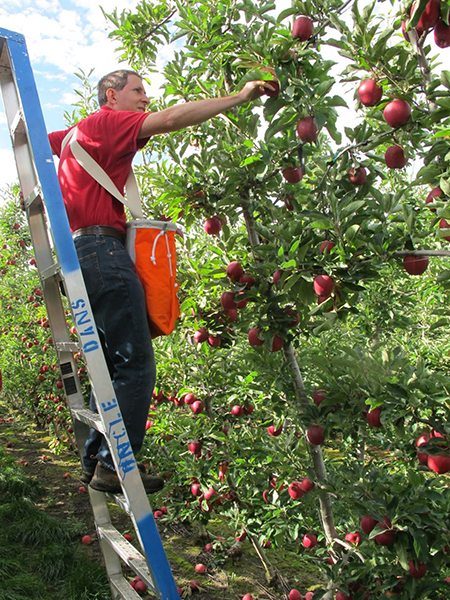
Marcel Bergerman (ECE 1996) picking apples in a commercial orchard. Understanding the challenges of a job is an important first step toward creating technologies to improve it.
“CMU’s entrepreneurial mindset and culture is genuine. When I was at CMU, people were creating technologies that were ahead of their time,” said Bergerman. “There were things being built at CMU 20-30 years ago that are now being spun out into companies and products.”
Near Earth Autonomy is one such startup. It began as a project between Bergerman, Sanjiv Singh from CMU’s Robotics Institute who is the company’s CEO, as well as CTO Lyle Chamberlain and CMU faculty member Sebastian Scherer.
After finishing his Ph.D., Bergerman spent several years back in Brazil before returning to CMU to work on a NASA contract as a project manager and became reacquainted with Singh. The two had been Ph.D. students at the same time in the 90s—but they didn’t meet in the lab.
“Actually, we met playing volleyball!” said Bergerman. He and his wife, Maria Yamanaka (CEE 1996), joined the Robotics Institute’s intramural volleyball team, which is where they first met Singh. As faculty members, Bergerman and Singh worked on several projects together, eventually winning a contract with the U.S. Navy to work on autonomous aerial cargo and utility systems. That was the start of Near Earth Autonomy.
Bergerman talks about the patience, dedication, and persistence required to innovate and achieve scientific progress, qualities from his days as a Ph.D. researcher that he carries with him in his role as COO.
“When our aircraft goes out and flies successfully and completes its objective, that’s a happy day. When our team comes back from long days in the field and things aren’t working yet, those are harder days,” said Bergerman. “People generally only see the end result of an effort, but those of us who work with innovation know those results don’t happen overnight. Principles are established little by little through design and experimentation. Success takes time.”
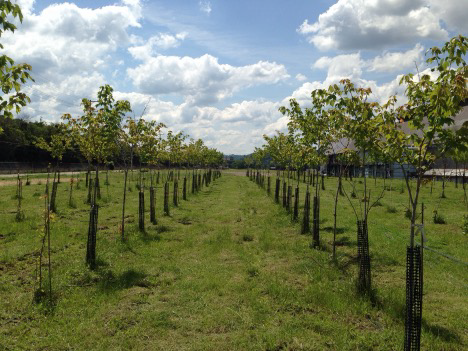
Bergerman is used to things taking time and painstaking effort. During his Ph.D. years, he planted a surrogate orchard near a decommissioned steel mill along the Monongahela River in Pittsburgh, personally digging 300 holes with an auger to plant trees for agricultural robots to navigate around. That site is now Hazelwood Green, home of CMU’s Mill 19 and Robotics Innovation Center.
“We were there 20 years ago, testing robots small and large,” said Bergerman. “Many of the trees we planted are still there.”
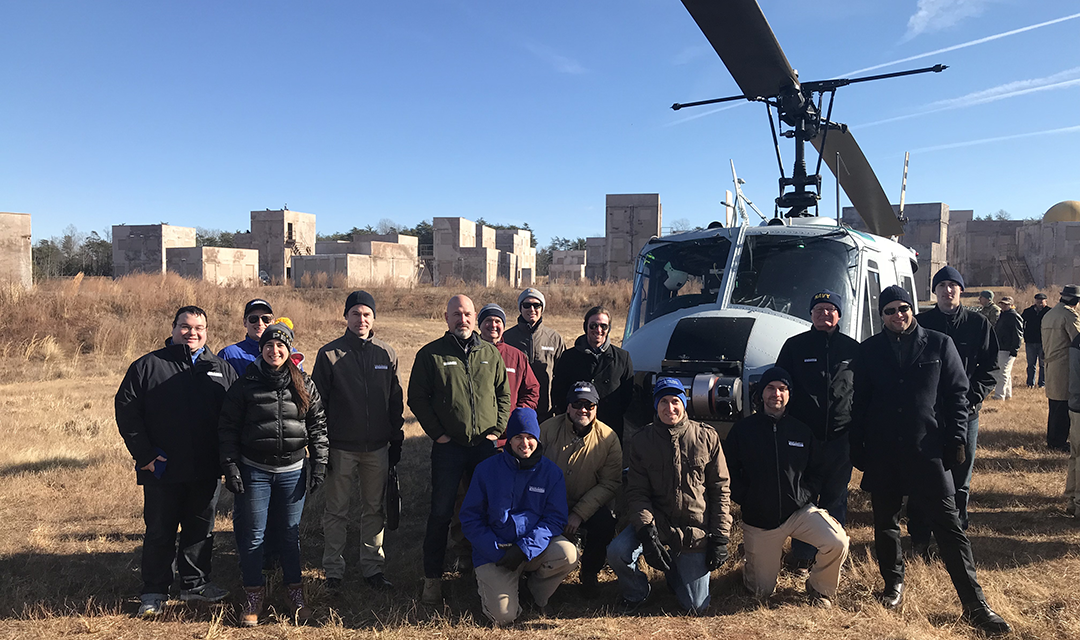
Pictured, top: The Near Earth Autonomy team during a flight test, gathered in front of a helicopter outfit with the company’s autonomous flight technology. (Source: Marcel Bergerman)