Summer of discovery
University fellowship program gives engineering undergrads the opportunity to conduct biomedical research.
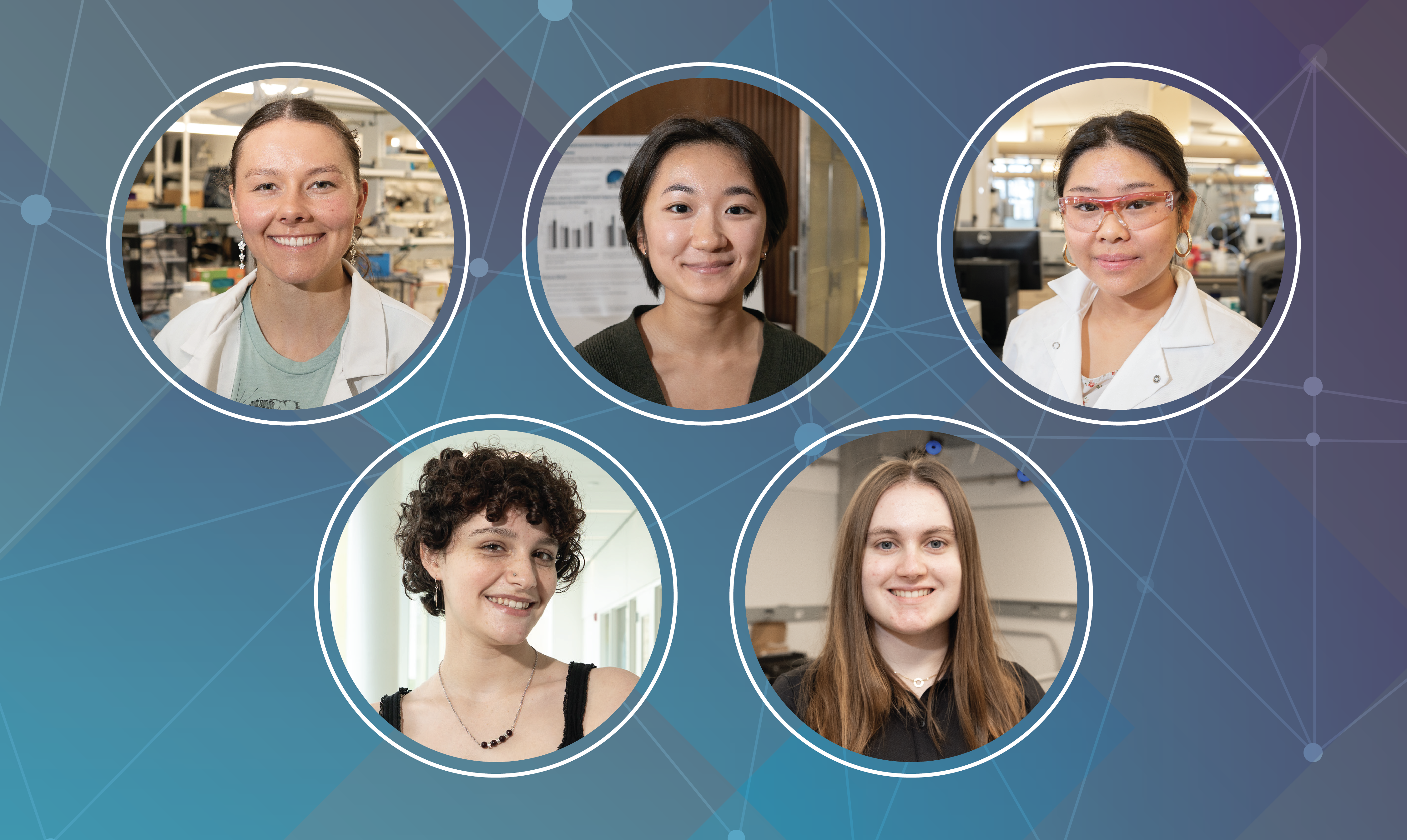
They came to Carnegie Mellon to earn degrees in chemical engineering, mechanical engineering, electrical and computer engineering, and materials science and engineering. But along the way, they were drawn to the biomedical engineering applications of their respective fields.
This past summer, they could be found in labs across campus helping research teams who are developing new medical devices, improving treatment protocols, and working to cure diseases.
These five students were among those who participated in the Summer Undergraduate Research Fellowship (SURF) program that awards participants $4,500 for 8-10 weeks of full-time summer research on campus. And these students would all agree that the SURF program has enriched them in many ways.
Rhea Soo, who came to Carnegie Mellon to earn a degree in electrical and computer engineering, became interested in biomedical engineering (BME) after taking an introductory course with Rosalyn Abbott and later the Biomedical Engineering Systems Modeling and Analysis course with Sossena Wood, assistant professor of biomedical engineering.
She went on to work in Wood’s lab for two semesters and used her SURF fellowship to conduct research with Wood this past summer.
“I am making my own process to create a pipeline of MRI scans of skull images that can be used to identify a potential relationship between skull thickness and the progression of sickle cell disease,” explained Soo.
Such MRI scans, which are more often used to image the brain, require time-consuming manual review and adjustment in order to capture the right information for the skull images. Soo found and has been using Brain Suite, software that can extract the skull images she needs.
In May she submitted an abstract to the Biomedical Engineering Society for the October 2025 conference showing the results of scans of 10 skulls—five with sickle cell disease (SCD) and five healthy skulls used as the control group.
Her work this summer was to expand that research to a sample size of 50 skulls.
There is a painstaking amount of detail in the work. But Soo, who plans to pursue her Ph.D. in bioengineering or biomedical engineering after she graduates in 2026, is grateful for the experience. She is pleased to be working with a professor who has given her the opportunity to work independently, Ph.D. students who have been wonderful mentors, and on research that will benefit her and patients with SCD.
Amber Lo knew that she was most interested in the biomedical side of chemical engineering and that studying ways to fight cancer, which had taken her grandmother, would be especially appealing.
“I had heard good things about Professor Sevenler, and after talking to him about his research, I was fully hooked,” said Lo who joined his lab in early 2025.
Derin Sevenler, assistant professor of chemical engineering, leads a research group developing microfluidic devices, similar to those used to make microelectronic computer chips, for potential gene therapies that can treat diseases such as cancer.
These tiny chip devices can perform a type of surgery on millions of individual cells within seconds by tearing nanoscale holes in their membranes, which can allow biomolecules such as DNA and protein to diffuse into the cells and treat disease at its molecular source.
After spending the spring semester training in the lab and learning how to culture cells and keep them alive, Lo used her SURF fellowship to continue work in the lab during the summer.
She helped to optimize the production of epoxy chips to ensure high volume production and create a high-throughput device that can allow the team to perform surgery on cells more efficiently.
Lo is specifically focused on modifying NK cells, which are the “natural killer” white blood cells that play a crucial role in the body's innate immune system, specifically in fighting infections and cancer. Unlike more commonly used modified T-Cell therapies, NK cells are a safer cancer treatment that produce fewer side effects, which can typically include high fevers, tremors, and seizures.
Lo explains that their method allows for larger amounts of modified cells to be produced in the sample method, which has the potential to lower the cost of cancer therapeutics.
“It’s very exciting to be working in this lab, anticipating the improvements that can be made, all while expanding my view of chemical engineering,” said Lo.
Sofia Warehall knows what it’s like to recover from a sports injury. The figure skater has had meniscus repair surgery twice. She is a mechanical engineering and German studies junior whose personal experience contributed to her delight in finding a research opportunity in mechanical engineering professor Eni Halilaj’s lab.
“I had hoped to maybe find research related to prosthetics, but this opportunity was even more in line with what I actually wanted to do,” said Warehall.
Halilaj, associate professor of mechanical engineering, leads the Musculoskeletal Biomechanics Lab to study ways to better understand biomechanics and integrate insights from experimental and computational work to develop effective rehabilitation strategies for those who have had ACL reconstruction surgery.
Warehall scheduled and attended MRI appointments with the young study participants and attended their sessions in the motion capture lab where infrared cameras are used to track body markers that record gait analysis. These analyses can be used to improve outcomes for as many as 50% of patients who can expect to develop osteoarthritis early in life.
She is also training a computer model to automatically label the multiple markers that are currently being manually tracked and labelled—a process that can take one to two hours per patient. Once the data is labelled, it needs to be scaled or matched to the patient’s actual bone structure, which is another manual labor-intensive process. Warehall also compared those manually obtained results to determine the accuracy of those produced by recently developed software that can automatically conduct the scaling process.
After spending the past spring semester being introduced to the lab, Warehall is grateful for the SURF grant that allowed her to get so much more involved in the lab over the summer.
Thea Spellmeyer was looking for experience in a wet lab after having completed what was mostly computer work constructing 3D models of tibiofemoral cartilage in the lab of Axel Moore, assistant professor of biomedical engineering, last summer. She used the Summer Undergraduate Research Fellowship grant to work with Phil Campbell, who she first met while taking his physiology course, one of her favorite classes.
“Learning how the body works is super fascinating,” she says. “The human body is amazing, and there is still so much more to discover.”
Campbell, professor of biomedical engineering, develops unique solutions to a wide variety of complex biomedical problems, including the development of natural-based biomaterials and tissue engineering, is committed to training the next generation of engineers and scientists.
Spellmeyer worked under the tutelage of Ph.D. student Nader Rezazadeh on a project to study the potential use of ultrafine fibers made of soybean protein as a wound dressing. The ultrafine fibers are created by electrospinning, a process that can create micro to nanoscale fibers by using an electric field to draw a polymer solution into thin filaments.
The premise is that the wound healing process can be enhanced with growth factors found in extracellular versicles, the nano-sized vesicles released by cells that play a critical role in cell-to-cell communication and influence the behavior of recipient cells.
Spellmeyer collected EVs from cultured cells that are added to soy polymer solutions, which are then electrospun into films to promote the type of cell growth that can accelerate healing. She also explored different sterilization methods to keep the films clean and free of contamination.
The hands-on experience added a new and enriching dimension to her ambition to work in genetic engineering or bioinstrumentation.
Caroline Vernon knew from an unusually young age that she wanted to work on artificial organs. She also knew she wanted to come to Carnegie Mellon to study biomedical engineering. And she then chose materials science and engineering as her primary major because of its applications in biomaterials.
“Making human anatomy from scratch is really cool to me,” said Vernon.
Her experience working in Adam Feinberg’s lab in the spring semester wasn’t her first lab experience; she had already conducted research while still in high school at Johns Hopkins University.
She used her SURF fellowship to expand her work with Feinberg, professor of biomedical engineering and materials science and engineering, whose research is focused on replacing human heart transplants by repairing or replacing damaged heart tissue with new 3D printed tissue.
Feinberg’s FRESH bioprinting technology enables fully biologic systems to be printed and developed by creating models of human anatomy made of collagen, a major building block of human tissue.
The process of injecting bioink and collagen into the gelatin bath requires high levels of precision in order for the team of doctoral students on the project to be able to identify and analyze their structure, distribution, and chemical composition. Vernon specifically worked on staining procedures that enhance the contrast in microscopic images of biological tissues or cells. These results allow for adjustments of the 3D prints to function more successfully in the body.
Vernon also had the opportunity to learn Feinberg’s FRESH bioprinting technology by attending the annual workshop that introduces participants to 3D printing of soft and biological materials and teaches them how to build their own open-source 3D bioprinting platform.
The opportunity Feinberg gives to students in both his lab and workshops demonstrate his belief in the importance of team-based science to developing technology and expanding its development with those who will further it in their own careers.