
Modern manufacturing cheat codes
Lynn Michelangelo
Jun 26, 2026
A small group of Carnegie Mellon students who graduated this spring with master’s degrees in mechanical engineering will be equipped with a unique toolkit that few, if any others, in their new workplaces will likely possess. The skillset they acquired in the new Application of AI and ML Methods for Modern Manufacturing course will also be of tremendous benefit to those who want to start their own companies.
Rahul Panat, professor of mechanical engineering, has developed a crash course in how to deploy computational methods for manufacturing that not long ago would have required more time, greater expense, and skilled computer scientists.
Recent developments in artificial intelligence (AI) and machine learning (ML) software and online platforms have dramatically lowered the barrier for using advanced computer vision techniques, large language models (LLMs), and generative design for advanced manufacturing applications.
AI is like a tiger: if you don’t learn to ride it, it will trample you. I want my students to master AI applications in mechanical engineering so they come out ahead.
Rahul Panat, Mechanical Engineering Professor and Associate Director of Research for MFI
“I teach my students that AI is like a tiger: if you don’t learn to ride it, it will trample you. I want my students to master AI applications in mechanical engineering so they come out ahead,” said Panat, who left a decade-long career at Intel as an R&D engineer to join CMU as a professor and associate director of research for the Manufacturing Futures Institute.
He began the course with a comprehensive review of traditional manufacturing processes, which Panat says is sometimes overlooked in engineering curriculums. He then gave the students a high-level overview of the AI and ML methods they would employ in a series of four project assignments.
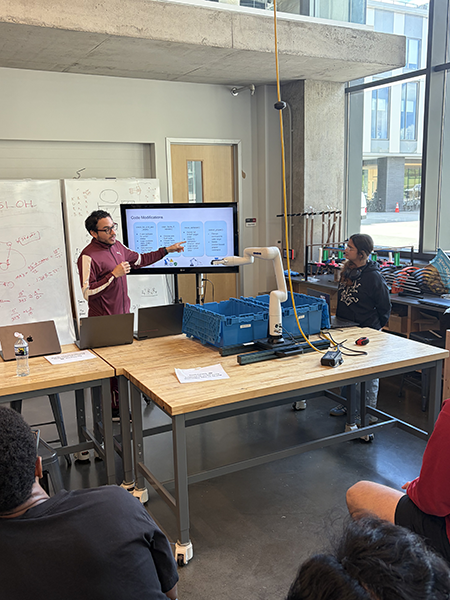
Rahul Panat’s students demonstrate the robotic action that they programmed.
In the first project, student teams developed an automated defect-detection system by training images of manufactured goods using a YOLO (You Only Look Once) off-the-shelf real-time computer vision model that could detect, segment, and classify objects. Using online data sets of thousands of images of 3D printed parts, students trained the model to detect various types of defects. The students were then able to use their models to successfully identify stringing, warping, and other defects in actual parts.
Ryan Kiachian, who will join Space X as a supply development engineer, happily reported that, “In my job interview at SpaceX, I talked about the work we did in the first project, and, well, I got the job!”
In my job interview at SpaceX, I talked about the work we did in the first project, and well, I got the job!
Ryan Kiachian, 2026 mechanical engineering master’s graduate
That initial project has given another student, Emmanuel George, two exciting opportunities to choose from. George, who earned his master’s degrees in mechanical engineering and engineering and technology innovation management this spring, enrolled in the course because he was eager to learn more about manufacturing after having spent the past summer working as an engineering program manager intern on the iPad team at Apple.
“I will hopefully have to decide between either a potential job offer from Apple and an offer of funding from a startup accelerator to launch a startup that can deliver AI monitored defect-detection and in-situ remediation solutions like those taught in the second project of the course,” explained George.
The students’ second project was to use a low-code agentic AI framework to control an additive manufacturing process. Such open-source platforms use LLMs to create an architecture of AI “agents” that can reason, plan steps, execute, observe, iterate, and communicate with one another with minimal need for writing code.
“AI is not replacing us, but we can make good practical use of it with less need for coding,” said Chirag Satpathy, who will earn his master’s degree in mechanical engineering and engineering and public policy this spring.
He looks forward to using what he has learned in the course when he joins General Wire Springs, a 95-year-old family run business, after graduation.
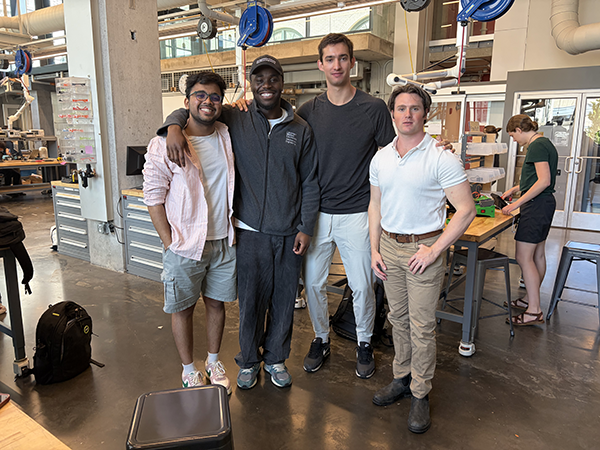
Students in Rahul Panat’s Application of AI and ML Methods for Modern Manufacturing course (left to right): Chirag Satpathy, Emmanuel George, Ryan Kiachian, and Jesse Barkley
For the third project, students used AI chatbots to describe and design small metal parts that they made using the Haas 5-axis CNC machine at MFI’s Mill 19 facility. The computer-controlled manufacturing equipment can move a cutting tool along five different axes to produce complex shapes with high precision.
Jesse Barkley, who will earn his masters in AI engineering/mechanical engineering as part of the U.S. Army AI integration program, will return to active duty when he graduates.
“As an AI engineer, this course provided me with hands-on projects that showed how AI can work in real time,” said Barkely. “I will leave CMU ready to deploy in the way an employer would expect.”
For the fourth and final project, the assignment was to use a robotics simulator to guide actual robot action on a six-axis robot arm. The students used an LLM to generate and reason about the code that would guide the robot’s actions.
“AI is about to replace coding in the same way that CAD replaced drafting tables,” said George, who believes the new special topics course was the best one he has taken at CMU. “AI-driven technology is advancing so fast that what we learned in this course is not commonly known or used in industry.”