Students tackle energy and climate challenges at Hackathon
Nicole Rihn
Nov 12, 2026
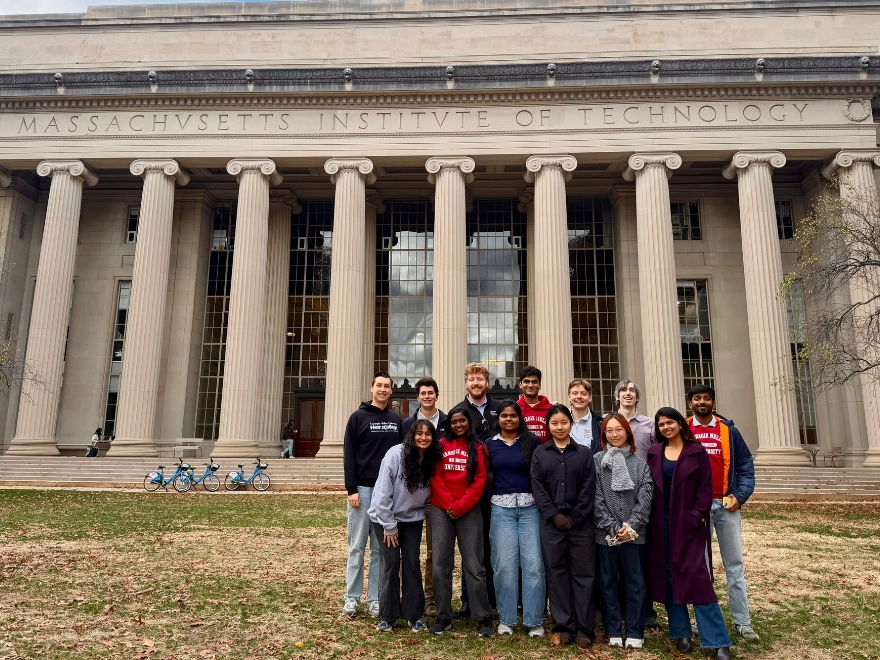
Fourteen students from Carnegie Mellon University participated in the 2026 MIT Energy and Climate Hackathon, held November 6–8 in Cambridge, Massachusetts. Supported by CMU’s Wilton E. Scott Institute for Energy Innovation, the students took on industry-driven challenges spanning energy technology, water resources, and climate finance.
The CMU contingent brought together students from the Energy Science, Technology and Policy (ESTP) program, Heinz College of Information Systems and Public Policy, and Human-Computer Interaction (HCI). With backgrounds ranging from mechanical, environmental and civil engineering to software development, project management, and policy, the group reflected the interdisciplinary expertise needed to address today’s energy challenges.
The hackathon featured problem statements ranging from heat pumps and battery management to desalination and climate finance. Each represented a different dimension of the energy transition and climate adaptation, where technological innovation must work alongside economic, environmental, and policy considerations. With just 36 hours to turn ideas into tangible solutions, four CMU teams developed tools addressing distinct real-world challenges.
MIT’s classrooms became hubs of activity, with whiteboards covered in calculations, ideas taking shape over coffee, and teams working late into the night. Against the backdrop of a rainy Cambridge weekend, students refined their prototypes, recorded demonstrations, and prepared their final pitches.
The group of participating CMU students included: Mayank Dixit, Dharunya Sundararajan, Matteo Perillo, Seamus Meagher, Anvesha Yadav, Sharvi Shah, Pranav Bhosale, Vinitha Palani, Henk Ufkes, and Patrick O'Toole from ESTP; Stuti Garg, Cassie Li, and Mary Zhang from the School of Architecture; and Gavin Loyd and Tanvir Kabir from Heinz College.
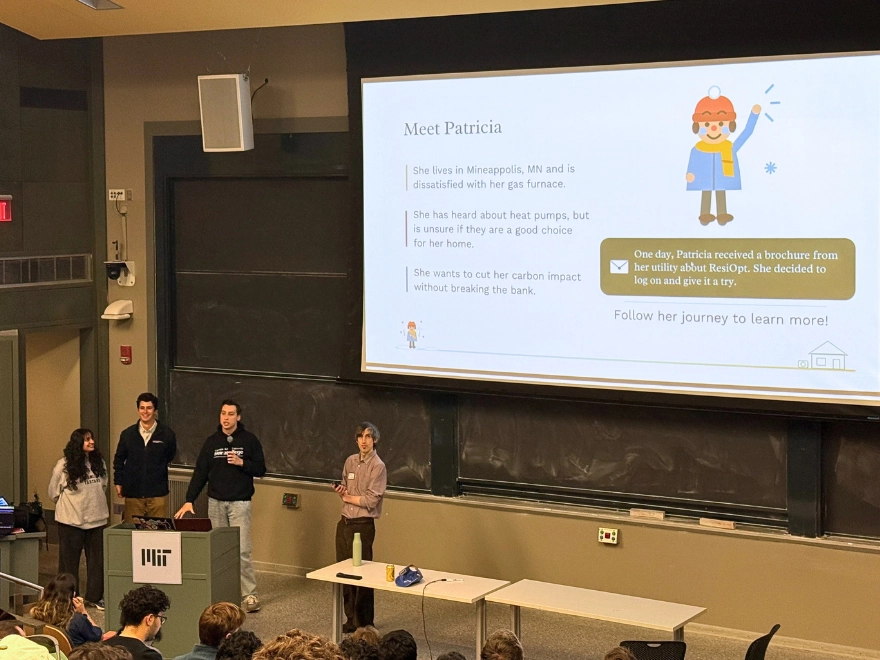
One group presents their project at this year's hackathon.
One team developed a climate-finance tool to help banks and lenders monitor agricultural loans after disbursement, improving visibility into climate-related risks and potential repayment challenges. Another created a location-based tool to explore freshwater availability and relevant policies for siting desalination across different regions, supporting more informed water-resource decisions.
A highlight of the weekend was CMU’s team working on the heat pump challenge, advancing to the finals among 14 participating teams in the Comsol sponsored track. The team developed a tool designed to help homeowners evaluate heat-pump sizing and estimated costs based on their home’s characteristics and emissions goals. Their presentation followed a fictional homeowner navigating the process of selecting a heat pump, bringing a relatable, human perspective to a complex technical challenge.
Beyond the solutions themselves, the hackathon tested the students’ ability to collaborate, think critically, and make decisions under tight deadlines. Participants ventured beyond familiar disciplines, drawing on one another’s strengths while balancing ambitious ideas with practical constraints.
As the 36-hour sprint concluded, the CMU teams returned to Pittsburgh with four developed concepts and a shared sense of accomplishment after a weekend of intense collaboration and creative problem-solving. The experience reflected CMU’s commitment to learning beyond disciplinary boundaries. For the students, it was an opportunity to discover how different perspectives, brought together around a common challenge, could turn ambitious ideas into tangible solutions.