
Overview
The Ozdoganlar Lab develops functional porous material systems in which engineered hierarchical porosity serves as a scaffold to create high-performance electrodes and reactive media. A signature direction is the 3D assembly of 2D/nanoscale conductors (e.g., MXenes; extendable to CNTs/graphene) within porous ceramic backbones to achieve mechanically robust, permeable, and electrically conductive architectures for electrochemical and mass-transport–limited applications.
This work is a collaboration with the Panat Lab @ CMU.
Our approach
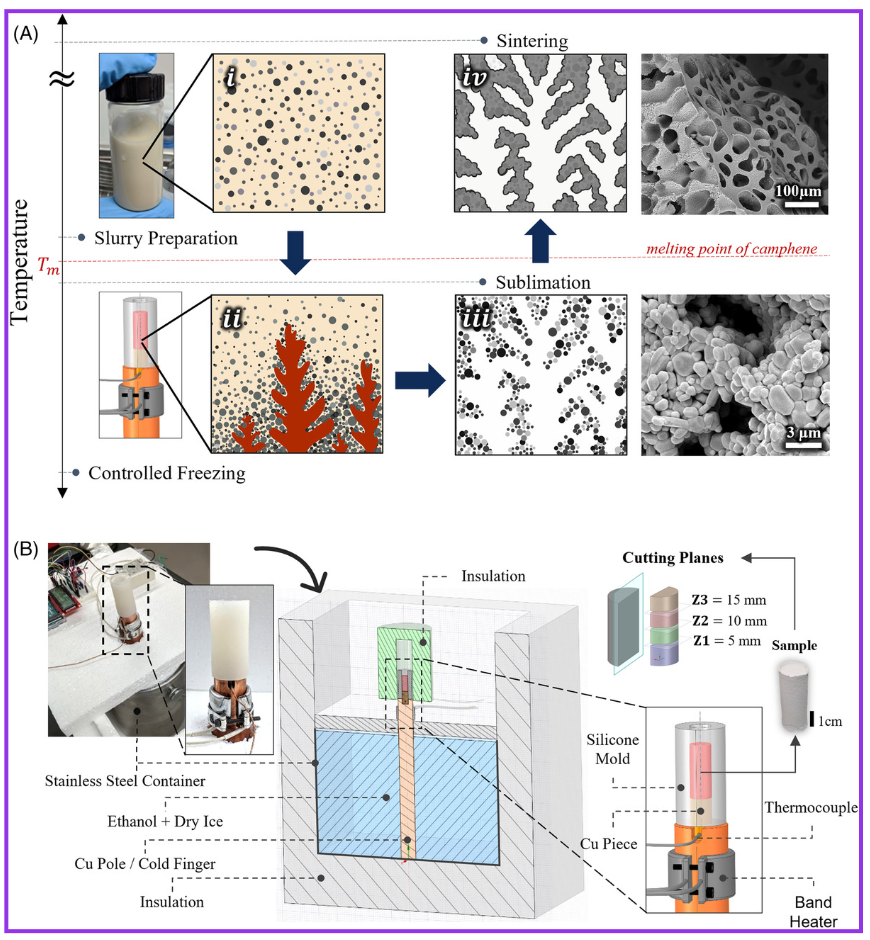
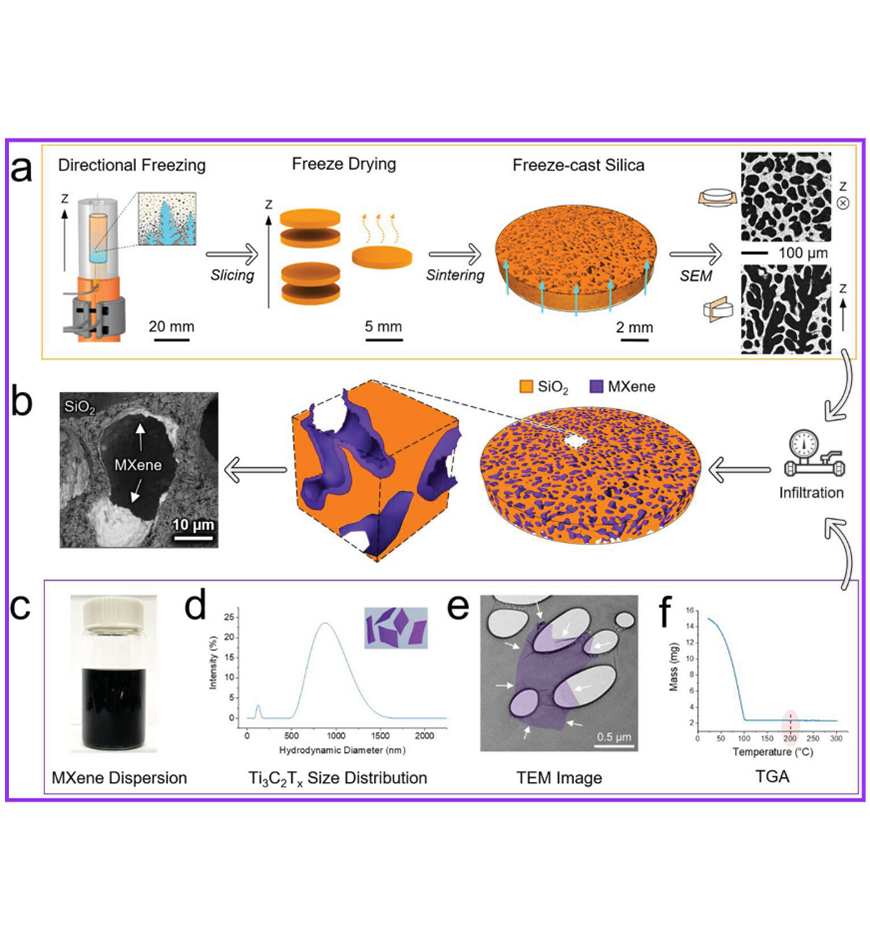
We use freeze casting to create directional, open, controllable porosity in ceramics, then use infiltration/coating strategies to assemble conductive networks (e.g., MXene) conformally along internal pore surfaces while preserving permeability, enabling tunable conductivity and electrochemical performance without clogging transport pathways.
Why it matters
Many electrochemical and transport-limited systems are constrained by:
- Transport limits (permeability, tortuosity, pore accessibility) that reduce active-material utilization area
- Restacking/packing of 2D materials that blocks penetration and lower accessible surface
- Mechanical fragility of standalone porous conductors, limiting handling and integration
Key research thrusts
- Freeze-cast ceramics and metals with tunable hierarchical/directional porosity
- 3D assembly of MXene/CNT/graphene-class networks on porous backbones to reduce restacking and increase utilization
- Porous electrodes with anisotropic conductivity
- Permeable functional media for coupled transport and reaction
Sample projects
- 3D Assembly of MXene Networks Using a Porous Ceramic Backbone (MX-PS): Freeze-cast porous silica followed by capillary infiltration of Ti₃C₂Tₓ MXene to form conformal networks on internal pore surfaces while preserving permeability; demonstrated tunable conductivity/capacitance and supercapacitor device integration. [1]
- Fabrication of Porous Ceramics with Controlled Porosity: Freeze-casting–based routes to program pore size, orientation, connectivity, permeability, and mechanical performance in silica/alumina-class ceramics. [2]
- Freeze-cast Alumina for High-temperature Gas Permeability (Microstructure-to-Performance): Links freeze-casting parameters and pore architecture to high-temperature gas transport performance in alumina-based porous ceramics.
Methods and capabilities
- Freeze casting of ceramics to create hierarchical/directional porosity
- Infiltration/coating to assemble internal conductive networks (e.g., MXene) without clogging
- Porosity and transport characterization (permeability/tortuosity and pore metrics as appropriate)
- Mechanical and microstructural validation (e.g., SEM/EDX mapping, compression tests)
- Electrode/device evaluation (conductivity anisotropy; electrochemical testing)
Applications
- Energy storage electrodes (e.g., supercapacitors) with high utilization and permeability
- Permeable functional electrodes/reactors where mass transport dominates performance
- Generalizable 3D assembly for other nanoscale conductors and backbone materials
References
- M. Arslanoglu, B. Yuan, R. Panat, and O. B. Ozdoganlar, “3D Assembly of MXene Networks using a Ceramic Backbone with Controlled Porosity,” Adv. Mater., vol. 35, no. 51, p. 2304757, 2023, doi: 10.1002/adma.202304757.
- M. Arslanoglu, O. B. Ozdoganlar, and R. Panat, “Fabrication of porous silica with controllable and tunable porosity via freeze casting,” J. Am. Ceram. Soc., vol. 105, no. 8, pp. 5114–5130, 2022, doi: 10.1111/jace.18503.