
Overview
The Ozdoganlar Lab develops next-generation microneedle systems that enable painless, precise, minimally invasive delivery and sampling through skin. Our platforms span dissolvable microneedle arrays (dMNAs) for intradermal/transdermal delivery of biologics, hybrid through-hole MNAs for higher-capacity delivery without requiring drug incorporation during fabrication, and hollow microneedle arrays for both delivery and collection of minute volumes of blood or interstitial fluid, supporting real-time biomarker monitoring and point-of-care diagnostics. In parallel, we develop programmable DNA-origami nanostructures as delivery platforms for therapeutic proteins and nucleic acids, in collaboration with Rebecca Taylor’s group @ CMU.
Our approach
Unlike formulation-first transdermal strategies, our work is driven by precision manufacturing, microdevice design, and process engineering. We engineer microneedle geometries (e.g., obelisk tips for optimized insertion) and fabrication workflows that:
- Localize cargo where it matters (e.g., tip-loaded delivery for high efficiency and minimal waste)
- Preserve bioactivity through compatible processing and materials
- Enable scalable production (including high-throughput manufacturing concepts)
- Extend beyond delivery to include sampling and sensing (hollow MNAs; skin-integrated biosensing concepts)
Why it matters
Skin is an exceptional interface for therapy and diagnostics. Still, the stratum corneum barrier limits delivery of many therapeutics, especially large biologics, and conventional injections can be painful, dose-inefficient, and systemically exposing. Key bottlenecks we target include:
- Reliable penetration and delivery to epidermal/dermal microenvironments and to the subcutaneous tissue
- Efficient delivery of high-value biologics with preserved function
- Dose efficiency and reduced systemic side effects via localized delivery
- Minimally invasive sampling for diagnostics and monitoring
- Biocompatibility and translation readiness of dissolvable base materials
Key research thrusts
- Dissolvable MNAs for biologics delivery (drugs, vaccines, nucleic acids, gene-therapy payloads, extracellular vesicles)
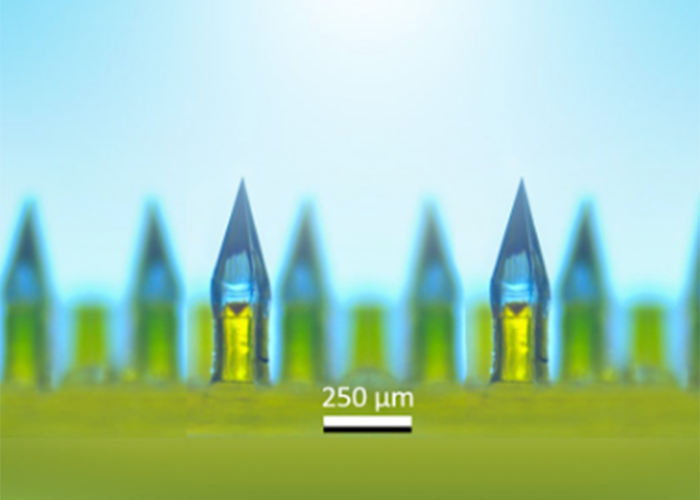
- Tip-loaded MNAs for high-efficiency, localized intradermal delivery with clinically relevant release profiles DNA origami nanostructure platforms for targeted delivery of therapeutic proteins and nucleic acids (a collaboration with the Taylor Lab @ CMU).
- Layer-loaded and large-array MNAs for multi-phase / multi-drug release profiles
- Hybrid through-hole MNAs enabling high-capacity delivery without embedding the drug during fabrication
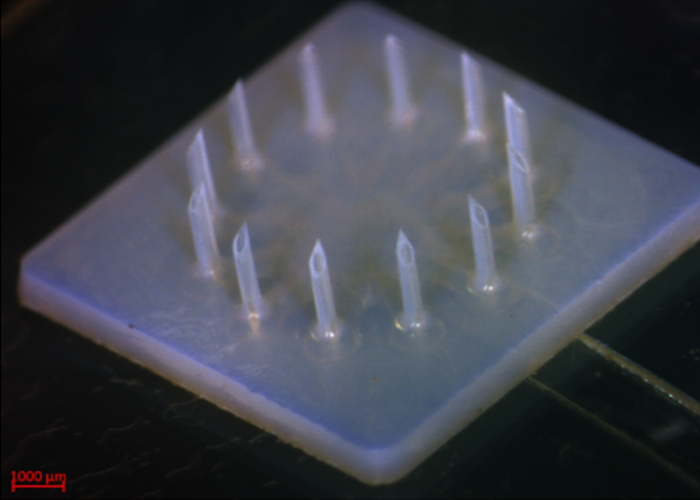
- Hollow MNAs for sampling and delivery, including blood and interstitial fluid collection
- Microneedle-enabled biosensing concepts (skin-integrated sensing approaches for inflammation monitoring)
Sample projects
- Tip-loaded Dissolvable MNAs for Localized Antibody Therapy (anti-TNF-α): Obelisk-shaped, tip-loaded dMNAs fabricated via micromilling, elastomer molding, and two-step molding. Demonstrated delivery into ex vivo human skin, clinically relevant release profiles, and therapeutic reduction of inflammatory biomarkers in vivo. [1], [2], [3], [4]
- Microneedle Delivery of Exosome-Encapsulated Curcumin for Inflammation: A minimally invasive intradermal delivery platform using dMNAs to deliver extracellular vesicle–encapsulated therapeutics for localized anti-inflammatory effects in skin. [5], [6]
- Cytotoxicity and Base-Material Screening for Dissolvable Microneedles: Systematic in vitro cytotoxicity evaluation of carbohydrate-based excipients/polymers used in dissolvable microneedles to support material selection, safety, and translation readiness. [7], [8]
Methods and capabilities
- Precision micromachining for mastermolds and microfeature definition
- Elastomer molding (e.g., PDMS) and casting/centrifugation-based replication
- Scalable microneedle manufacturing concepts (including automation-ready approaches)
- Cargo localization workflows (e.g., centrifuge-driven tip loading; multi-layer casting)
- Bioactivity validation (e.g., binding/functional assays)
- Skin models: benchtop phantoms, ex vivo human skin explants; in vivo testing (as appropriate)
- Biocompatibility assessment (in-house wet lab): systematic cytotoxicity testing of candidate dissolvable polymers
- DNA-origami nanostructure design/assembly for programmable cargo presentation (in collaboration with Rebecca Taylor’s group
Applications
- Localized treatment of inflammatory skin disease with reduced systemic exposure
- Intradermal/transdermal delivery of vaccines and nucleic-acid therapeutics
- High-capacity delivery of large molecules via hybrid MNAs
- Minimally invasive diagnostics and monitoring using hollow MNAs (blood/ISF sampling)
- Skin-integrated sensing platforms for monitoring inflammation and disease biomarkers
References
- G. Erdos, G. Falo, E. Korkmaz, B. Ozdoganlar, and L. D. Falo, “120 Microneedle array delivery of skin targeted adenovector vaccines,” J. Invest. Dermatol., vol. 138, no. 5, p. S20, May 2018, doi: 10.1016/j.jid.2018.03.124.
- E. Korkmaz and O. B. Ozdoganlar, “Dissolvable and Coated Microneedle Arrays: Design, Fabrication, Materials and Administration Methods,” in Microneedling in Clinical Practice, CRC Press, 2020.
- E. Korkmaz et al., “Therapeutic intradermal delivery of tumor necrosis factor-alpha antibodies using tip-loaded dissolvable microneedle arrays,” Acta Biomater., vol. 24, pp. 96–105, Sep. 2015, doi: 10.1016/j.actbio.2015.05.036.
- E. Korkmaz et al., “Tip-Loaded Dissolvable Microneedle Arrays Effectively Deliver Polymer-Conjugated Antibody Inhibitors of Tumor-Necrosis-Factor-Alpha into Human Skin,” J. Pharm. Sci., vol. 105, no. 11, pp. 3453–3457, Nov. 2016, doi: 10.1016/j.xphs.2016.07.008.
- O. B. Ozdoganlar, P. G. Campbell, S. S. Yerneni, and E. P. Yalcintas, “Intradermal Delivery of Extracellular Vesicle-Encapsulated Curcumin Using Dissolvable Microneedle Arrays,” US20230404929A1, Dec. 21, 2023 Accessed: Feb. 25, 2026. [Online].
- S. S. Yerneni, E. P. Yalcintas, J. D. Smith, S. Averick, P. G. Campbell, and O. B. Ozdoganlar, “Skin-targeted delivery of extracellular vesicle-encapsulated curcumin using dissolvable microneedle arrays,” Acta Biomater., vol. 149, pp. 198–212, Sep. 2022, doi: 10.1016/j.actbio.2022.06.046.
- T. D. Y. Kozai et al., “Chronic tissue response to carboxymethyl cellulose based dissolvable insertion needle for ultra-small neural probes,” Biomaterials, vol. 35, no. 34, pp. 9255–9268, Nov. 2014, doi: 10.1016/j.biomaterials.2014.07.039.
- B. Bediz et al., “Dissolvable Microneedle Arrays for Intradermal Delivery of Biologics: Fabrication and Application,” Pharm. Res., vol. 31, no. 1, pp. 117–135, Jan. 2014, doi: 10.1007/s11095-013-1137-x.