
Overview
The Ozdoganlar Lab develops biointegrated device platforms that interface with the body for continuous sensing and closed-loop therapy, spanning implantable, ingestible, and wearable form factors. Our work couples precision micro- and nanomanufacturing with biomaterials, packaging, and system integration to create devices that operate reliably in complex biological environments. A significant emphasis is on high-compliance interfaces and manufacturing-enabled scalability.
Our approach
We design the device architecture, materials stack, and fabrication/assembly processes together so the final system is mechanically compatible with tissue, manufacturable and repeatable, and testable under realistic physiological constraints. This includes enabling insertion/implantation strategies for ultra-compliant devices (e.g., dissolvable shuttles) and scalable fabrication routes for soft/stretchable conductors and patterns.
Why it matters
Biointegrated systems promise continuous, patient-specific monitoring and therapy, but deployment is constrained by:
- Mechanical mismatch, causing inflammation/scarring and performance drift
- Insertion/implantation barriers for compliant microdevices
- Packaging and long-term reliability challenges
- Gaps in scalable manufacturing and integration that block translation
Key research thrusts
- Implantable closed-loop platforms for continuous measurement and therapy delivery
- Ultra-compliant probes and electrode arrays, as well as insertion/implantation strategies using dissolvable delivery vehicles
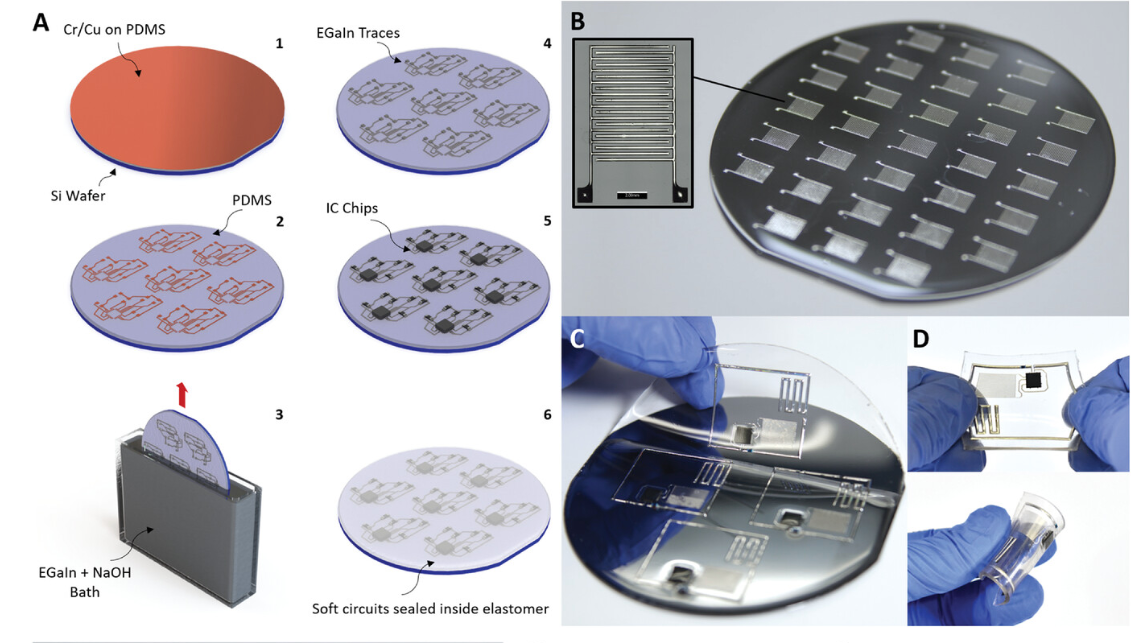
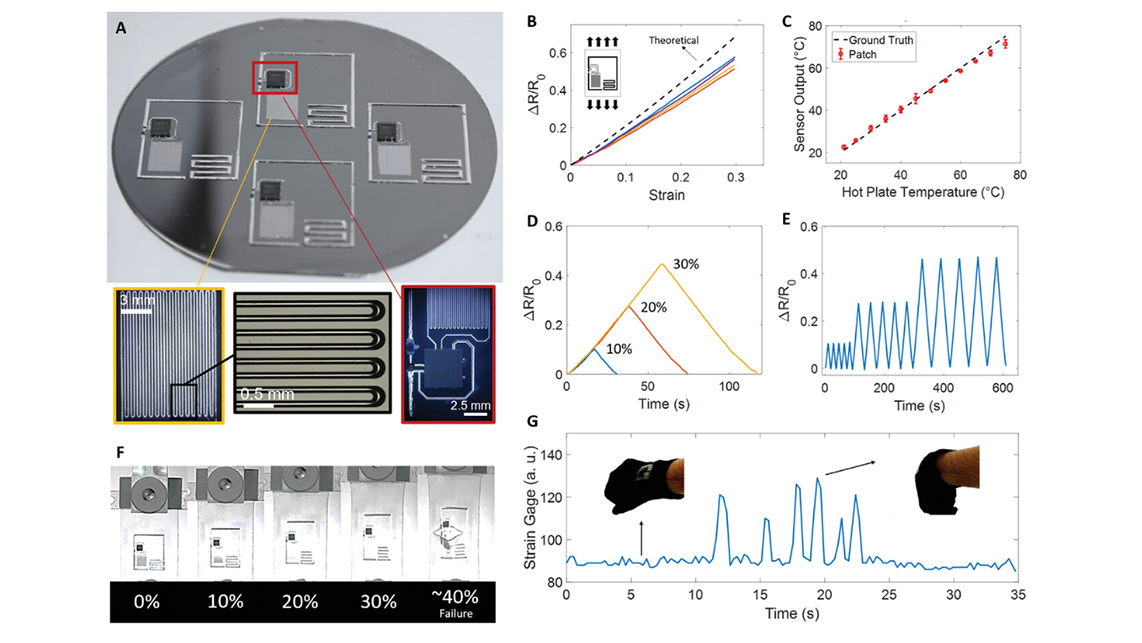
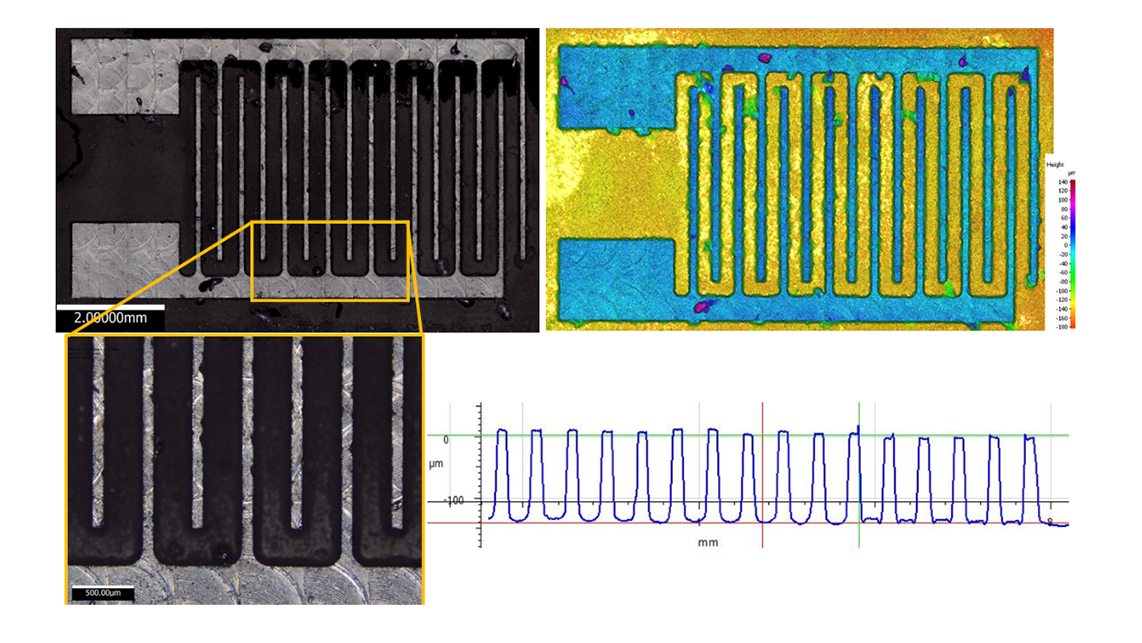
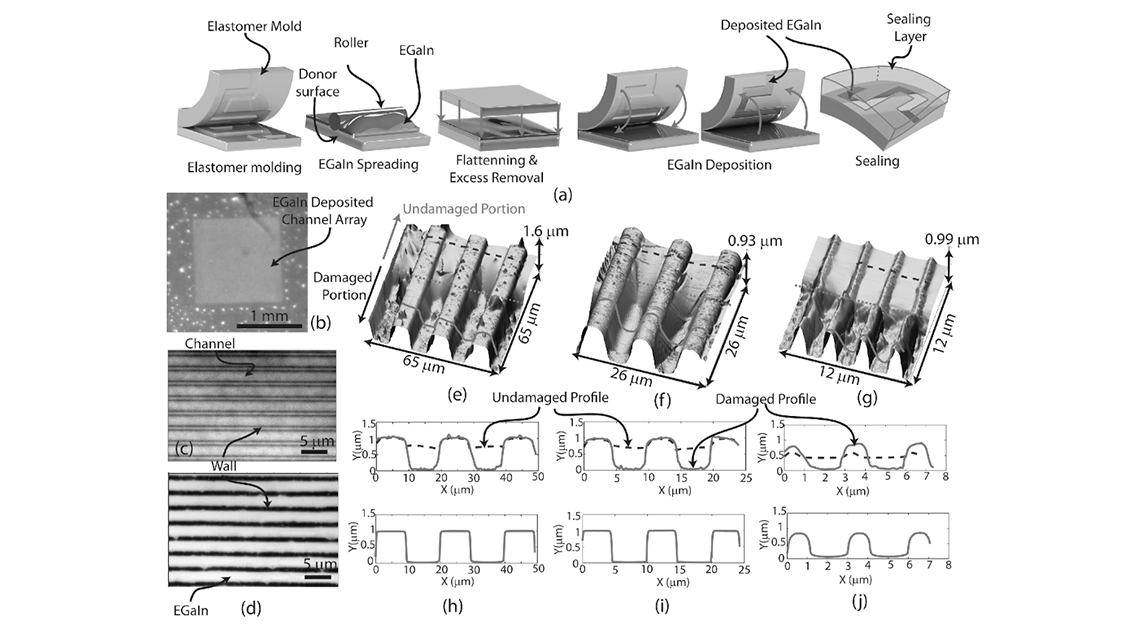
- Soft/stretchable wearable electronics enabled by manufacturing innovations in liquid-metal patterning and high-density soft-matter circuitry.
- Skin-integrated biosensing concepts (e.g., biosensor tattoos)
- Ingestible living sensing paradigms with noninvasive readouts (e.g., urine-based barcodes) Biocompatibility, tissue response, and chronic-performance evaluation
Sample projects
- BIO-INSYNC (ARPA-H): Biointegrated Implantable Systems for Cell-based Sensing and Therapy: A CMU-led ARPA-H program developing implantable “living” systems that use human cells to continuously measure hormone levels and deliver precise replacement doses, aiming to reduce the burden of lifelong daily treatment. [1]
- Ultra-Compliant Neural Probes with Dissolvable Insertion Needles: Temporary dissolvable shuttles enabling insertion of compliant probes, with design insights linked to tissue response and chronic outcomes. [2], [3], [4]
- POSEIDON C-DETECT (ARPA-H): Ingestible Living Sensors for Urine-based Early Cancer Detection: In this large, multidisciplinary project, we are developing a multi-cancer early detection (MCED) kit to detect stage-1 tumors from urine with targets of high sensitivity, high specificity, and tissue-of-origin prediction accuracy. The approach uses orally administered sensors that release nucleic acid barcodes, which are then detected from urine using a unique multiplexed device. [5]
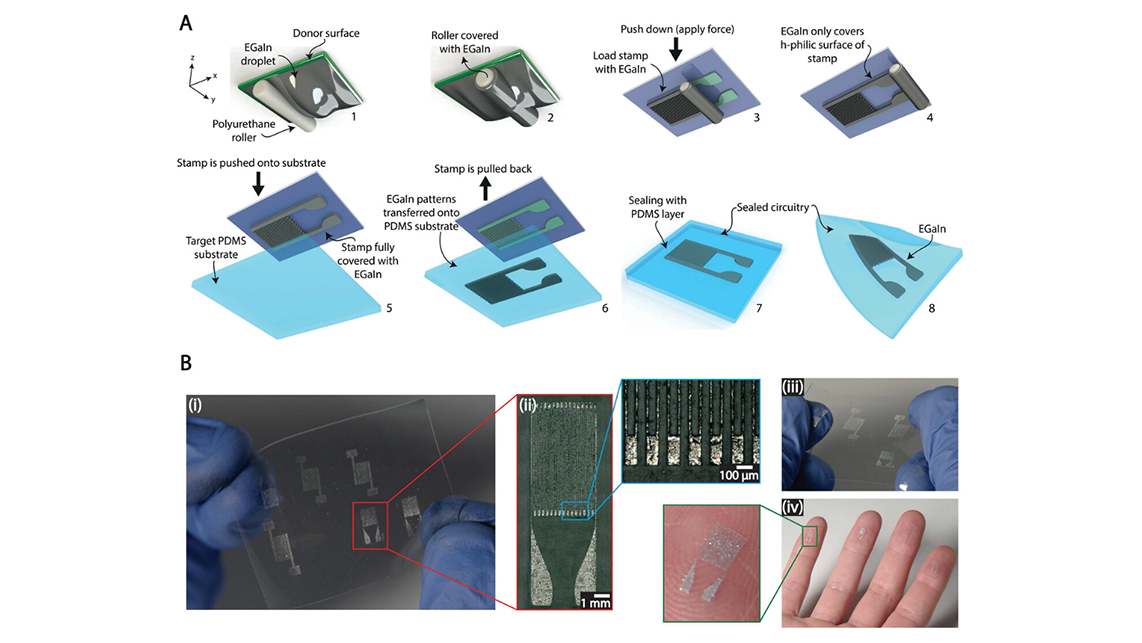
- Manufacturing of Soft/Stretchable Electronics (Liquid-Metal-Based): Scalable processes including microcontact printing, sealing/encapsulation, and robust interfacing/integration approaches for wearable, skin-conformal electronic systems. [6], [7], [8], [9]
Methods and capabilities
- Precision micro/nano-manufacturing for device architectures and molds
- Soft/stretchable electronics manufacturing and integration methods
- Implantable insertion/implantation engineering (dissolvable shuttles/needles; interface mechanics)
- Packaging/encapsulation concepts for exposure to biofluids
- Benchtop and preclinical evaluation of tissue response, stability, and safety, supported by our wet-lab cell-based assays
Applications
- Closed-loop management of chronic disease
- Neural and peripheral interfacing with reduced mechanical mismatch
- Wearable, skin-integrated sensing and monitoring
- Ingestible/living sensing for low-burden screening with noninvasive readouts
References
- S. Pecchia, “Carnegie Mellon lands ARPA-H award for implantable bioelectric medicine project.” Accessed: Feb. 26, 2026. [Online]. Available: https://engineering.cmu.edu/news-events/news/2024/10/02-bio-insync.html
- T. D. Kozai et al., “Chronic tissue response to carboxymethyl cellulose-based dissolvable insertion needle for ultra-small neural probes,” Biomaterials, vol. 35, no. 34, pp. 9255–9268, 2014.
- P. Gilgunn, “Ultra-compliant neural probes are subject to fluid forces during dissolution of polymer delivery vehicles,” 2013 35th Annu. Int. Conf. IEEE Eng. Med. Biol. Soc. EMBC, Jan. 2013, Accessed: Feb. 26, 2026. [Online].
- T. D. Y. Kozai, “Ultra-miniature ultra-compliant neural probes with dissolvable delivery needles: design, fabrication and characterization”, doi: 10.1007/S10544-016-0125-4.
- K. Landram, “Revolutionizing early cancer detection with at-home technology.” Accessed: Feb. 26, 2026. [Online].
- K. B. Ozutemiz, C. Majidi, and O. B. Ozdoganlar, “Scalable Manufacturing of Liquid Metal Circuits,” Adv. Mater. Technol., vol. 7, no. 11, p. 2200295, 2022, doi: 10.1002/admt.202200295.
- K. B. Ozutemiz, J. Wissman, O. B. Ozdoganlar, and C. Majidi, “EGaIn–Metal Interfacing for Liquid Metal Circuitry and Microelectronics Integration,” Adv. Mater. Interfaces, vol. 5, no. 10, p. 1701596, 2018, doi: 10.1002/admi.201701596.
- B. A. Gozen, A. Tabatabai, O. B. Ozdoganlar, and C. Majidi, “High-Density Soft-Matter Electronics with Micron-Scale Line Width,” Adv. Mater., vol. 26, no. 30, pp. 5211–5216, 2014, doi: 10.1002/adma.201400502.
- E. P. Yalcintas, K. B. Ozutemiz, T. Cetinkaya, L. Dalloro, C. Majidi, and O. B. Ozdoganlar, “Soft Electronics Manufacturing Using Microcontact Printing,” Adv. Funct. Mater., vol. 29, no. 51, p. 1906551, 2019, doi: 10.1002/adfm.201906551.