
Overview
The Ozdoganlar Lab develops precision manufacturing technologies for micro- and mesoscale components and systems, with deep expertise in micromachining, micromolding, high-precision micro- and mesoscale 3D printing (additive manufacturing), and high-fidelity metrology. We pair these capabilities with validated modeling of machining dynamics, tool–workpiece interaction, and measurement systems to enable repeatable fabrication of complex geometries across metals, polymers, ceramics, and composite/soft materials.
Our approach
We co-develop enabling processes, metrology methods, and validated models so that precision fabrication becomes predictable and controllable. This includes work on vibration modeling and experimentation, ultra-high-speed spindle error motions, spindle-speed-dependent tool behavior, and measurement correction for micromachining.
Why it matters
At micro/meso scales, performance is often limited by:
- Tool/machine dynamics (runout, radial throw, vibration) that dominate tolerance and surface quality
- Metrology bandwidth/accuracy limitations for high-speed processes
- Strong process–material coupling (microstructure effects, subsurface deformation, tool wear)
- Scaling bottlenecks where prototypes don’t translate to robust production
Key research thrusts
- Micro- and nano-scale material removal (micromachining, nanomilling)
- Micromolding / replication and hybrid process chains (removal, molding)
- High-precision micro- and mesoscale 3D printing (additive manufacturing) and hybrid additive–subtractive processes for complex geometries
- Precision metrology (surface, dimensional, motion/spindle metrology; error separation)
- Dynamics and modeling of micro-tools and machines
- Measurement science for micromachining (e.g., high-frequency correction)
- Process–material interaction at micro scales
Sample projects
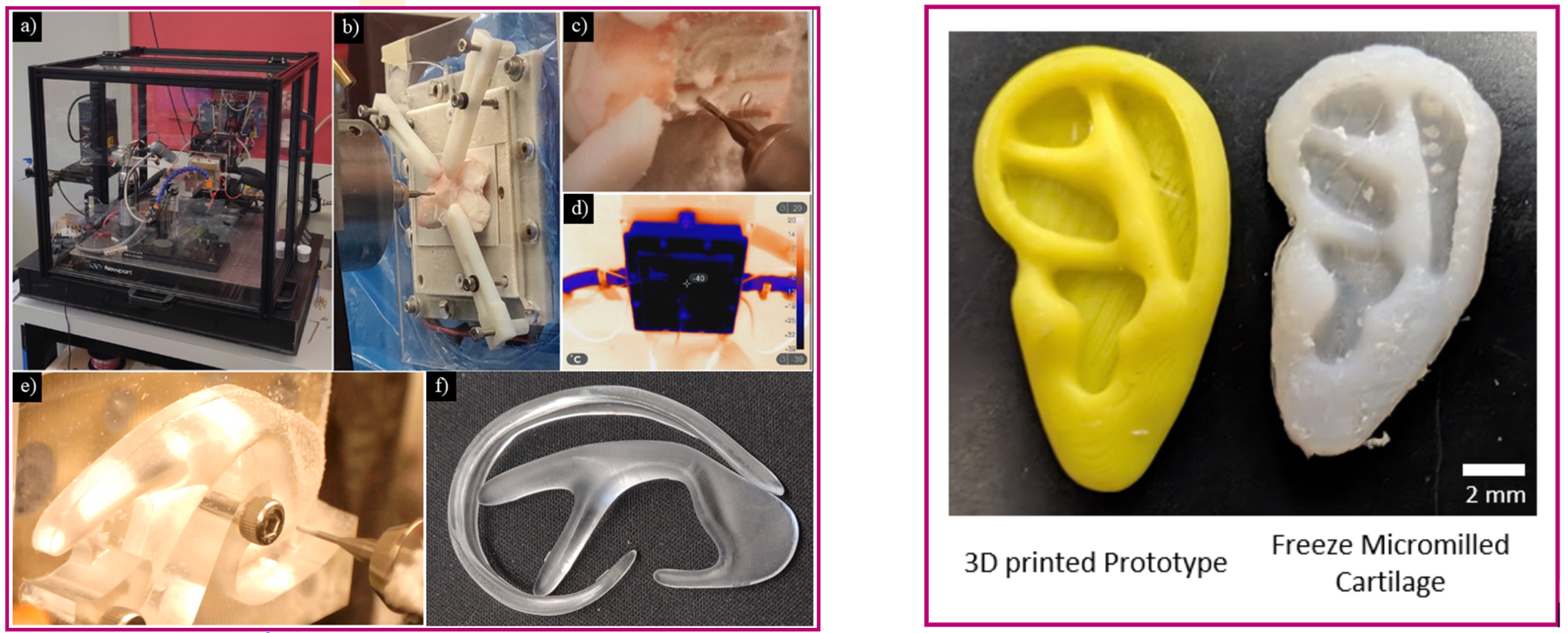
- Cartilage Freeze Micromilling for Tissue Repair Applications: Cryogenic/freeze micromilling approaches for biologically relevant soft tissues (e.g., cartilage) to enable controlled geometry generation while preserving key properties. [1], [2]
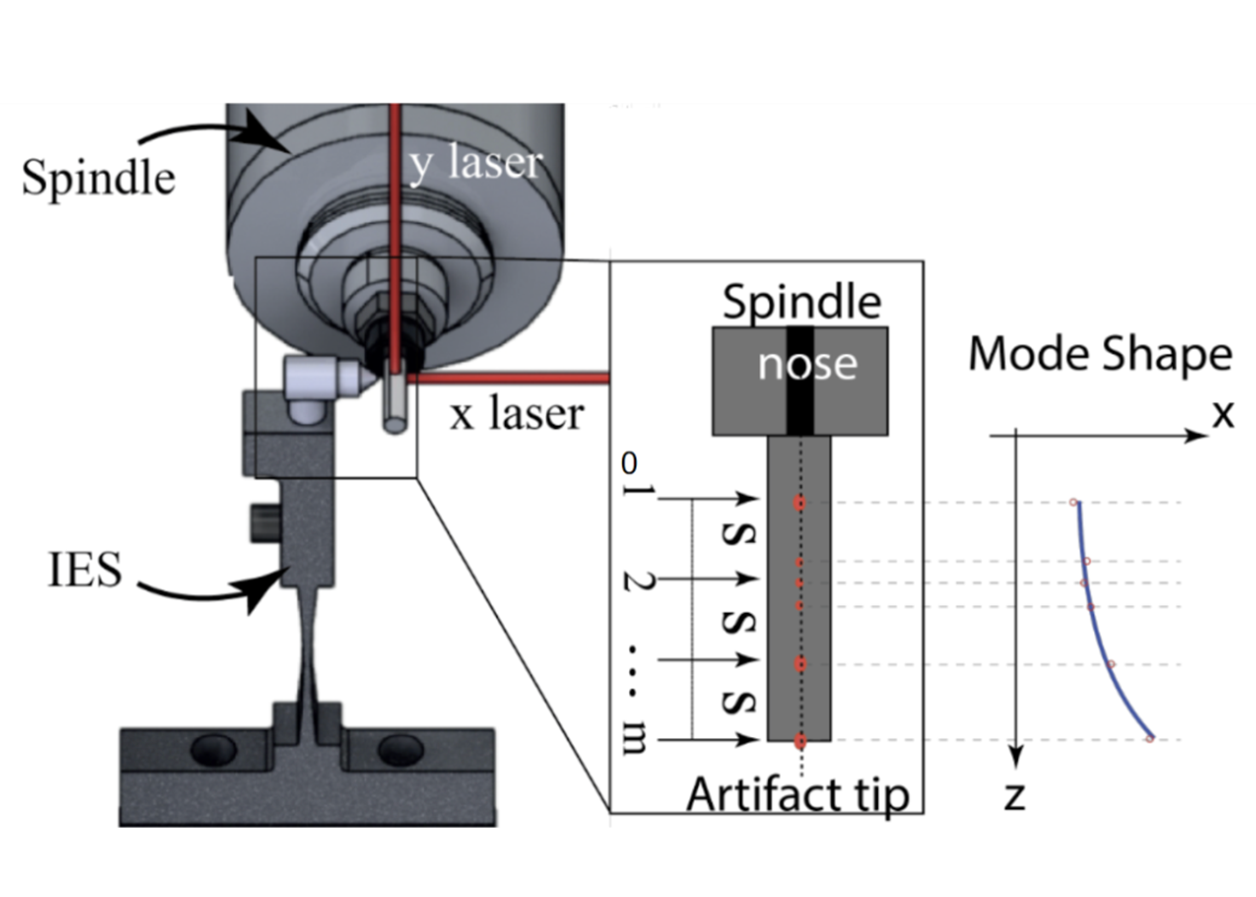
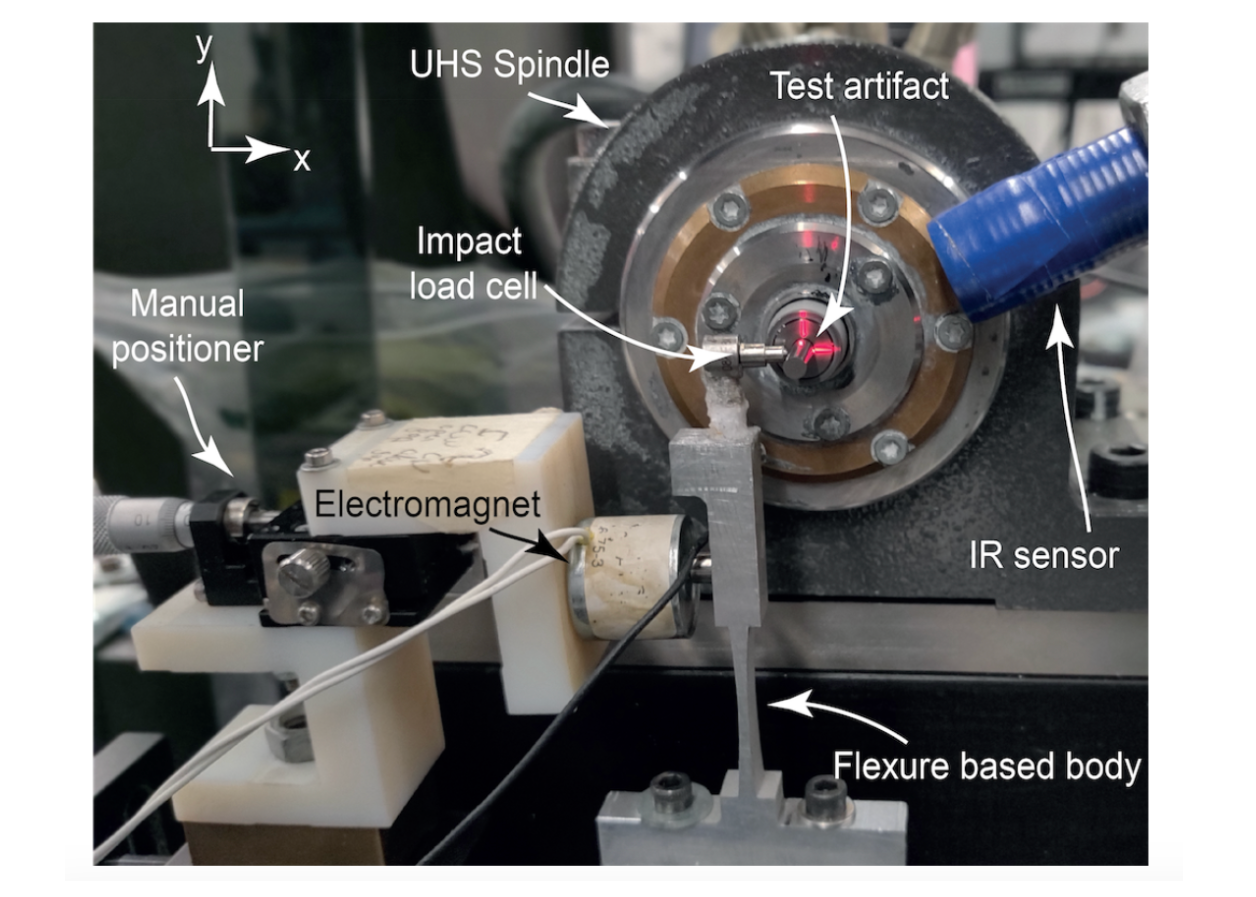
- LDV-based Spindle Metrology for Ultra-high-speed Micromachining: Methods to quantify axial/radial error motions and separate error sources for miniature UHS spindles. [3], [4], [5]
- Spindle-speed-dependent Tool-tip Dynamics Modeling for Arbitrary Microtool Geometries: A modeling framework to predict tool-tip dynamics across spindle speeds for realistic microtool geometries to improve stability prediction and process control. [6], [7], [8], [9], [10], [11], [12], [13]
- High-frequency-corrected Force Measurement for Micro-end Milling: Identification/correction of dynamometer dynamics for accurate micromachining force measurement. [14]
Methods and capabilities
- Micromachining (micro-end milling, micro-drilling; metals/polymers/ceramics)
- Micro/nano replication (elastomer molding; hybrid process chains)
- High-precision micro/mesoscale 3D printing (additive manufacturing) with process development and dimensional qualification
- Motion/spindle metrology (LDV-based methods; multi-orientation error separation)
- Surface/dimensional metrology and qualification artifacts
- Dynamics and vibrations, including analytical modeling and experimental validation
Applications
- Medical and biomedical device manufacturing (microfeatures, molds, interface components)
- Microfluidic systems and tissue-engineering platforms, enabled by precise microchannel fabrication, supported by design, modeling, and experimental analysis.
- Soft/stretchable and hybrid systems enabled by high-resolution manufacturing and integration pathways
- Precision process development and qualification for micro/meso manufacturing
- Precision process development and qualification for micro/meso manufacturing and micro/mesoscale additive manufacturing (3D printing)
References
- L. Camison et al., “SP36. Development Of A 3D Freeze-micromilling Process For The Fabrication Of Cartilage Implants In Complex Anatomic Shapes,” Plast. Reconstr. Surg. Glob. Open, vol. 12, no. Suppl 4, p. 103, Apr. 2024, doi: 10.1097/01.GOX.0001015708.56318.13.
- N. M. Kass et al., “59. An Animal Study Investigating Long-term Retention Of New Costal Cartilage Allograft,” Plast. Reconstr. Surg. – Glob. Open, vol. 12, no. S4, p. 41, Apr. 2024, doi: 10.1097/01.GOX.0001015328.57924.e7.
- S. Shekhar, B. Bediz, and O. B. Ozdoganlar, “Tool-tip dynamics in micromachining with arbitrary tool geometries and the effect of spindle speed,” Int. J. Mach. Tools Manuf., vol. 185, p. 103981, Feb. 2023, doi: 10.1016/j.ijmachtools.2022.103981.
- B. Bediz, B. Arda Gozen, E. Korkmaz, and O. Burak Ozdoganlar, “Dynamics of ultra-high-speed (UHS) spindles used for micromachining,” Int. J. Mach. Tools Manuf., vol. 87, pp. 27–38, Dec. 2014, doi: 10.1016/j.ijmachtools.2014.07.007.
- B. Bediz, E. Korkmaz, and O. Burak Ozdoganlar, “An impact excitation system for repeatable, high-bandwidth modal testing of miniature structures,” J. Sound Vib., vol. 333, no. 13, pp. 2743–2761, Jun. 2014, doi: 10.1016/j.jsv.2014.02.022.
- B. Bediz and S. Aksoy, “A spectral-Tchebychev solution for three-dimensional dynamics of curved beams under mixed boundary conditions,” J. Sound Vib., vol. 413, pp. 26–40, Jan. 2018, doi: 10.1016/j.jsv.2017.10.006.
- S. Filiz, B. Bediz, L. A. Romero, and O. B. Ozdoganlar, “A Spectral-Tchebychev Solution for Three-Dimensional Vibrations of Parallelepipeds Under Mixed Boundary Conditions,” J. Appl. Mech., vol. 79, no. 051012, Jun. 2012, doi: 10.1115/1.4006256.
- B. Yagci, S. Filiz, L. L. Romero, and O. B. Ozdoganlar, “A spectral-Tchebychev technique for solving linear and nonlinear beam equations,” J. Sound Vib., vol. 321, no. 1, pp. 375–404, Mar. 2009, doi: 10.1016/j.jsv.2008.09.040.
- B. Bediz, L. A. Romero, and O. B. Ozdoganlar, “Three dimensional dynamics of rotating structures under mixed boundary conditions,” J. Sound Vib., vol. 358, pp. 176–191, Dec. 2015, doi: 10.1016/j.jsv.2015.08.015.
- S. Filiz, B. Bediz, L. A. Romero, and O. B. Ozdoganlar, “Three dimensional dynamics of pretwisted beams: A spectral-Tchebychev solution,” J. Sound Vib., vol. 333, no. 10, pp. 2823–2839, May 2014, doi: 10.1016/j.jsv.2014.01.010.
- S. Shekhar, B. Bediz, and O. B. Ozdoganlar, “Tool-tip dynamics in micromachining with arbitrary tool geometries and the effect of spindle speed,” Int. J. Mach. Tools Manuf., vol. 185, p. 103981, Feb. 2023, doi: 10.1016/j.ijmachtools.2022.103981.
- S. Shekhar and O. B. Ozdoganlar, “Dynamics of Miniature and High-Compliance Structures: Experimental Characterization and Modeling,” Exp. Mech., vol. 62, no. 2, pp. 299–312, Feb. 2022, doi: 10.1007/s11340-021-00788-5.
- S. Lotfan, D. Dedekoy, B. Bediz, and E. Cigeroglu, “A weak-form spectral Chebyshev technique for nonlinear vibrations of rotating functionally graded beams,” Mech. Adv. Mater. Struct., vol. 31, no. 16, pp. 3651–3665, Aug. 2024, doi: 10.1080/15376494.2023.2181472.
- E. Korkmaz, B. A. Gozen, B. Bediz, and O. B. Ozdoganlar, “Accurate measurement of micromachining forces through dynamic compensation of dynamometers,” Precis. Eng., vol. 49, pp. 365–376, Jul. 2017, doi: 10.1016/j.precisioneng.2017.03.006.