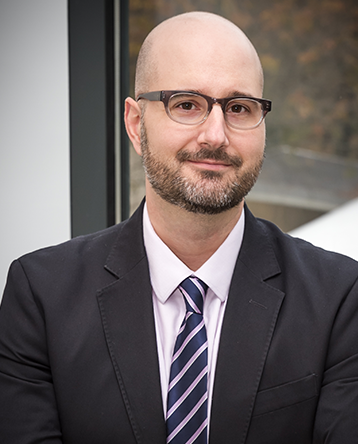
Constantine (Costa) Samaras is the director of the Carnegie Mellon University Scott Institute for Energy Innovation, the Trustee Professor of Civil and Environmental Engineering, and an affiliated faculty member in the Department of Engineering and Public Policy. His research focuses on the pathways to clean, climate-safe, equitable, and secure energy and infrastructure systems. Samaras analyzes how technologies and policies affect energy use and national security, resilience to climate change impacts, economic and equity outcomes, and life cycle environmental emissions and other externalities. He is a founder and director of both the Center for Engineering and Resilience for Climate Adaptation and the Power Sector Carbon Index. He is, by courtesy, a faculty member in CMU’s H. John Heinz III College of Information Systems and Public Policy.
From 2021-2024, he served in the White House Office of Science and Technology Policy (OSTP) as the principal assistant director for energy, OSTP Chief Advisor for Energy Policy, and then OSTP Chief Advisor for the Clean Energy Transition, where he worked with the OSTP Director, Deputy Director for Industrial Innovation, and senior governmental leaders in coordinating Federal activities on U.S. energy policy, assessing energy technologies for meeting U.S. climate, resilience, equity, and security objectives, and aligning energy innovation systems to achieve U.S. climate commitments.
With more than two decades of experience in energy, transportation, and climate change, he has served on three National Academies Committees evaluating emerging energy technologies and earth systems research, served as the chair of the ASCE Committee on Adaptation to a Changing Climate, and served on the Alternative Transportation Fuels and Technologies Committee the Energy Committee of the Transportation Research Board. He has published numerous studies examining electric and automated vehicles, renewable electricity, life cycle assessment, clean energy transitions and decarbonization policy, AI ethics, and climate resilience, in journals such as Nature, Proceedings of the National Academies of Sciences, Nature Climate Change, Environmental Research Letters, Climatic Change, and others. He was also a contributor to the 4th National Climate Assessment, and was one of the lead author contributors to the Global Energy Assessment. His 2008 paper helped define modern electric vehicle life cycle assessment broadly across the field, he co-authored a foundational 2014 RAND report that defined future directions on autonomous vehicles and public policy, and he holds a U.S. patent for a system that charges and optimizes fleets of small automated delivery vehicles.
Samaras has also led analyses on energy security, strategic basing, and defense technology issues faced by the Department of Defense. In 2014, he created the course “Climate Change Adaptation for Infrastructure,” which is one of the first civil and environmental engineering courses in the world that teaches climate change adaptation to engineers. This led to the creation of a graduate concentration in Climate Change Adaptation in the Civil and Environmental Engineering Department at Carnegie Mellon University. He also teaches courses on energy use and systems assessment, and infrastructure and environmental interconnections. In 2018, he was named Professor of the Year by the Pittsburgh Section of the American Society of Civil Engineers.
He regularly provides commentary to online, print, radio, and television media, and his writing and comments have appeared in The New York Times, The Washington Post, The Wall Street Journal, The Los Angeles Times, NPR, The Atlantic, PBS, ABC News, CBS News, NBC News, WIRED, and other outlets. He has presented his research and policy implications to current and former cabinet secretaries, senior appointed governmental leaders, senior federal and military decisionmakers, Congress Members and professional staff, and the leadership of major utilities, automotive companies, and technology firms.
From 2009 to 2014 he was a RAND Corporation senior researcher, most recently as a senior engineer and a professor at the Pardee RAND Graduate School, and was an adjunct senior analyst through 2021. From 2008 to 2009 he was a post-doctoral fellow in the Climate Decisionmaking Center at Carnegie Mellon, working on electric transportation and low-carbon technology policy. From 1999 to 2004 he was an engineer working on several multibillion-dollar infrastructure megaprojects in New York, including the extension of the Number 7 subway line in Manhattan, and also worked on the rebuilding of the subway line underneath of the World Trade Center after the attacks of September 11, 2001.
Samaras received a joint Ph.D. in civil and environmental engineering and engineering and public policy from Carnegie Mellon, an M.P.A. in public policy from the Wagner Graduate School of Public Service at New York University, and a B.S. in civil engineering from Bucknell University.